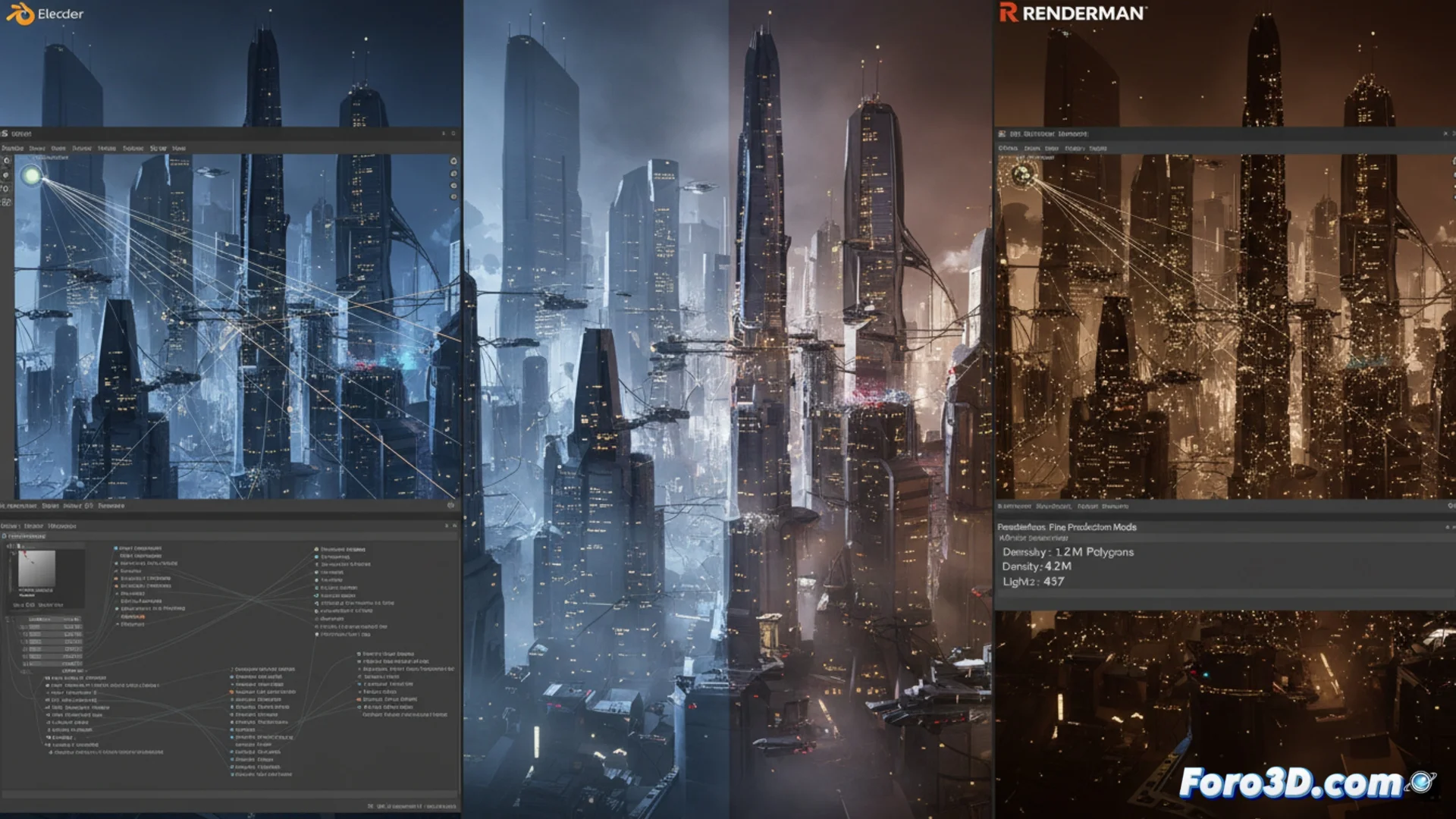
Cycles and RenderMan: two philosophies for processing complex scenes
When working with high-complexity scenes, the Cycles and Pixar RenderMan engines present fundamentally different approaches. One is integrated into a unified ecosystem, while the other is designed to scale in industrial production environments. Understanding their differences is key to choosing the right tool. 🎨
Cycles: the engine integrated into Blender
Cycles operates as part of Blender, offering a unified environment where you can model, animate, and render without switching software. This greatly speeds up testing and adjusting parameters on the fly. Its core is based on path tracing and it can use both CPU and GPU, with the latter option being much faster with the right hardware.
Main features of Cycles:- Operates within Blender, allowing for rapid iteration.
- Uses a hybrid engine that significantly speeds up with compatible graphics cards.
- Manages complex effects like volumes, hair, and subsurface scattering.
- Its node system for materials and compositing is extremely flexible.
- Reducing noise in complex scenes may require many samples and computation time.
While Cycles invites you to test and see results instantly, RenderMan sometimes seems to ask you to sign a contract before changing a parameter.
RenderMan: designed to scale in production
RenderMan was created to overcome the challenges of large-scale animation and visual effects. Its architecture is optimized to efficiently handle extremely dense geometries and scenes with hundreds of lights, which is common in professional studios. Although it traditionally used CPU, it now also accelerates with GPU.
RenderMan's strengths:- Architecture that scales to handle millions of polygons and a large number of lights.
- Offers precise control over noise and render time through its parameters.
- Supports the REYES system as well as physical path tracing.
- Its integration with applications like Maya or Houdini is deep, but requires setting up an external render pipeline.
- Prioritizes efficient resource management in complex productions.
Which one to choose for your project?
Both engines can generate high-fidelity images. The final decision does not depend only on power, but on your workflow and the technical resources you have available. Cycles is ideal for those seeking immediacy and an all-in-one ecosystem within Blender. RenderMan is the choice for projects that demand extreme scalability and integrate into a professional studio pipeline. Patience, in this field, remains a technical resource as well. ⚙️