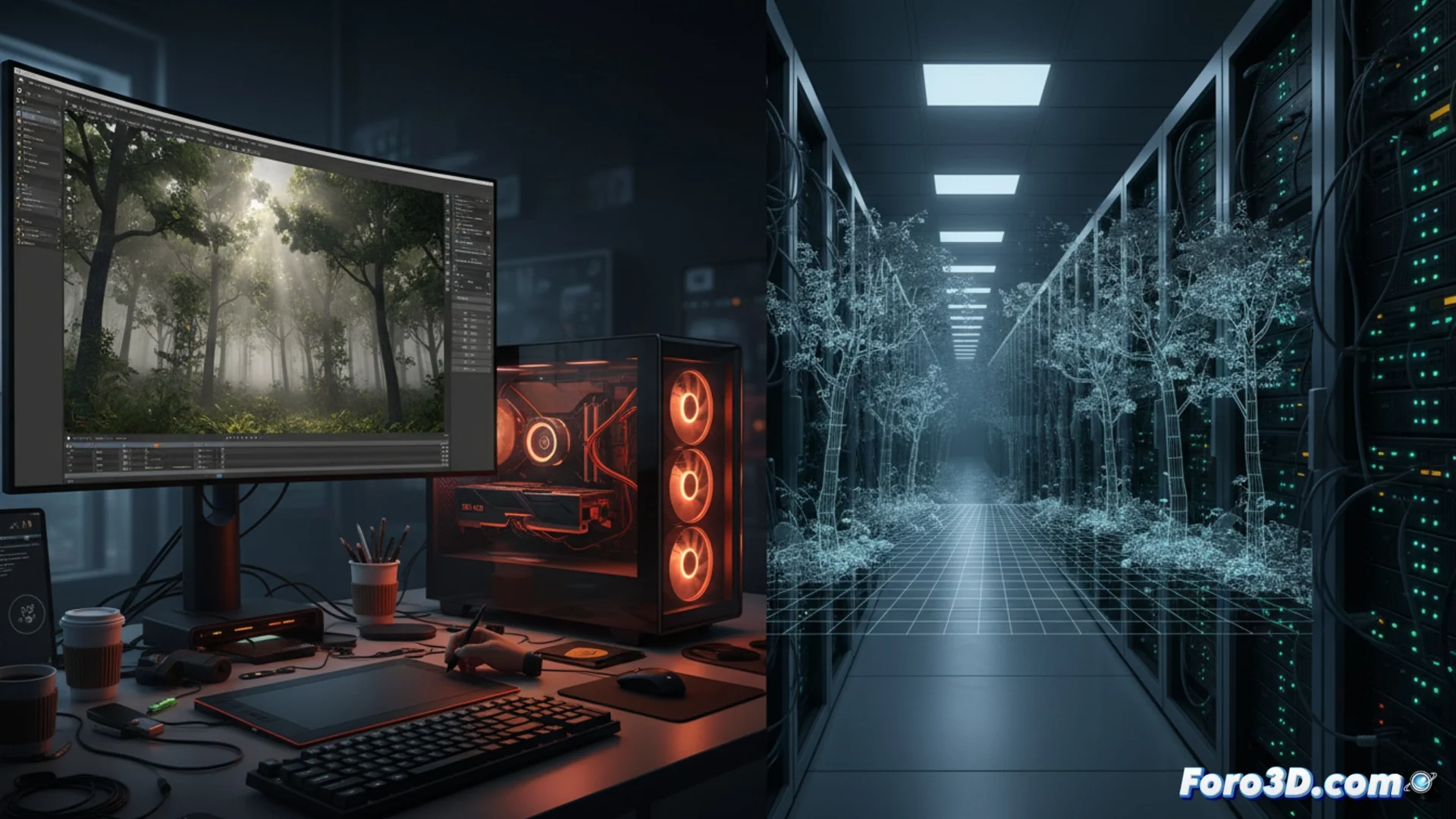
Cycles and MoonRay: two path tracing engines with different approaches
In the world of 3D rendering, path tracing has established itself as the leading technique for achieving realism. Two powerful exponents, although with opposing philosophies, are Cycles from Blender and MoonRay from DreamWorks Animation. Both calculate light by tracing rays, but their design responds to radically different needs. 🎯
Cycles: integration and accessibility in Blender
The Cycles engine functions as a central component within Blender. Its greatest strength is the fluidity with which an artist can go from modeling and animating to seeing the final result. Its shading nodes system is very comprehensive, allowing the creation of complex materials. To speed up calculations, it primarily relies on graphics hardware (GPU). However, when handling scenes with extremely dense geometry (billions of polygons), it may encounter memory limits on a single machine, requiring the user to actively optimize the scene.
Key features of Cycles:- Unified engine: It is fully integrated into Blender, making it easy to iterate quickly.
- GPU acceleration: Scales its performance with powerful graphics cards.
- Manual resource management: The artist must optimize geometry, use instances, and control memory for heavy scenes.
Cycles prioritizes agile work by the artist within an integrated environment, even though its computational power is limited by local hardware.
MoonRay: designed for industrial production scale
MoonRay was born with a clear objective: to render complete animation sequences for cinema with very tight deadlines. Its internal architecture is designed from scratch for distributing the workload on render farms with thousands of processor cores. It divides each frame into tiles that are calculated in parallel on many servers. It includes advanced features for simulating hair, skin, and a very flexible shading system, typical of a major studio. It is not an application that you open and use, but a library that integrates into a complex production pipeline.
Pillars of MoonRay's architecture:- Distributed rendering: Its core is optimized to run efficiently on hundreds of computers at the same time.
- Pipeline focus: It is a tool for studios, connecting to other production systems.
- High-level features: Includes advanced capabilities for effects like hair and volumetrics, designed for large-scale projects.
Choice according to the work context
The decision between one and the other depends entirely on the environment. Cycles is ideal for independent artists, small studios, or any workflow where immediacy and integration in Blender are paramount. MoonRay is the solution for productions where render time is a critical factor and there is infrastructure to distribute computation massively. While in one case you adjust a parameter and wait for the GPU to finish, in the other, the frame has already been silently distributed among hundreds of machines. The choice defines not only the result, but the entire way of producing. ⚙️