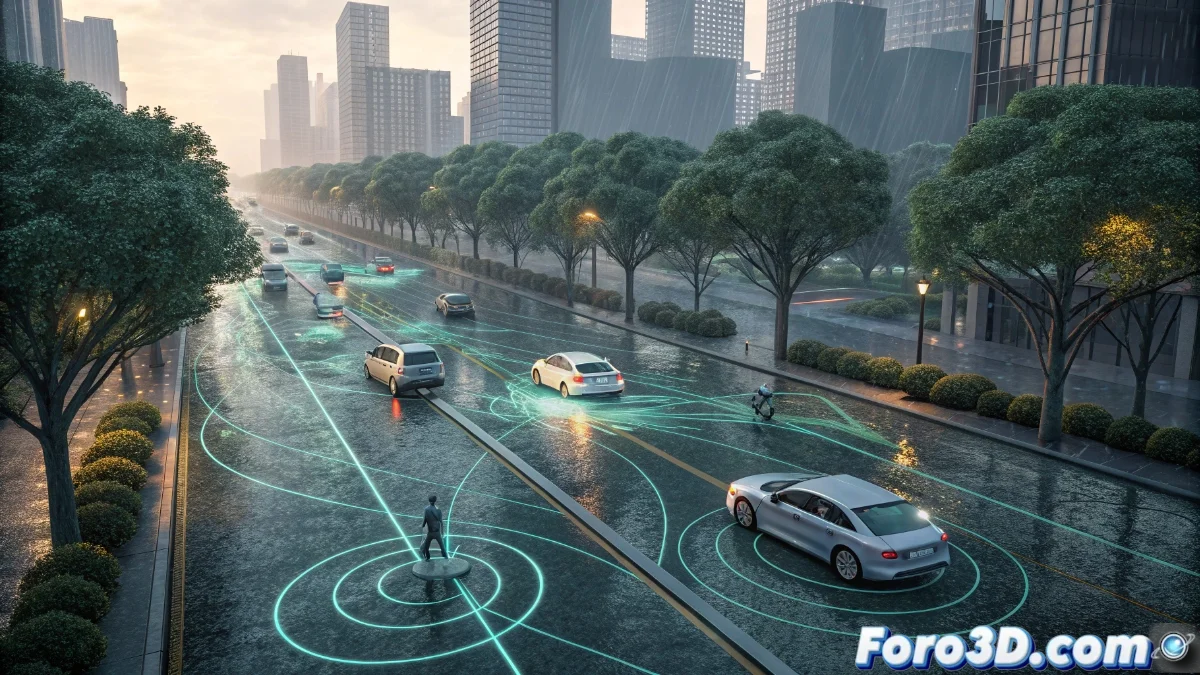
CWMDT: Counterfactual Simulations for Autonomous Systems
While traditional AI models are limited to predicting based on present observations, CWMDT introduces a revolutionary paradigm by enabling the exploration of hypothetical scenarios through specific interventions. This technology builds textual digital twins where every element and relationship is encoded in structured text, employing advanced language models to reason about modifications and then generate visual sequences that show the evolution of these changes. 🚀
Applications in Autonomous Mobility and Industrial Automation
In the field of autonomous vehicles, CWMDT goes beyond analyzing current traffic to model counterfactual situations such as the sudden removal of obstacles or the appearance of extreme road conditions. This capability provides an additional layer of safety by allowing the anticipation of numerous outcomes before executing critical maneuvers.
Key advantages in different domains:- Autonomous vehicles: Simulation of multiple risk scenarios without real physical exposure
- Logistics robotics: Prediction of consequences when reorganizing warehouses, minimizing collisions
- Operational optimization: Generation of predictive videos to visually validate complex strategies
The ability to visualize errors that you never committed in reality, but that you can analyze in detail thanks to CWMDT, represents a paradigm shift in the validation of autonomous systems.
Transformation in Planning and Development of Autonomous Agents
The counterfactual intervention simulation offered by CWMDT completely redefines planning and training processes for autonomous systems. By visualizing hypothetical scenarios with a high degree of precision, platforms can explore alternatives that would be prohibitive in real environments due to their cost or danger.
Fundamental benefits:- Development acceleration: Drastic reduction in dependence on extensive physical testing
- Improved interpretability: Use of structured text and linguistic models for transparent reasoning
- Multi-platform adaptability: Consistent application across diverse domains and configurations
Impact on the Future of Artificial Autonomy
The counterfactual predictive capability of CWMDT sets a new standard in the design of safe and efficient autonomous systems. This technology not only improves real-time decision-making, but fundamentally transforms how we conceive and validate complex autonomous behaviors, creating a robust bridge between digital simulation and physical implementation. 🌉