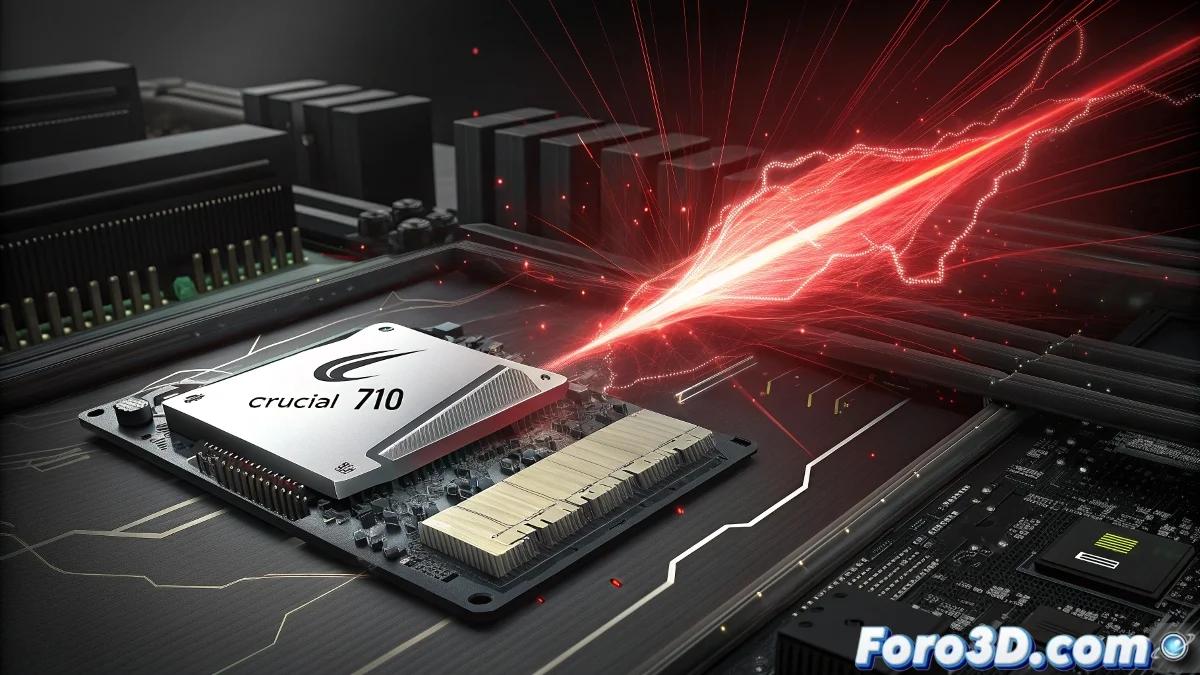
When Speed Promises Clash with Thermal Reality
The Crucial T710 entered the market with the ambition of becoming the undisputed king of PCIe 5.0 storage, promising speeds that would make even the fastest SSDs from the previous generation blush. However, as often happens in the hardware world, theory and practice sometimes take separate paths. 💻 Real-world testing has revealed that this SSD is like that sports car that promises 300 km/h but overheats at 200: the on-paper specifications are impressive, but physical limitations ultimately dictate real performance. For enthusiasts expecting the holy grail of storage, the T710 has been a humbling lesson on the importance of thermal management in the PCIe 5.0 era.
Dream Specifications, Nightmare Performance
On paper, the Crucial T710 has it all: PCIe 5.0 x4 interface, theoretical sequential read speeds of up to 14,500 MB/s, and the credentials of a brand with decades of experience in flash memory. 📊 The problem arises when you try to maintain those speeds for more than a few minutes. Overheating becomes the T710's worst enemy, forcing it to drastically reduce its performance through aggressive throttling. It's like hiring an Olympic runner who can only maintain a sprint for 100 meters before having to walk the rest of the marathon.
Identified Technical Issues:- Temperatures exceeding 85°C under sustained loads
- Throttling that reduces speeds by up to 60%
- Power consumption up to 40% higher than competitors
- Inconsistent performance in prolonged tasks
The PCIe 5.0 Curse: When Speed Has a Price
The T710 is not the only PCIe 5.0 SSD battling the laws of thermodynamics, but it is one of the clearest examples of how the industry is paying the price for the transition to this new interface. 🔥 PCIe 5.0 doubles the bandwidth compared to PCIe 4.0, but it also doubles (or triples) heat generation and power consumption. While the controllers and NAND flash struggle to stay cool, users are discovering that having the fastest SSD on the market isn't very useful if it can't maintain its speeds when most needed.
Is the T710 Worth It? It Depends on the Purpose
It's not all bad news for the Crucial T710. In usage scenarios with short bursts of activity, like game loading or occasional file transfers, it can deliver spectacular performance. 🎮 The problem arises in professional environments that require sustained transfers: 8K video editing, intensive virtualization, or database servers. For the average user who just wants Windows to boot fast and games to load in seconds, the throttling will likely go unnoticed. For the professional moving terabytes daily, it will be a constant frustration.
Scenarios Where It Performs Acceptably:- Game and application loading
- Short transfers of large files
- Use as a system drive in gaming PCs
- Office tasks and general browsing
The Competition Isn't Standing Still
While Crucial struggles with the T710's thermal issues, other manufacturers have learned from these mistakes. Models like the Samsung 990 Pro or the WD Black SN850X offer more than enough PCIe 4.0 performance for most users, with better thermal management and more reasonable power consumption. ⚡ Even within the PCIe 5.0 ecosystem, solutions like the Seagate FireCuda 540 or the Corsair MP700 include more effective heatsinks and firmware better optimized for thermal control. The T710 finds itself in the uncomfortable position of being a transitional product that arrived a bit undercooked to the market.
Solutions and Alternatives for the User
If you already own a T710 or are determined to buy one, there are strategies to mitigate its limitations. A high-quality heatsink