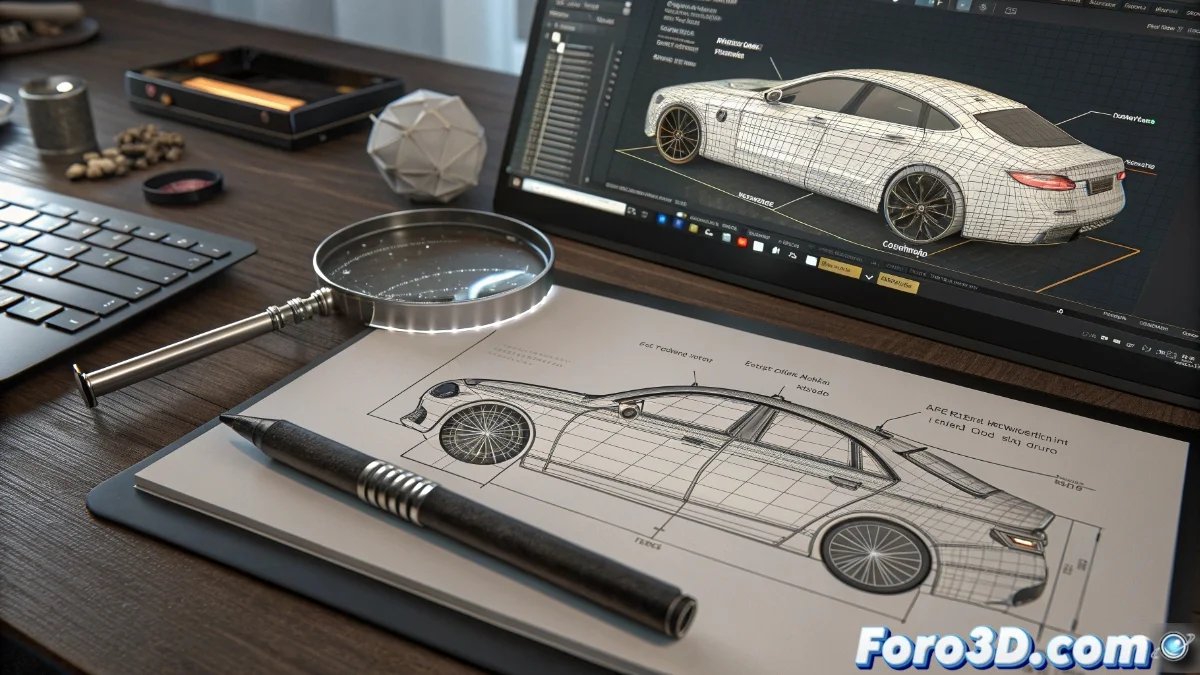
Creative Forensic Analysis in 3D Works: Technical Breakdown for Digital Artists
The creative forensic analysis represents an essential methodology for digital creators, allowing them to dismantle admired three-dimensional pieces and explore each internal component. This technique goes beyond superficial observation, delving into the fundamental layers that make up the work, from the geometric structure to the implemented technical resources. 🎨
Geometry and Construction Disassembly
When starting the technical disassembly of a 3D creation, the focus centers on the geometric architecture. Artists examine the mesh topology, evaluating polygonal density and the modeling strategies employed. This phase allows identifying how transitions between surfaces are managed, the use of subdivisions for fine details, and geometric optimization to balance quality and performance. Understanding these aspects facilitates replicating efficient methods and avoiding common errors in personal projects.
Key elements in geometric analysis:- Evaluation of topology and polygon flow in the mesh
- Identification of techniques like retopology to simplify scanned geometry
- Analysis of digital sculpting tools to add organic complexity
Genius often lies in well-executed simplicity, not in overloaded complexity
Exploration of Lighting and Material Setup
Lighting and materials are fundamental pillars that define realism and atmosphere in 3D environments. During the analysis, lighting configurations are broken down, identifying types such as directional, point, or area lights, and their interaction with shaders and textures is studied. Parameters like intensity, color, and shadows are reviewed meticulously, along with advanced techniques like global illumination or ray tracing. In parallel, materials are analyzed to understand how visual properties are simulated using normal maps, specular, or roughness. This detailed examination teaches how to combine elements coherently, improving the ability to create scenes that convey specific emotions and narratives.
Critical components in materials and lighting:- Light setup: directional, point, and area lights
- Use of advanced techniques: global illumination and ray tracing
- Material properties: reflectivity, transparency, and roughness
Educational Perspective and Practical Application
Creative forensic analysis offers an invaluable educational perspective by revealing the artistic and technical decisions behind the final result. Creators can apply this knowledge to their own projects, adopting efficient methods and avoiding unnecessary complications. The irony of discovering that seemingly simple solutions can outperform overloaded approaches is both humbling and liberating, reminding us that technical excellence often emerges from precise execution rather than extreme complexity. 💡