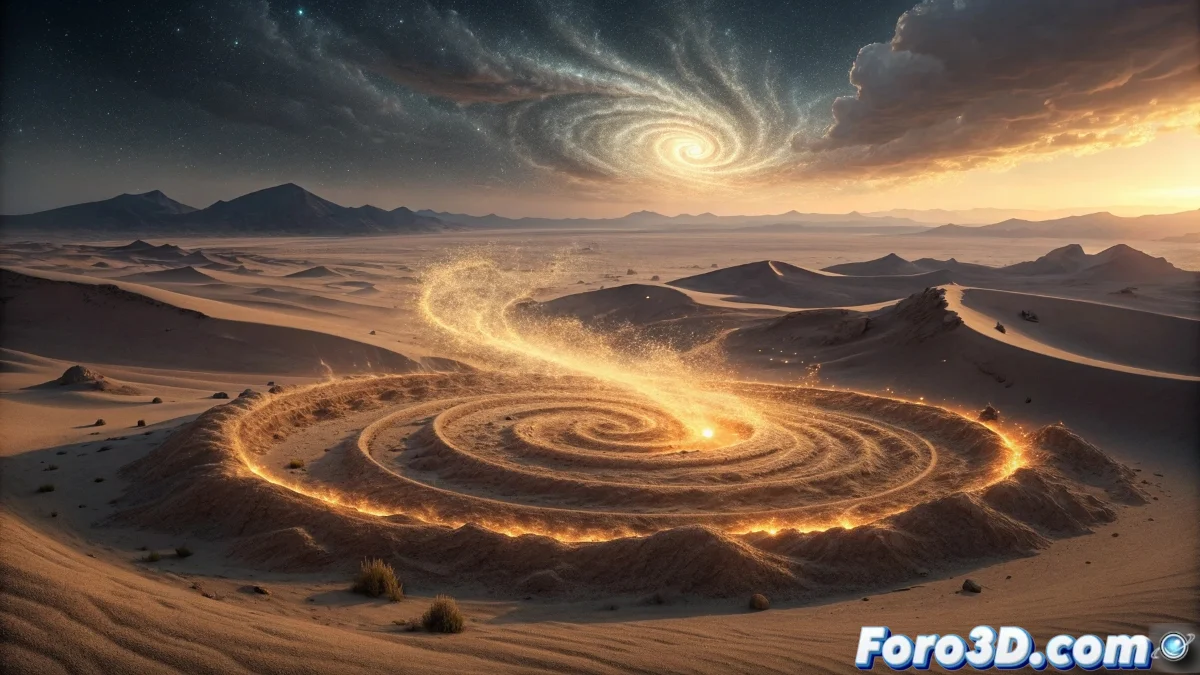
Creating the Supernatural Sand Vortex of the Gobi Desert in 3D Coat
The ancient narratives of the nomadic tribes of Central Asia describe an extraordinary phenomenon in the depths of the Gobi Desert: a sand whirl that defies physical laws by spinning in the opposite direction to the prevailing winds. Historical caravaners documented this event as a spiritual manifestation rather than a mere meteorological occurrence, creating a rich mythological tradition that endures to this day 🌪️.
Historical Context and Cultural Significance
Over the centuries, the inverted vortex acquired deep spiritual connotations within local shamanic practices. Rituals incorporated the belief that this dimensional portal allowed for the expulsion of evil entities from the earth's depths. During the peak of the Mongol dynasties, accounts were enriched with detailed testimonies linking the phenomenon to inexplicable disappearances and experiences of consciousness transfer.
Key Elements of the Mythology:- Spin contrary to the prevailing wind as a defining characteristic
- Interpretation as a dimensional portal in shamanic rituals
- Association with mysterious disappearances in historical chronicles
The real mystery isn't why the vortex spins backwards, but who's going to explain to the client that your fee doesn't include exorcisms in the final render.
Initial Setup and Project Preparation
When starting 3D Coat, configure a new sculpting project with a resolution of 2048x2048 pixels to ensure the capture of fine details in the sand textures. Set the color space to sRGB mode for accurate representation of desert tones, from the warmest ochers to the golds of sunset. Import or generate a subdivided base plane that will function as the desert surface, optimizing performance in the initial modeling phases.
Essential Technical Parameters:- 2048x2048 working resolution for maximum detail
- sRGB color space for chromatic fidelity
- Moderate initial subdivision for performance optimization
Modeling Techniques and Vortex Structure
Use the digital sculpting tools, specifically Clay Strips and Move, to sculpt the base dunes surrounding the phenomenon. Develop the central spiral cone using the Pinch brush with medium intensity to define the characteristic inverted rotation. Work with multiple subdivision levels, starting with low polygon density for the general shape and progressively increasing it to incorporate erosion and blown sand texture. Apply modified Symmetry to achieve the distinctive asymmetric twist of the supernatural vortex.
Lighting System and Material Development
Set up a triple lighting system that includes: a main directional light simulating the crepuscular sun, soft fill lighting for shaded areas, and a warm accent light from the base suggesting paranormal energy. Develop a custom sand material using the Smart Material system, combining Microvertex layers for the base and PBR for specular reflections. Adjust roughness and height parameters to achieve the granular appearance characteristic of sand in dynamic motion.
Detailed Lighting Configuration:- Main directional light for solar simulation
- Fill lighting for controlled contrast
- Warm lower accent for supernatural effect
Special Effects and Rendering Process
To simulate