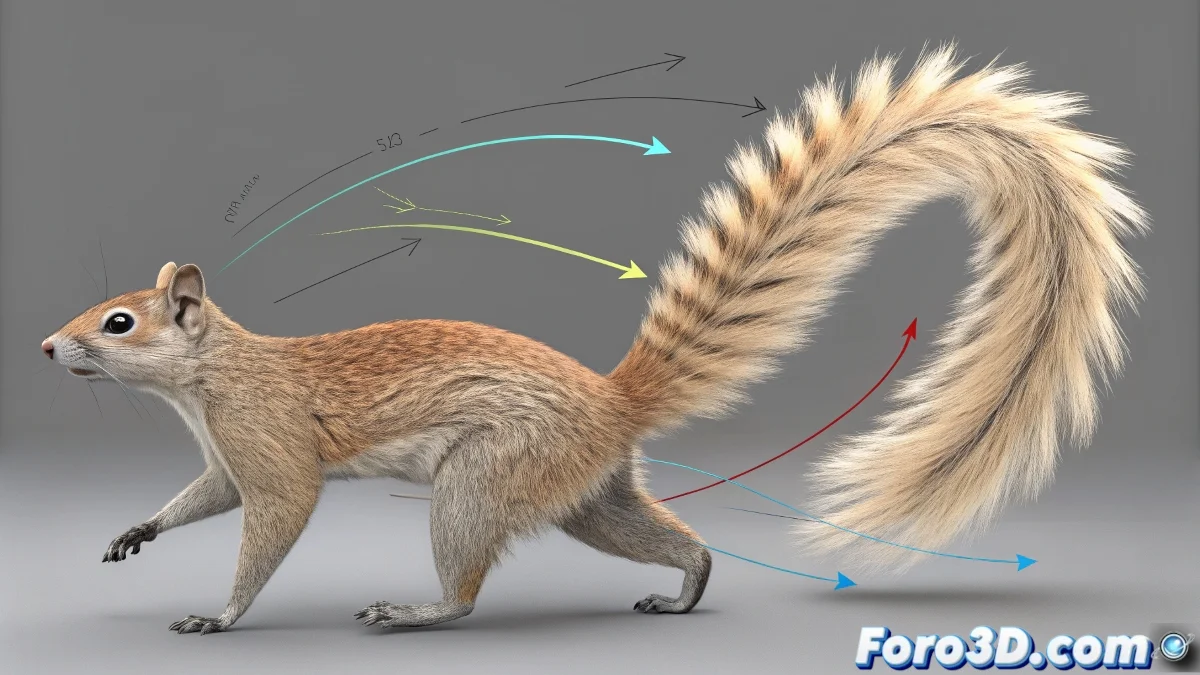
The Art of Bringing Tails to Life with Dynamics
Simulating the fluid and organic movement of an animal's tail in Maya represents one of the most rewarding challenges in rigging and animation 🐬. Combining dynamic systems like nHair or nCloth with a well-structured rig allows for the creation of natural behaviors that would be virtually impossible to animate manually with traditional keyframes. The result is a tail that reacts physically to the body's movement with elegance and realism.
Setting Up the Segmented Rig
The foundation of success lies in a carefully planned joint structure. Dividing the tail into multiple hierarchically connected segments provides the base upon which dynamics will be applied. The proximal joints must be firmly anchored to the body using constraints, ensuring that the base of the tail faithfully follows the main character's movement while the distal segments enjoy dynamic freedom 🦴.
A well-simulated tail is one that nobody notices but everyone would miss if it were gone.
Integration with Dynamic Systems
nHair with Dynamic Curves becomes the perfect ally for imparting artificial life to the tail. Converting the joint chain into a dynamic curve allows each segment to react to the movement of the previous ones, creating that continuous, natural flow characteristic of animal tails. The magic happens when the physical simulation automatically calculates the interactions between segments.
- Conversion to Dynamic Curve: Transforms the bone chain into a dynamic system
- Intelligent Constraints: Anchors strategic points to the main rig
- Collision Objects: Prevents penetration with the body and environment
- Goal Weights: Controls the balance between dynamics and animation
Parameter Tuning for Realism
The devil is in the details – or in this case, in the simulation parameters. Fine-tuning these values transforms a generic simulation into a believable movement specific to each type of creature.
- Stiffness: Controls the rigidity or flexibility of the tail
- Damping: Regulates damping and prevents infinite oscillations
- Mass: Defines the perceived weight of each segment
- Drag: Simulates resistance to movement through an aquatic or aerial medium
Refinement and Artistic Control
Pure dynamics rarely produce perfect results for every situation. Manual intervention through secondary controllers and deformers allows guiding the simulation towards artistically desirable outcomes.
- Spline IK Overlay: Provides kinematic control over the dynamic curve
- Keyframe Blending: Blends dynamics with manual animation at key moments
- Pose Correction: Adjusts specific poses where the simulation fails
- Cache Optimization: Bakes the simulation for rendering performance
Professional Workflow
A methodical approach ensures consistent and efficient results. Following a logical sequence of operations maximizes control while minimizing troubleshooting time.
And when your tail decides to behave like an uncontrollable whip or a flaccid spaghetti noodle, you can always say it's a newly discovered species feature 🐋. After all, in the world of 3D animation, sometimes simulated accidents become the best performance moments.