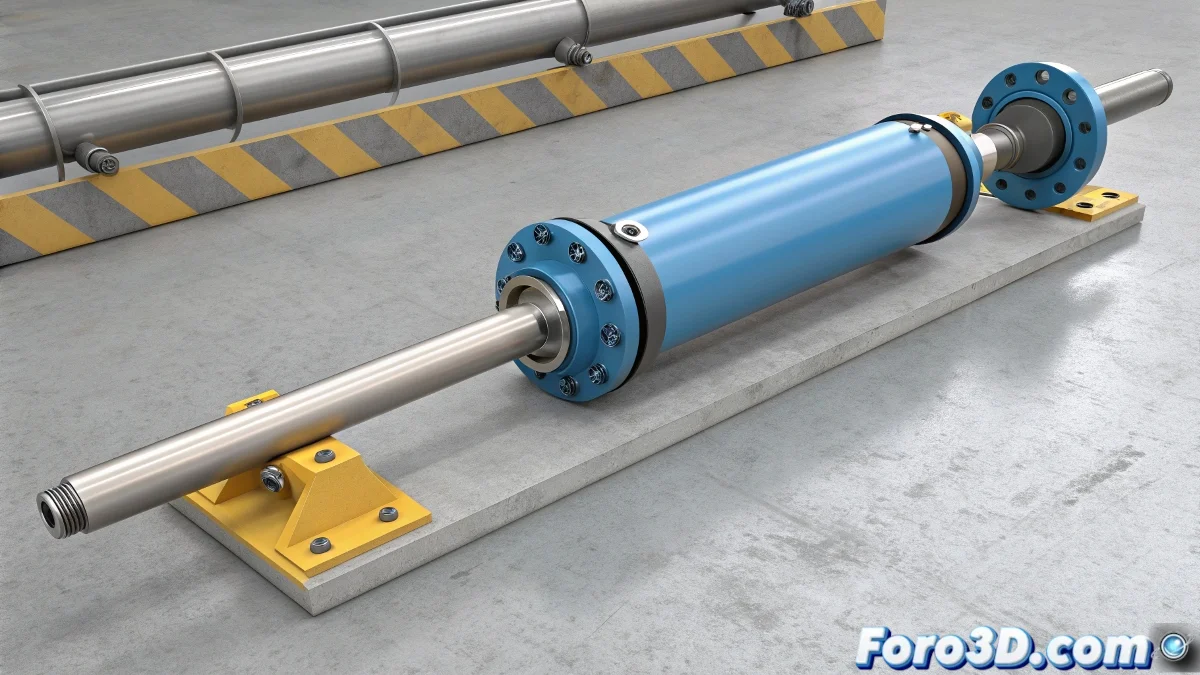
The Art of Connecting Joints with Smart Geometry
Creating cylinders that automatically orient between two joints in Maya is like establishing digital bridges that dynamically adapt to their anchor points 🌉. This technique is invaluable for mechanical systems, robotic limbs, or any situation where geometry needs to connect two moving points while maintaining correct orientation and proportion.
Preparation: The Importance of Local Axes
The success of this technique critically depends on the correct alignment of the cylinder's local axes. A poorly oriented axis will result in erratic rotations regardless of how the constraints are configured.
- Initial Alignment: Orient the cylinder along the Y axis generally
- Freeze Transformations: Reset transformations before applying constraints
- Visual Verification: Use display → transforms → local rotation axes
- Central Pivot: Ensure the pivot is at the geometric center
A well-aligned local axis is like a calibrated compass: it always points in the right direction.
Aim Constraint Setup for Orientation
Aim constraints are the heart of the system, responsible for keeping the cylinder pointing towards the target joint like a digitally guided missile.
- Aim Vector: Configure according to the cylinder's orientation axis (usually Y)
- Up Vector: Set the axis that maintains vertical orientation
- World Up Type: Use "object rotation" for greater stability
- Constraint Weights: Adjust influence for smooth blending
Controlling the Second End with Complementary Techniques
While the aim constraint controls one end, the other end requires additional approaches to complete the connection system.
- Secondary Aim Constraint: For fine control of the opposite end
- Point Constraint: To fix position without affecting rotation
- Pole Vector Constraint: For twist and intermediate orientation control
- Expression-Based Control: For complex custom behaviors
Stretch Systems for Adaptable Length
For cylinders that must stretch or compress between joints, stretch deformers add that crucial layer of mechanical realism.
- Native Stretch Deformer: Specific deformer for stretching
- Distance Expressions: Mathematical calculation of length based on joint positions
- Volume Preservation: Maintaining volume during compression
- Scale Limiters: Preventing unwanted extreme stretching
Common Practical Applications
This technique finds application in numerous animation and rigging scenarios where dynamic connection between elements is needed.
- Robotic Arms: Connections between mechanical parts
- Hydraulic Systems: Realistic pistons and hydraulic cylinders
- Organic Connections: Tentacles, appendages, and biological extensions
- UI Elements: Visual connections in animated interfaces
Optimization and Troubleshooting
Like any technical system, problems can arise that require debugging and optimization.
- Gimbal Lock: Avoid by using quaternions or Euler filters
- Sudden Flip: Adjust up vector objects for greater stability
- Performance: Use efficient constraints for complex systems
- Render Considerations: Verify that deformations render correctly
Professional Workflow
Implementing this system consistently requires following a specific methodology to ensure predictable results.
And when your cylinder decides