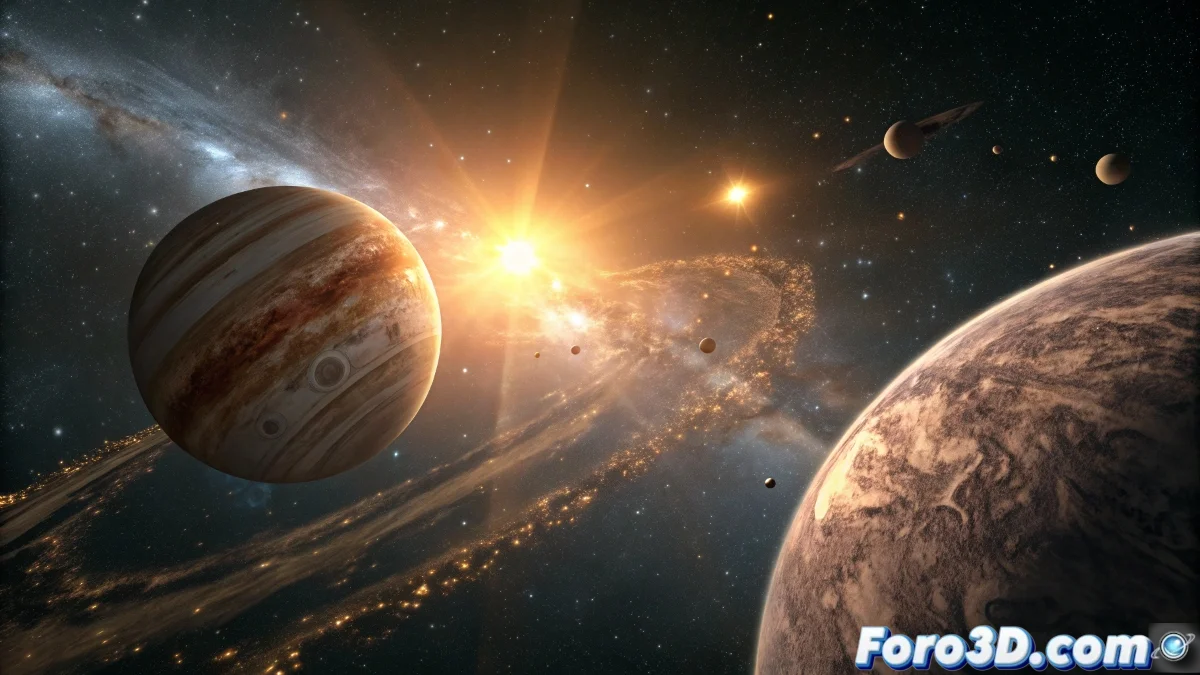
Bringing New Worlds to Life with VUE 🌌
Scientists announce the discovery of a new exoplanet orbiting a young star, very similar to the Sun. This finding opens the door to studying planetary systems in early stages of formation and analyzing how conditions favorable for life could develop on distant worlds. VUE presents itself as the perfect tool to visualize this discovery, allowing the creation of realistic astronomical scenes with detailed atmospheres, precise light effects, and immersive space environments.
Setting Up the Stellar Environment
The process begins by creating the starfield using VUE's Environment Object. The parameters for star density and nebulae are adjusted to generate a rich and believable background. By controlling Exposure and Light Source, the light from a young star is simulated—bright, with a slightly warmer hue than our Sun, and with an intensity that bathes the entire scene. The star's position is defined as the central point around which all elements will orbit. 🔭
Modeling and Texturing the Exoplanet
The exoplanet is created as a Sphere Object to which procedural materials are applied:
- Surface textures with variation of continents and oceans
- Volumetric cloud layers with transparency and movement
- Atmospheric scattering to simulate light dispersion in the atmosphere
- Controlled Specularity in oceanic areas for stellar reflections
These combined elements create a believable world with unique characteristics.
Rendering an exoplanet is imagining how the light from a distant star caresses a world no human has ever seen.
Environmental Effects and Complementary Elements
To enrich the scene, the following are added:
- Interstellar nebulae using Volumetric Objects with density control
- Asteroid fields via instancing systems for optimization
- Secondary moons orbiting the exoplanet with elliptical trajectories
- Stellar dust particles reflecting the light from the central star
These details contribute to the narrative of a planetary system in formation.
Lighting and Visual Atmosphere
VUE allows for advanced lighting control:
- Crepuscular rays passing through planetary atmospheres
- Luminous halos around the exoplanet against the starfield background
- Refraction and reflection on atmospheric surfaces
- Ambient occlusion for depth in cloud formations
The balance between light and darkness enhances the vastness of space.
Animation and Final Composition
The scene is animated to show:
- Planetary orbit around the star using Path Objects
- Axial rotation of the exoplanet showing different sides
- Cinematic camera movement with Depth of Field
- Cloud evolution and atmospheric formations over time
The final render is exported in high-quality formats for scientific or educational presentations.
While astronomers celebrate the discovery, we celebrate that VUE doesn't crash unexpectedly during the final render. At least our digital exoplanets will always be there... just a Ctrl + S away. 😅