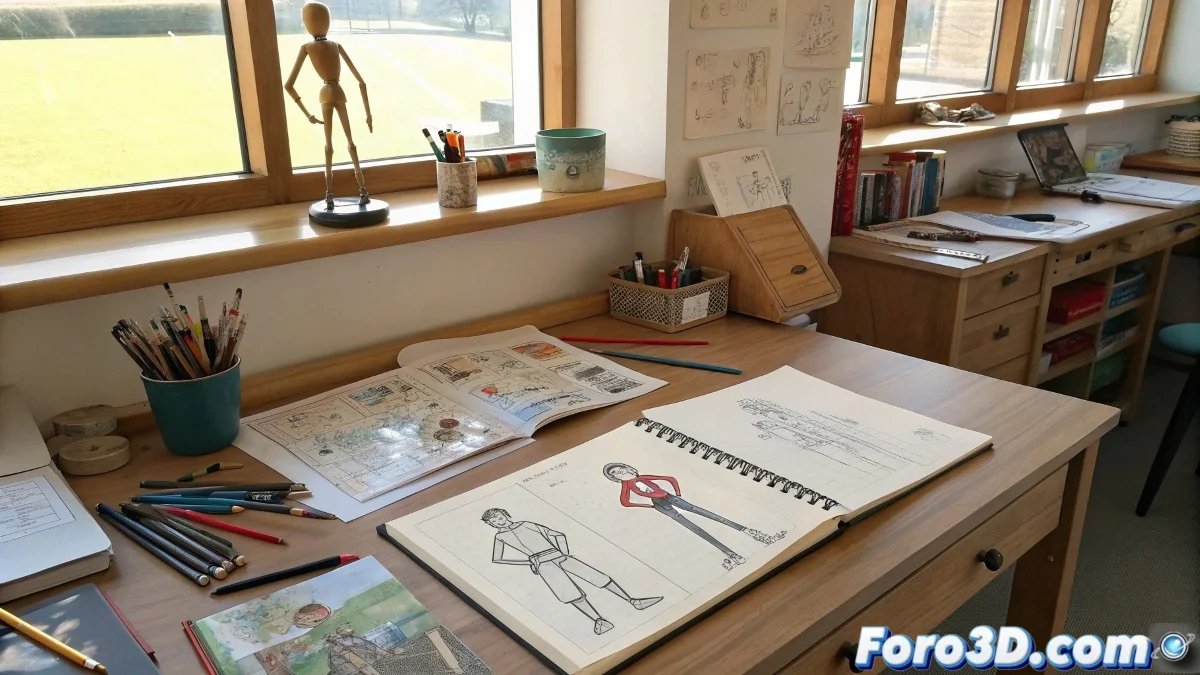
The Self-Taught Animator's Path to Canada
Creating a portfolio for animation studies in Canada without prior artistic training is like building a house starting from the foundations 🏗️. Canadian universities, renowned for their world-class animation programs, look for candidates who demonstrate a fundamental understanding of form, space, and movement – skills that transcend specific software and form the foundation of every good animator.
The Fundamental Pillars: Beyond Software
While many aspiring animators focus on mastering 3D tools, admissions committees deeply value traditional skills that evidence a structural understanding of art. These fundamentals are the universal language that separates technicians from artists.
- Human Figure Drawing: Proportions, gesture, and basic anatomical structure
- Hand and Expression Studies: The most expressive parts of the human body
- Perspective and Composition: Understanding three-dimensional space on a two-dimensional medium
- Real-World Observation: Ability to translate what is observed into visual representation
A strong portfolio demonstrates that you can see, not just that you can operate software.
Structuring Self-Directed Learning
Without access to formal arts education, creating a structure for self-directed learning is crucial for consistent progress. This approach requires discipline but offers flexibility to focus on specific areas of need.
- Daily Sketching Sessions: 30-60 minutes of daily observational drawing
- Progressive Anatomical Studies: From basic skeletons to superficial musculature
- Perspective Exercises: Interior and exterior scenes with vanishing points
- Motion Sketches: Capturing gestures and quick actions
Portfolio Development: Quality Over Quantity
An effective portfolio doesn't need to contain hundreds of pieces, but it must clearly demonstrate the learning process and understanding of fundamentals. Visible progression is as important as final quality.
- Turnaround Sheets: Multiple angles of the same figure or object
- Value Studies: Drawings that demonstrate understanding of light and shadow
- Movement Sequences: Simple storyboards or flipbooks showing action
- Design Processes: Preliminary sketches through to final version
Transition to the Digital and 3D World
Once traditional fundamentals are established, the transition to digital media becomes the natural next step in the portfolio's evolution.
- Basic Digital Tools: Photoshop for digital painting and composition
- Introduction to 3D: Simple modeling of objects and environments
- Basic Animation: Principles of animation applied in 3D software
- Integration of Techniques: Combining traditional drawing with 3D elements
Specific Focus for Canadian Admissions
Canadian institutions have particular expectations that are worth addressing directly in the portfolio.
- Media Diversity: Show technical versatility without sacrificing quality
- Visible Process: Include sketches and studies alongside final pieces
- Visual Narrative: Demonstrate the ability to tell stories visually
- Originality: Avoid copies and show a personal artistic voice
Support Resources and Communities
The self-taught path doesn't mean going it alone. Numerous resources and communities exist to support artistic development.
And when your first human figures look more like aliens than humans, remember: even the great Renaissance masters started by drawing crooked circles and lines 🎨. The artist's journey is a marathon, not a sprint, and every poorly drawn line brings you closer to