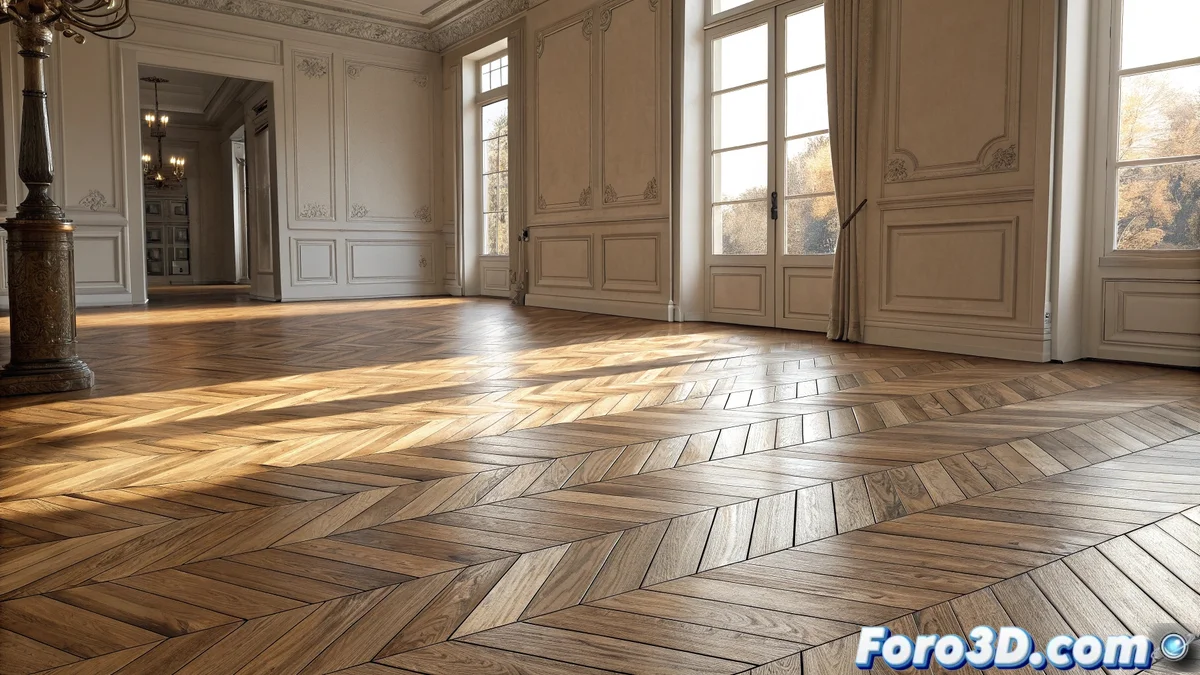
Creating Realistic Parquet Textures with Procedural Nodes in Blender
In the world of 3D design, Blender offers us the ability to generate completely procedural parquet textures using only the node system, eliminating the need for external texture maps and providing absolute control over every visual aspect of the material. 🪵
Basic Setup for Wood Grains
The process begins in the Shader Editor where we set up a new material. We implement a strategic combination of Noise and Musgrave nodes to simulate natural wood grains. We adjust parameters like scale and roughness to mimic grain variations, then use a ColorRamp node to define the transition between light and dark tones characteristic of authentic parquet.
Key Elements for Grains:- Noise and Musgrave nodes to generate organic grain variations
- Scale and roughness adjustments to control detail level
- ColorRamp to define the light and dark color palette
The beauty of the procedural approach lies in the infinite flexibility to adjust each parameter without losing quality when scaling.
Building Parquet Patterns
To recreate classic herringbone or chevron patterns, we implement a system of Mapping and Texture Coordinate nodes connected to mathematical operations. We use Math nodes with multiplication and division functions to create modular repetitions, while a modified Brick Texture node allows us to delimit the joints between planks. We apply alternating rotational transformations to achieve that characteristic interlocking that defines quality parquet floors.
Pattern Components:- Mapping and Texture Coordinate system for spatial arrangement
- Math operations for modular and angular repetitions
- Modified Brick Texture for joints between planks
Enhancing Material Realism
We elevate realism by incorporating a Bump or Normal Map node connected to displacement, using the same grain pattern as a source to generate micro-reliefs on the surface. We adjust the Roughness parameter in the Principled BSDF to achieve that typical semi-matte shine of waxed floors, and apply slight color variations using Hue Saturation Value nodes to avoid repetitive patterns. The final result is significantly enhanced with HDRI lighting that accentuates the material's imperfections and depth.
Final Finishing Techniques:- Bump/Normal Map nodes for surface micro-reliefs
- Roughness adjustments for natural semi-matte shine
- Color variations with HSV to avoid visual repetition
Final Reflections on the Process
This advanced procedural method demonstrates that it is possible to create high-quality parquet textures without relying on external resources, offering total flexibility in adjusting every visual parameter. Whoever thought installing a parquet floor was complicated clearly hadn't explored the 6 hours of nodal tweaking needed to avoid one plank looking repeated next to another, but the final result more than justifies the effort invested. 💫