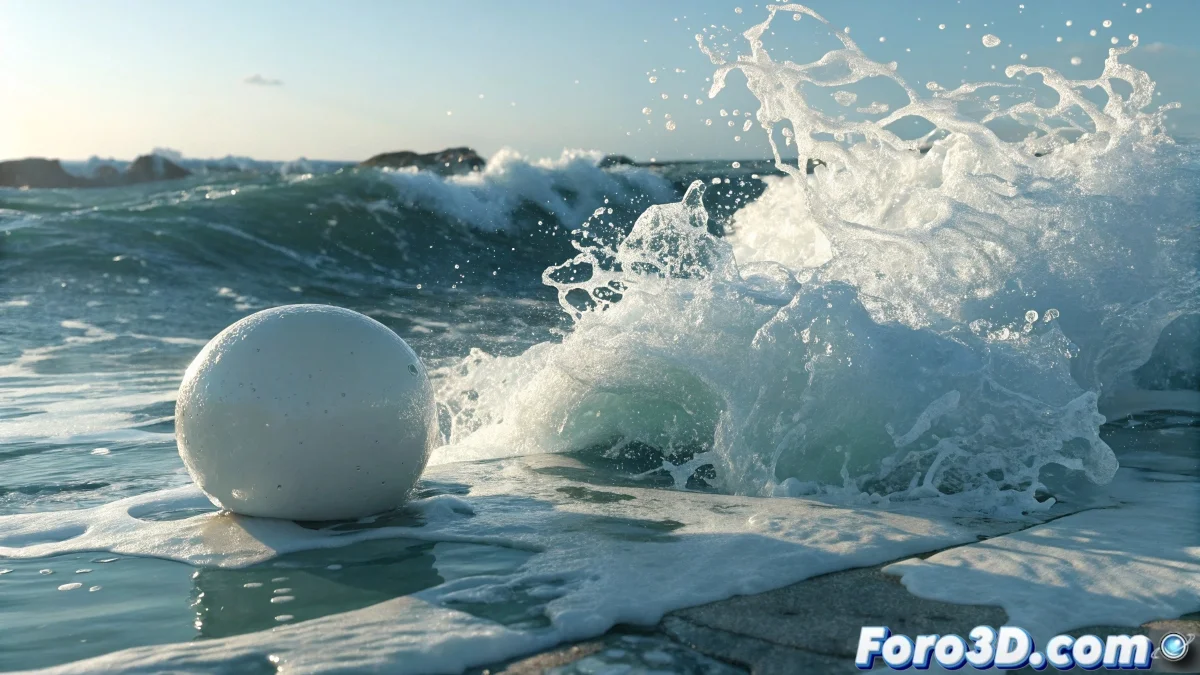
The Art of Perfect Splashes in SketchUp
Creating that realistic effect of falling water with splashes and white foam in V-Ray for SketchUp is like capturing a fleeting moment of water physics. The challenge lies in the fact that SketchUp doesn't have native fluid simulation systems, so we need to use creative modeling and material techniques to trick the eye and create the illusion of moving water.
To achieve this convincing effect, we will work on three fronts: the geometry of the splashes, the material of the moving water, and the white foam at the impact point. Each element contributes to creating that visual magic that makes the water appear truly liquid and in motion.
In SketchUp, splashing water doesn't fall, it's modeled with patience and rendered with cunning
Modeling the Splashes
Start by creating the geometry that will represent the droplets and splashes. Use organic and random shapes to avoid that artificial look of perfectly spherical droplets.
- Individual droplets: deformed spheres using the Scale tool
- Main splashes: vertically elongated teardrop shapes
- Fine spray: small scattered dots around
- Concentric ripples: flattened circles on the surface
Water Material for V-Ray
Configure a specific V-Ray material for moving water. Falling water has different properties than still water.
Use the VRayMtl material with high reflection and refraction. Moving water is more turbulent and less transparent than still water 😊
- Reflection: pure white or near-white color
- Refraction: pure white for total transparency
- IOR: 1.33 for pure water
- Bump map: soft noise for movement texture
Creating the White Foam
The foam at the impact point is crucial for realism. Create simple but effective geometry and apply a specific foam material.
Model irregular, amorphous shapes in the impact zone. Real foam is chaotic and has volume; it's not just a flat texture.
- Foam geometry: flattened and compressed spheres
- Random distribution: avoid repetitive patterns
- Size variation: from large bubbles to fine foam
- Depth: multiple layers for realistic volume
Foam Material for V-Ray
The foam needs a material that simulates air bubbles trapped in water. It's not simply white; it has visual complexity.
Use a VRayMtl with high reflection but also high roughness. Foam is shiny but diffuse, not like a mirror.
- Diffuse color: slightly bluish or grayish white
- Reflection: 60-80% with roughness 0.3-0.5
- Refraction: disabled or very low
- Bump: fine noise for bubble texture
Composition and Scale Techniques
Correct scale is essential for realism. Splashes that are too large look cartoonish; too small and they go unnoticed.
Study photographic references of falling water and pay attention to the size relationship between droplets, splashes, and the main body of water.
- Real references: study photos of fountains and waterfalls
- Consistent scale: all droplets in proportion
- Direction of movement: consistent with physics
- Variable density: more foam near the impact