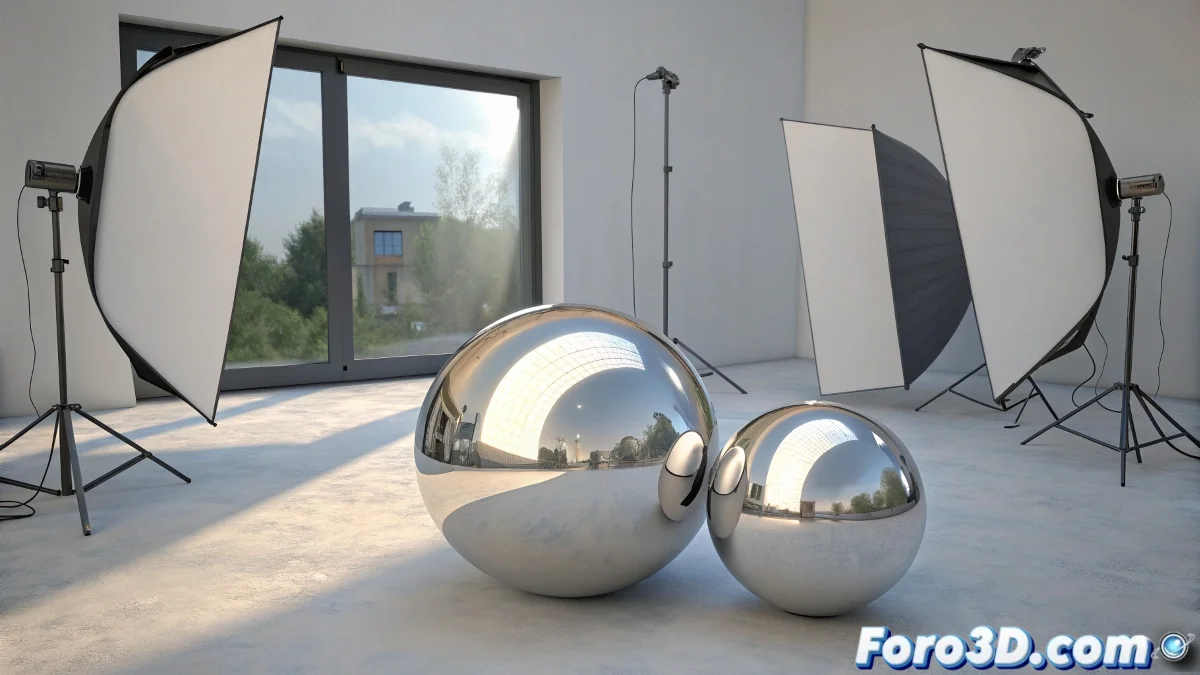
The Challenge of Recreating Digital Photography Studios
When you aim to create reflection maps that simulate a photography studio, you are tackling an essential technique for product renders and professional visualizations. A good studio reflection map must capture the essence of a controlled environment: dark backgrounds that don't distract, screen reflections that provide soft lighting, and strategic light points that define the shape of objects. The key is understanding that these maps don't just add reflections; they completely define the lighting and atmosphere of your scene.
Creating Your Own Studio Reflection Map
You can create effective reflection maps using different approaches depending on your needs. From simple methods with editing software to more advanced techniques with specific renders, flexibility is your best ally.
- Photoshop or GIMP to create custom maps from scratch
- Rendering chroma spheres in prepared studio scenes
- Using existing HDRIs and modifying them for dark backgrounds
- Combining light layers with blending modes for precise control
Solving Distortion in Sphere Mapping
The problem of distortion at the poles of spheres is one of the classics of 3D texturing. When you apply a planar or cylindrical mapping to a sphere, the UV coordinates inevitably compress at the poles, creating that stretching effect you so want to avoid. The solution requires understanding the limitations of each type of mapping and choosing the correct strategy for your specific case.
Mapping a sphere without distortion is like wrapping an orange with paper: there will always be wrinkles, but you can choose where to put them
- Spherical mapping for uniform distribution but with polar compression
- UVW Unwrap with projection from multiple angles
- Cubic mapping for textures that tolerate seams
- Cylindrical coordinates for spheres with non-critical poles
Advanced Techniques for Perfect Textures
For projects where visual quality is paramount, there are professional techniques that minimize or hide distortion problems at the poles. These require more setup time but offer notably superior results.
Mastering the art of sphere mapping and creating reflection environments is like learning the secrets of traditional studio photography 🎭. Every technique you master brings you closer to creating renders that not only look realistic but convey a clear artistic and professional intent.