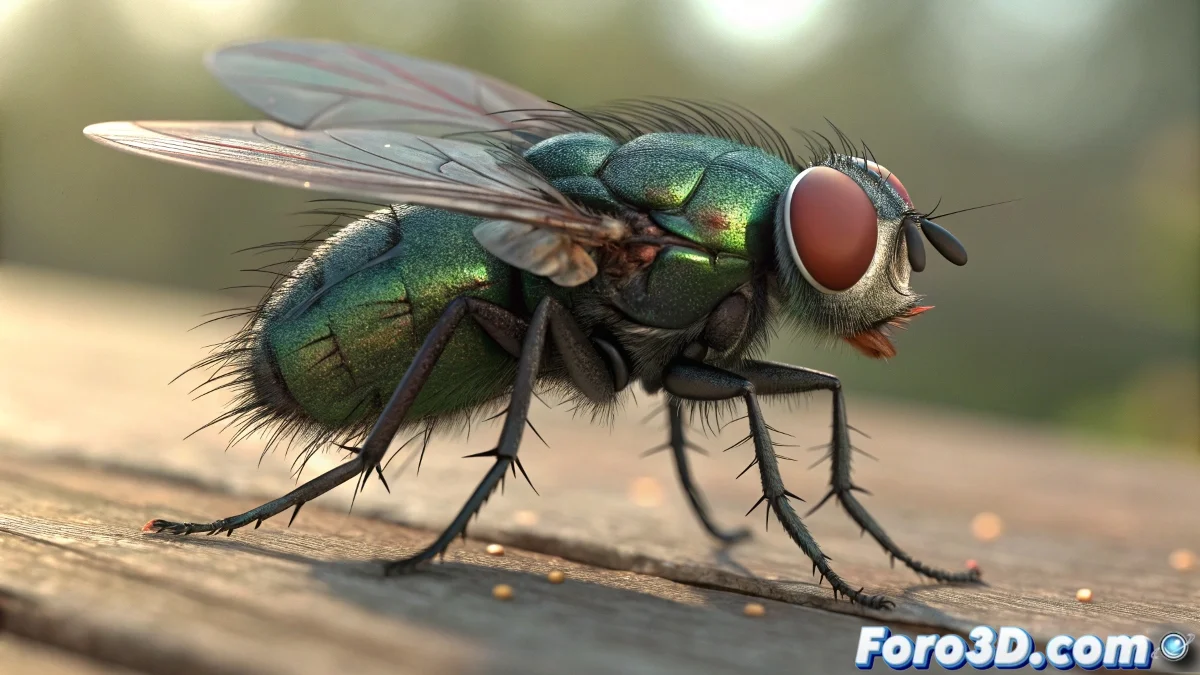
The Fun Art of Bringing an Insect to Life
Modeling a fly might seem like the strangest task in the world, until you decide to turn it into a character with charisma. 🤪 The goal is not realism, but capturing the essence of comedy. In 3ds Max, this means breaking the rules of real anatomy and embracing exaggeration. A model like this is a perfect exercise to demonstrate technical skill and, above all, a great sense of humor. After all, what says more about an artist than their ability to make people smile with a bug?
The Foundations of a Funny Fly
The secret lies in intelligently altering the proportions. Huge, bulging eyes convey personality immediately, while somewhat clumsy wings add charm. 🪰 The mesh structure, or topology, is crucial; it's vital to ensure that areas that might move, like the mouth or the base of the wings, are modeled with quads. This guarantees that surface smoothing is perfect and error-free.
A comic character is born from solid geometry and the audacity to exaggerate.
For final details, like a wide smile or antennae with curves, the use of edge loops is fundamental. These rings of edges allow you to control the shape with precision and define the volumes well.
Materials That Add Personality
This is where the model truly comes to life. For the body, materials with a low specular level and glossiness should be used. This avoids metallic appearances and gives that plastic look so typical of cartoons. The eyes can benefit from a Fresnel shader to mimic their natural moisture, with a very faint reflection. 👀
- Credible Wings: Using a transparent material with an opacity map and slight subsurface scattering (SSS) simulates the thinness and translucency of an insect's wings.
- Quality Textures: It's better to use procedural textures or the PBR workflow than to rely on flat images. This gives more realism and consistency under any light.
- Touches of Humor: Adding colored veins on the wings or an exaggerated shine in the eyes enhances the comic style. Subtlety is not welcome here!
A Clear Path to Success
Following a logical order makes everything easier. This work sequence is recommended. 💻
- Blocking: Define the exaggerated shapes with basic geometry.
- Mesh Refinement: Ensure all topology is in quads for good deformation.
- UV Unwrapping: Prepare the UVs for painting textures efficiently.
- Material Application: Build and assign the cartoon and PBR shaders.
The final result will be a unique character, ready to be the star of any scene. If you manage to make a fly more interesting than a superhero, then your mission is accomplished. 😉