Correcting Biases in Projected Stellar Distances
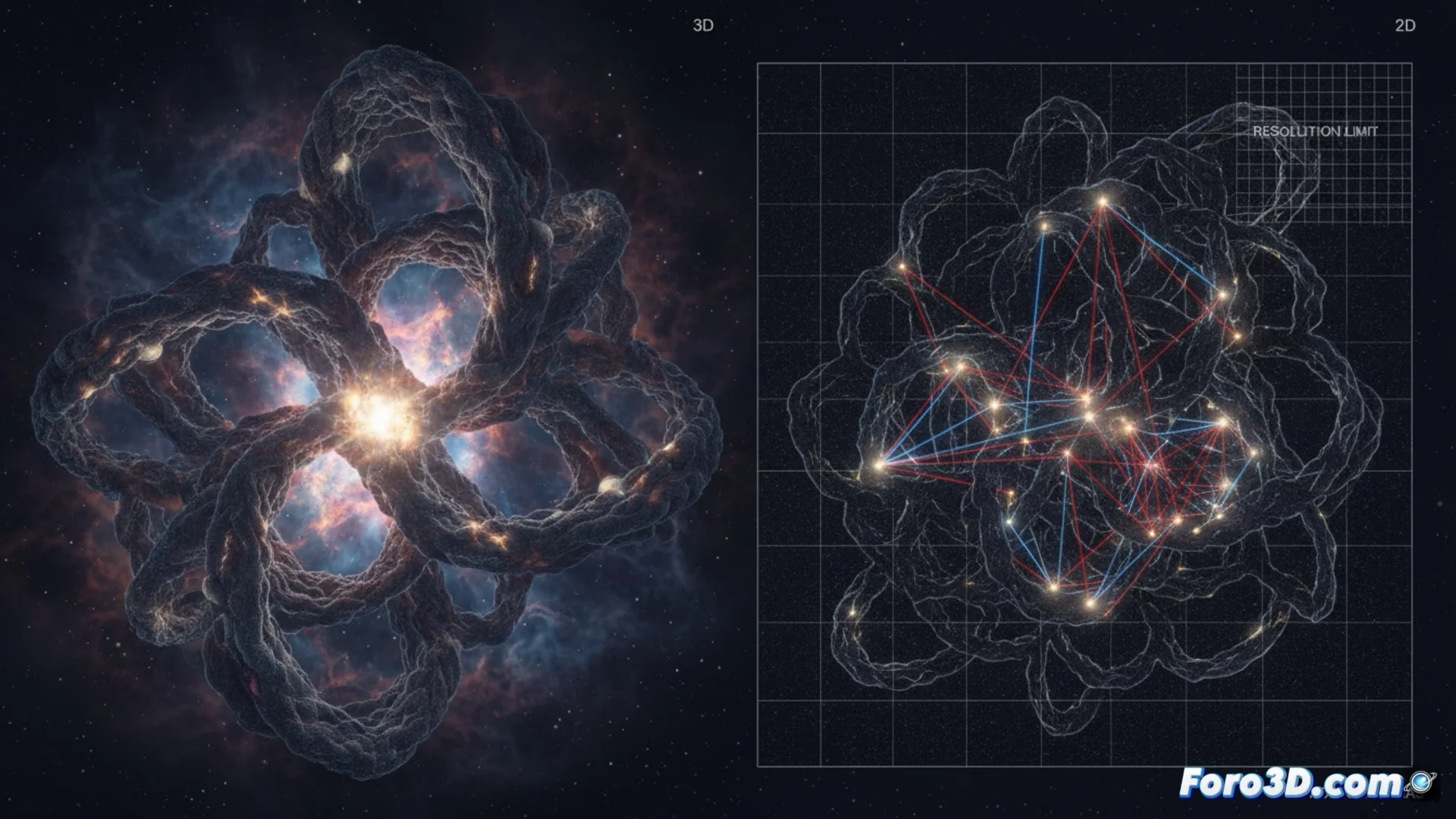
When gas clouds collapse to form stars, they break into a complex three-dimensional network of dense clumps. Astronomers often measure the separation between these neighboring cores in two dimensions, as projected against the sky. However, this approach oversimplifies spatial reality and produces two systematic errors that counteract each other. 🔭
The Two Opposing Biases of 2D Projection
When projecting three-dimensional positions onto a plane, the measured distances inevitably shorten and the neighborhood network is altered. At the same time, the finite resolution of telescopes makes very close cores appear merged, creating the illusion that they are farther apart. These opposing effects distort our understanding of how a cloud fragments.
Consequences of measuring in two dimensions:- Geometric shortening: Distances between cores always appear smaller than they are in real space.
- Loss of neighbors: The network of connections between the closest clumps changes completely.
- Instrumental blending effect: Limited resolution capability groups nearby sources, masking their true proximity.
The classic geometric factor for converting 2D to 3D is not sufficient to compensate for these combined biases.
An Empirical Model for a True 3D View
Through numerical experiments with spherical and fractal-structure clouds, both effects were quantified. The study produced an empirical correction factor that depends on the number of detected cores and the resolution of the instrument used.
Key results of the correction:- For data with few cores or low resolution, the real 3D distances are only 20% to 40% greater than the projected ones.
- In extensive and well-resolved samples, separations in three-dimensional space are usually twice the 2D measurements.
- The typical uncertainty when applying this conversion is around 30-40%, mainly derived from the unknown morphology of the original cloud.
Impact on Our Understanding of Star Formation
Applying this calibration allows transforming projected measurements into realistic estimates of physical separations. This adjustment significantly modifies the fragmentation scales deduced, both in real observations and computer simulations. It therefore offers a more accurate and reliable view of the complete process that gives rise to stars. 🌌
So, if you ever thought stellar neighbors were too crowded, it might just have been an artifact of observing in two dimensions with limited resolution. A powerful telescope and the right correction factor can reveal the true living space that really exists between them.