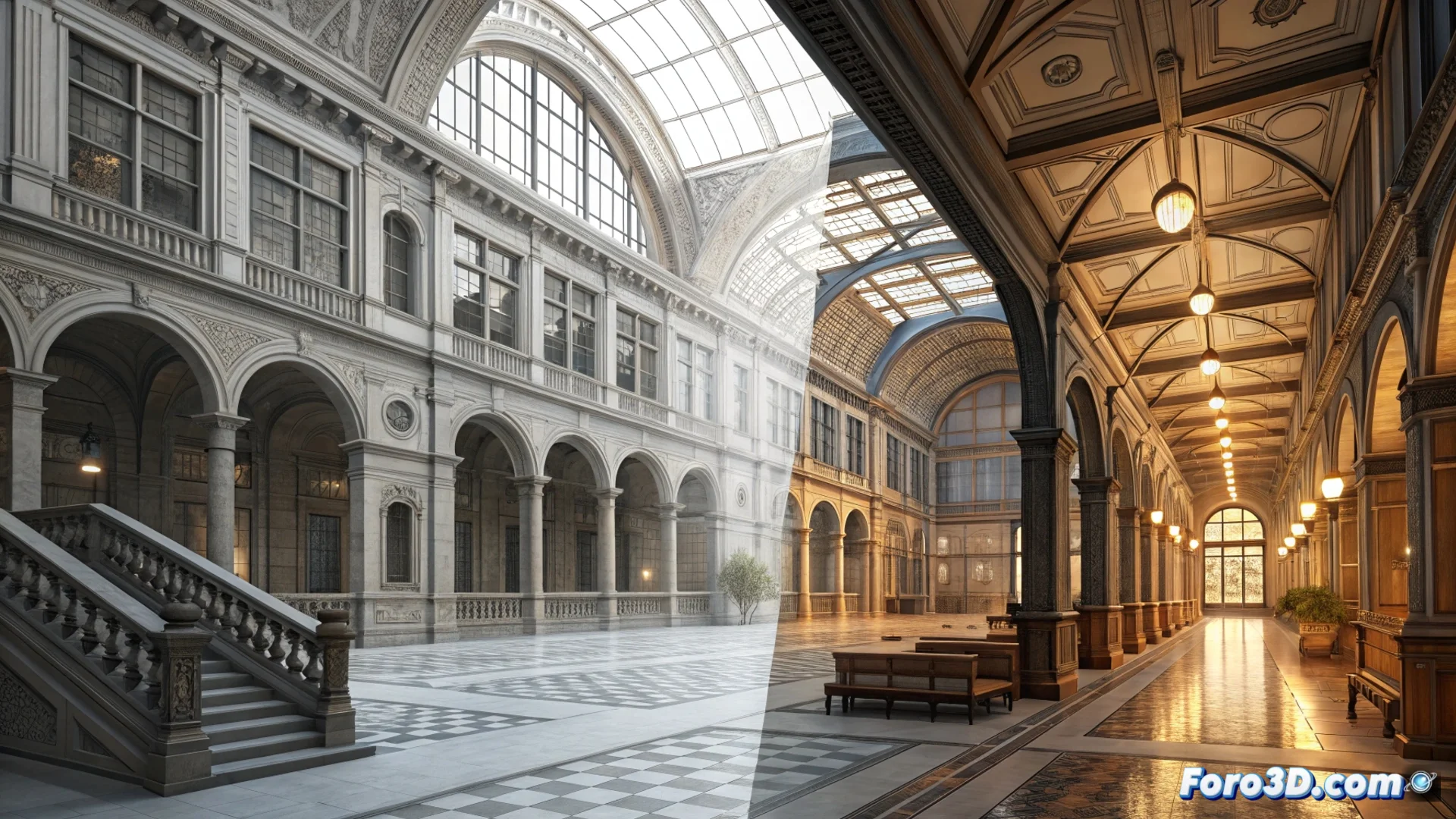
Corona Render and V-Ray: Rendering Philosophies in Complex Scenes
When working with dense 3D scenes, the rendering engines Corona Render and V-Ray reveal opposing work philosophies. One prioritizes immediacy and simplicity, while the other focuses on absolute control and customization. Choosing between them defines how a project is approached from the start 🎨.
Core Approaches of the Rendering Engine
The Corona philosophy is based on providing an agile and predictable workflow. Its engine, which uses path tracing, handles global illumination automatically, allowing scenes to be set up quickly. In contrast, V-Ray provides granular control over every setting, thanks to its hybrid engine that combines path tracing with irradiance maps. Both can process highly detailed geometries, many lights, and complex materials, but the way to optimize these elements is radically different.
Key Differences in Workflow:- Corona Render: Seeks physically accurate results immediately, ideal for iterating and making creative decisions on the spot.
- V-Ray: Offers an exhaustive control panel, perfect for projects with very strict technical specifications where every detail matters.
- Common Point: Both are capable of handling high-complexity scenes, but the path to the final result is different.
An artist using Corona gets predictable renders almost instantly; an artist using V-Ray can spend hours fine-tuning samples for a tiny detail that perhaps only they notice.
Setting Up Lights and Materials
This is where the divergence is most noticeable. Corona greatly simplifies the process of adjusting lights and creating materials, speeding up the initial testing phases. Its materials are physically correct by default, and its interactive lighting system responds quickly. V-Ray, on the other hand, allows fine-tuning every light and material property with millimeter precision. It has an extensive and customizable library of assets, although exploiting its full potential requires deeper technical knowledge.
Aspects to Consider:- Iteration Speed: Corona makes it easy to test many lighting ideas in little time.
- Technical Control: V-Ray gives the power to adjust advanced parameters and meet specific production requirements.
- Libraries: Both include material libraries, but V-Ray's is notably more extensive and configurable.
Managing Performance and Memory
In terms of speed, Corona usually processes faster in interiors with complex lighting, due to its efficient global light management. V-Ray can match or exceed this performance in outdoor scenarios or when using its advanced network distributed rendering feature. Managing RAM memory with heavy geometries is vital; both engines have tools for instancing and optimizing, but V-Ray offers more low-level options to control exactly how assets are loaded into memory, which is crucial for extremely large scenes.