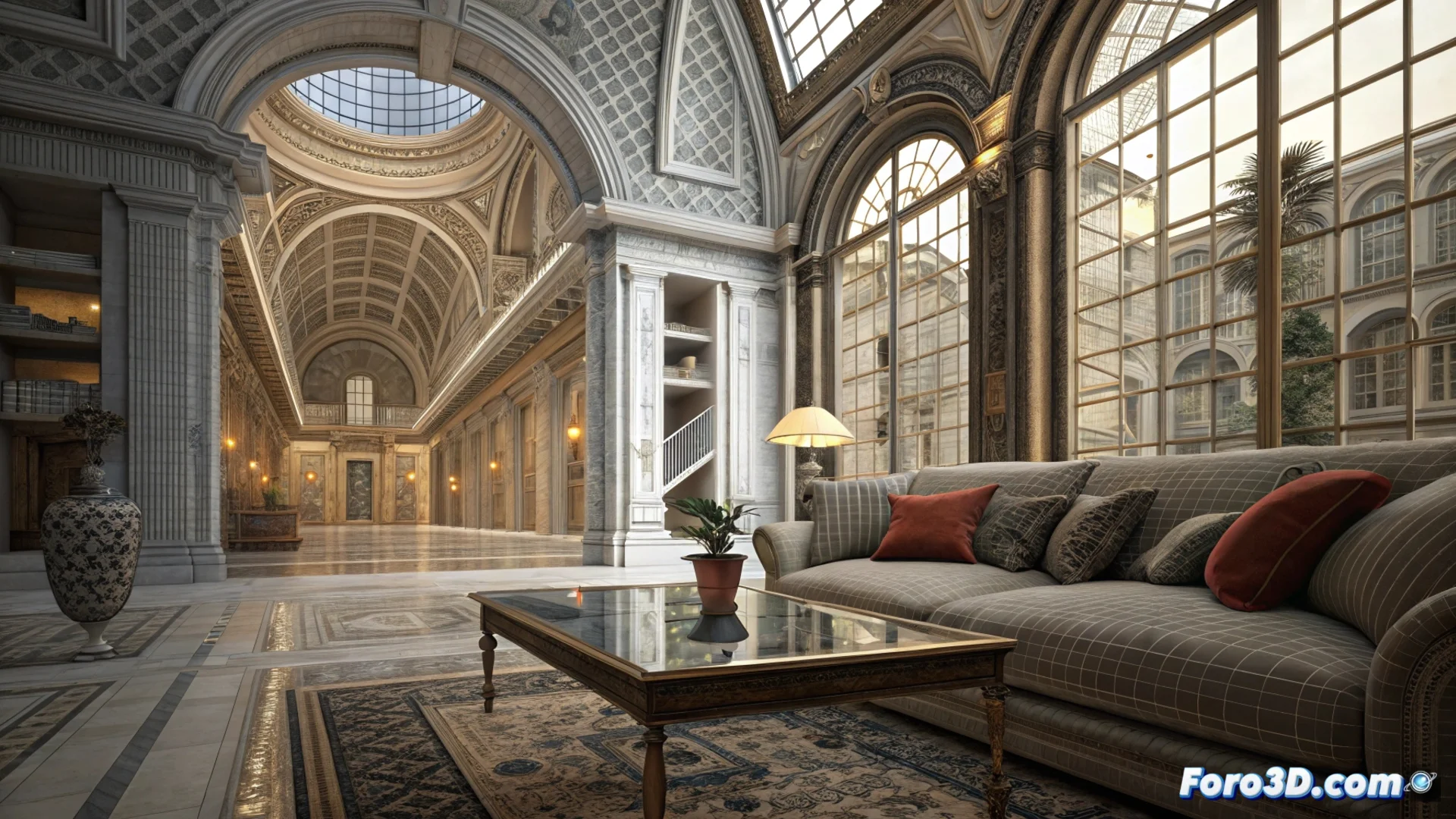
Corona Render and Unreal Engine: Two Philosophies for Handling Complex Scenes
In the field of 3D rendering, two engines stand out for their power but with radically different approaches. Corona Render, integrated into applications like 3ds Max and Cinema 4D, and Unreal Engine, the leading real-time platform, represent two paths to resolve visual complexity. While one calculates patiently, the other prioritizes immediacy. 🎯
Corona Render: Physical Precision Above All
This engine specializes in generating static images and animations with absolute photorealism. Its core is a ray tracing engine that simulates phenomena like global illumination, materials, and caustics with great accuracy. To achieve this, its workflow is linear: parameters are adjusted and then wait for it to process the frame, prioritizing final quality over interactive speed. This implies longer calculation times to eliminate noise and resolve indirect lighting in dense scenes. 🧠
Key Features of Corona Render:- Ray tracing-based engine for precise physical simulation.
- Workflow focused on adjust and wait, ideal for producing final images.
- Requires long render times to achieve artifact-free quality in complex scenes.
Corona Render patiently calculates every light interaction, pursuing physical fidelity without compromises.
Unreal Engine: The Power of Interactivity
Unreal Engine operates with an opposite paradigm. Its real-time rendering engine is based on rasterization and hybrid ray tracing techniques. Its strength is maintaining high frame rates, allowing to explore and modify complex environments instantly. It achieves this fluidity through an automatic level of detail (LOD) system, aggressive geometry culling, and extensive use of shaders and precomputed data. Although it can approach photorealism, adjustments often need to be balanced to not affect performance. ⚡
Key Features of Unreal Engine:- Real-time engine optimized for high frame rates and interactivity.
- Employs techniques like automatic LOD and culling to efficiently handle dense geometry.
- Ideal for projects that need immediate feedback, such as VR or live architectural visualizations.
How to Choose Between Them?
The decision is not based on which is better, but on the final objective of the project. Choose Corona Render when the main purpose is to produce an image or animation with maximum physical realism, and render time is not a critical limitation. On the other hand, Unreal Engine is the option when the project demands interactivity, such as in virtual reality experiences, real-time architectural visualizations, or virtual cinematic productions where immediate response is needed. Both can load dense geometry and high-resolution textures, but their methods for optimizing and displaying that data are fundamentally different. 🤔