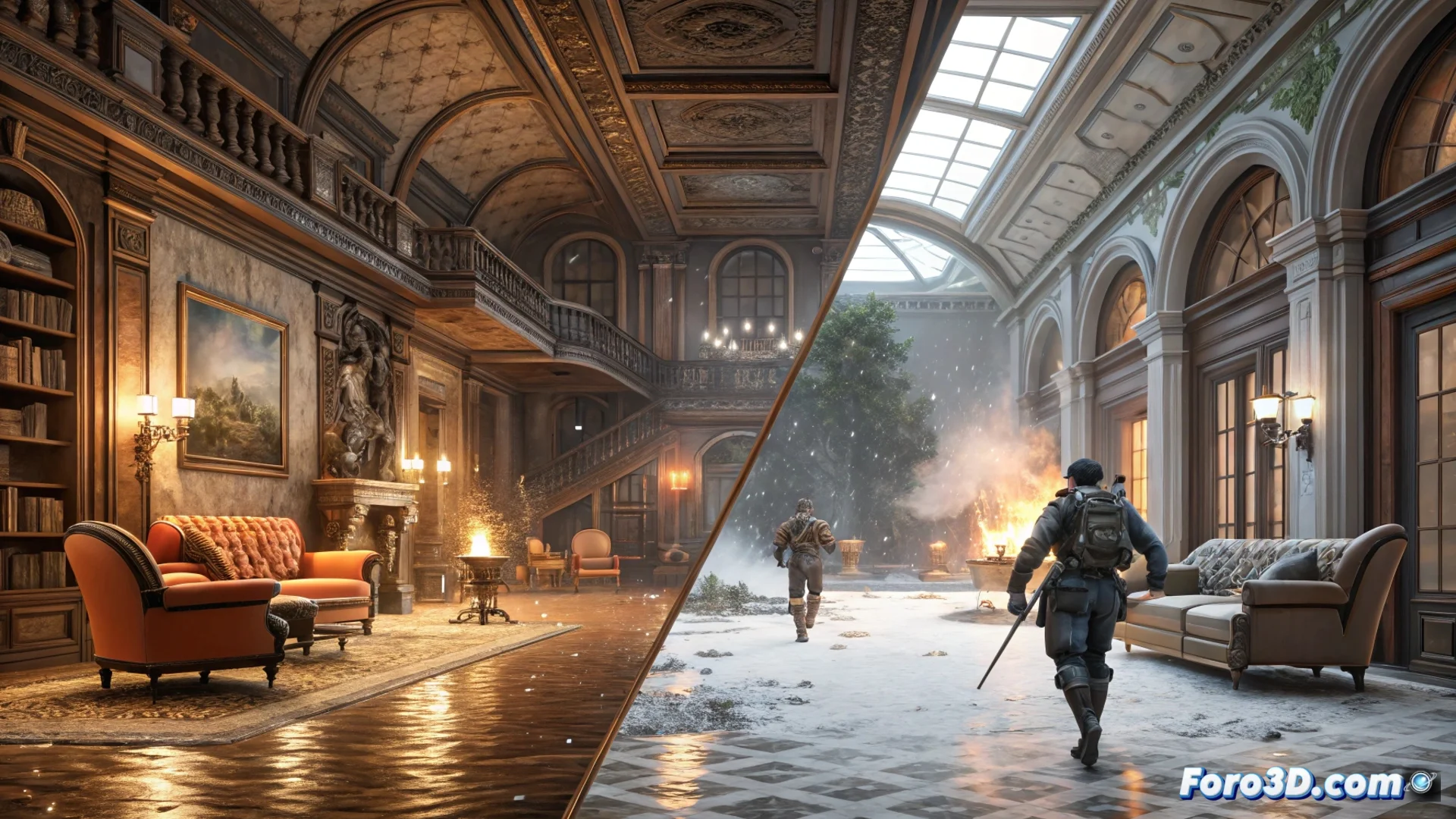
Corona Render and Unity: Two Philosophies for Processing Graphics
In the field of digital visual creation, two tools represent opposing paradigms: Corona Render and Unity. 🎨 While the first seeks physical perfection in every frame, the second focuses on generating smooth interactivity. Understanding their fundamentals is key to choosing the right technology for each project.
Engines with Different Objectives
Corona Render, which operates within 3ds Max and Cinema 4D, employs a ray tracing engine that accurately simulates how light and materials behave in the real world. Its goal is to achieve maximum photorealism, regardless of how long it takes to calculate an image. To handle heavy scenes, it uses techniques like instancing objects and intelligently managing memory. On the other hand, Unity operates as a real-time engine, where the primary objective is to maintain a constant and high frame rate, above 30 fps. 🔄 It achieves this with methods like culling non-visible geometry, using levels of detail (LOD), and precalculating lighting. Its render pipeline, whether the built-in one, URP, or HDRP, always seeks a balance between visual quality and performance.
Different Metrics and Optimization Strategies
The way to measure and handle complexity is radically different in each environment.
In Corona Render:- Complexity is evaluated by the number of polygons, lights, and samples per pixel.
- The artist can add details almost without limit, but the time to render each frame grows proportionally.
- It is optimized by adjusting the number of light samples to reduce noise in shadows and reflections.
- Complexity is defined by a strict budget of milliseconds per frame.
- Constant optimization is required: combining draw calls, using texture atlases, and simplifying shaders.
- Complex lighting is precomputed (baked), which limits how lights and objects can move during runtime.
A modeler can spend days detailing a lamp in Corona for a perfect frame, while in Unity that lamp might be a texture with a normal map if the player only sees it from afar.
Selecting the Right Tool
The final choice depends entirely on the product that needs to be created.
Corona Render is chosen when the final result is a static image or a video sequence of the highest visual quality, where render time per frame is a secondary factor. It is the preferred tool for architecture, product visualization, and design. Conversely, Unity is selected when developing an interactive application, video game, or virtual reality experience where fluidity is mandatory. In this case, visual quality is adapted, and graphical "tricks" are used that the eye does not perceive in motion to maintain the frame rate. 🎮
In summary, Corona Render and Unity approach the graphics process from opposite extremes: one prioritizes physical fidelity without haste, and the other, real-time interactive response. Mastering their differences allows artists and developers to make the most of each one's potential.