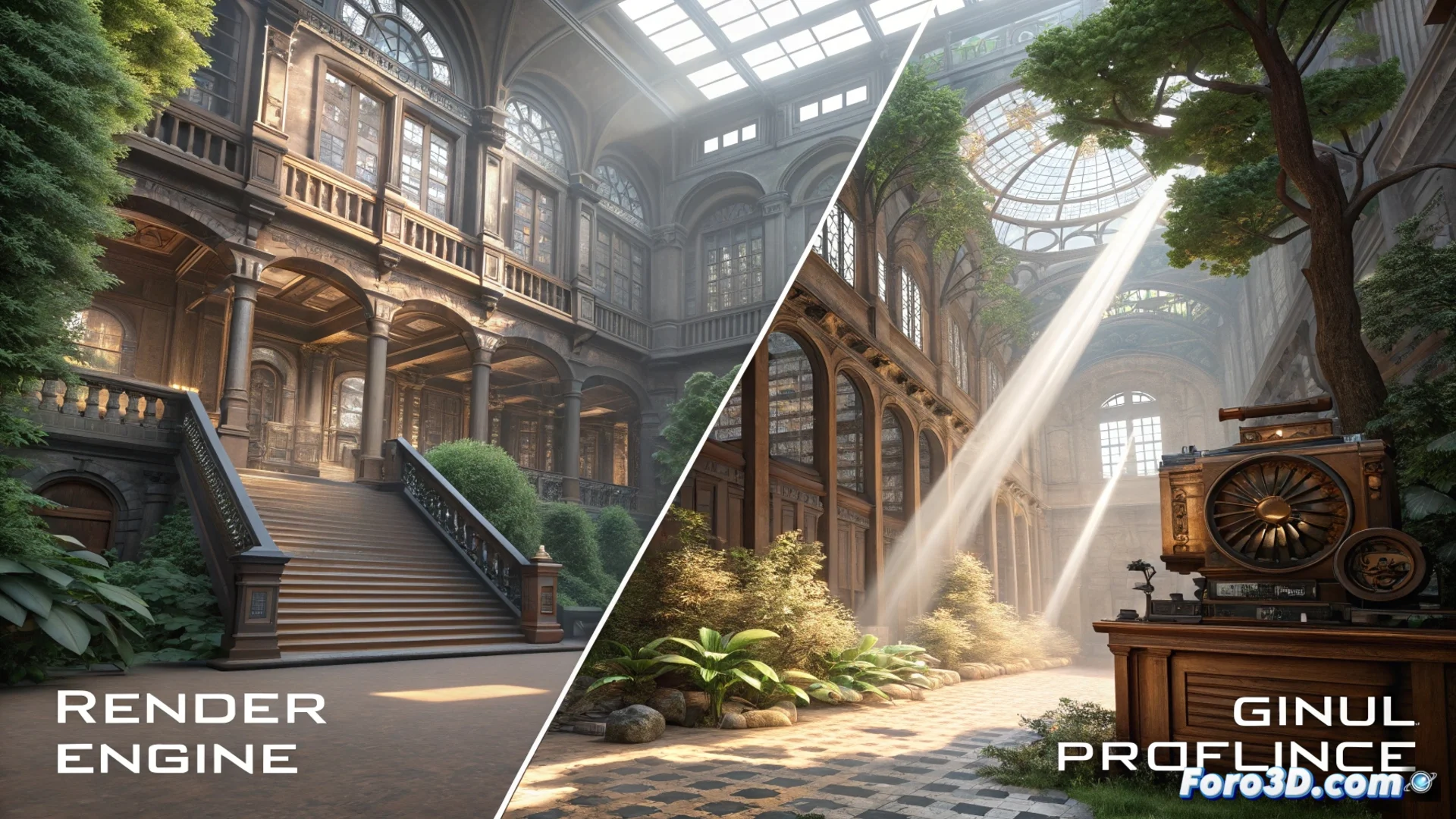
Corona Render and Octane Render: two approaches for complex scenes
In the world of 3D rendering, handling projects with high complexity requires choosing the right tool. Corona Render and Octane Render are two leading engines that, although they pursue the same goal, achieve it through opposing technical philosophies. One bets on precision and predictability, while the other prioritizes speed and immediate response. Understanding their foundations is key to optimizing any professional workflow 🚀.
Technical architecture: the basis of everything
The fundamental difference lies in how each engine uses your computer's hardware. Corona Render operates with a hybrid architecture, primarily employing the CPU and relying on the GPU as an accelerator. This allows it to handle large amounts of RAM memory to load scenes with extremely dense geometries without crashing. On the other hand, Octane Render is a pure GPU engine, meaning the entire processing load falls on the video memory (VRAM) of your graphics cards. This decision completely defines how they behave when facing different challenges.
Impact on workflow:- Corona for heavy environments: Ideal for architectural visualization with a lot of detail, extensive forests, or any scene where polygon complexity is the main factor. Its RAM usage avoids premature bottlenecks.
- Octane for speed and interactivity: Provides nearly real-time previews, allowing instant adjustments to lights, materials, and cameras. However, it may hit limits sooner with massive geometry scenes.
- Volumetrics and particles: For effects like dense smoke, fog, or complex particle systems, Octane usually shows superior fluidity during the preview phase, thanks to its parallel computing power on the GPU.
The choice is not about which is better, but about what type of complexity defines your project: massive geometry or dynamic effects and speed?
Visual quality and material handling
Both engines can produce very high-quality images, but the path and effort required differ. Corona Render is characterized by offering a very balanced and "ready-to-use" result from the first moment, with physical lighting that reduces the time needed to balance the scene. Octane Render provides more granular and direct control over the light path, allowing very specific visual styles to be achieved, although it often requires more manual adjustments.
Key aspects in materials and lighting:- Default lighting: Corona simplifies the process with very well-achieved initial settings. Octane offers more freedom but requires more knowledge to configure.
- Complex materials: Both natively handle advanced shaders like subsurface scattering (subsurface scattering) or metal and enamel layers. Corona usually speeds up the process with preconfigured material libraries.
- Post-production workflow: Corona images often need less retouching in compositing. Octane images, being more adjustable in real-time, are sometimes conceived with a subsequent post-processing step in mind.
Final decision: work philosophy
In the end, choosing between Corona and Octane comes down to evaluating your own way of working and the resources you have available. Do you prefer an engine that allows you to plan calmly, trusting that the final render will require minimal tweaks? Corona is a solid option. Or do you value more the ability to improvise and experiment on the fly, seeing changes immediately, even if you later have to polish the result in compositing? Then Octane might be your ally. Both are powerful tools capable of handling complex scenes; the key is to align their architecture with the specific demands of your project and your hardware 🎯.