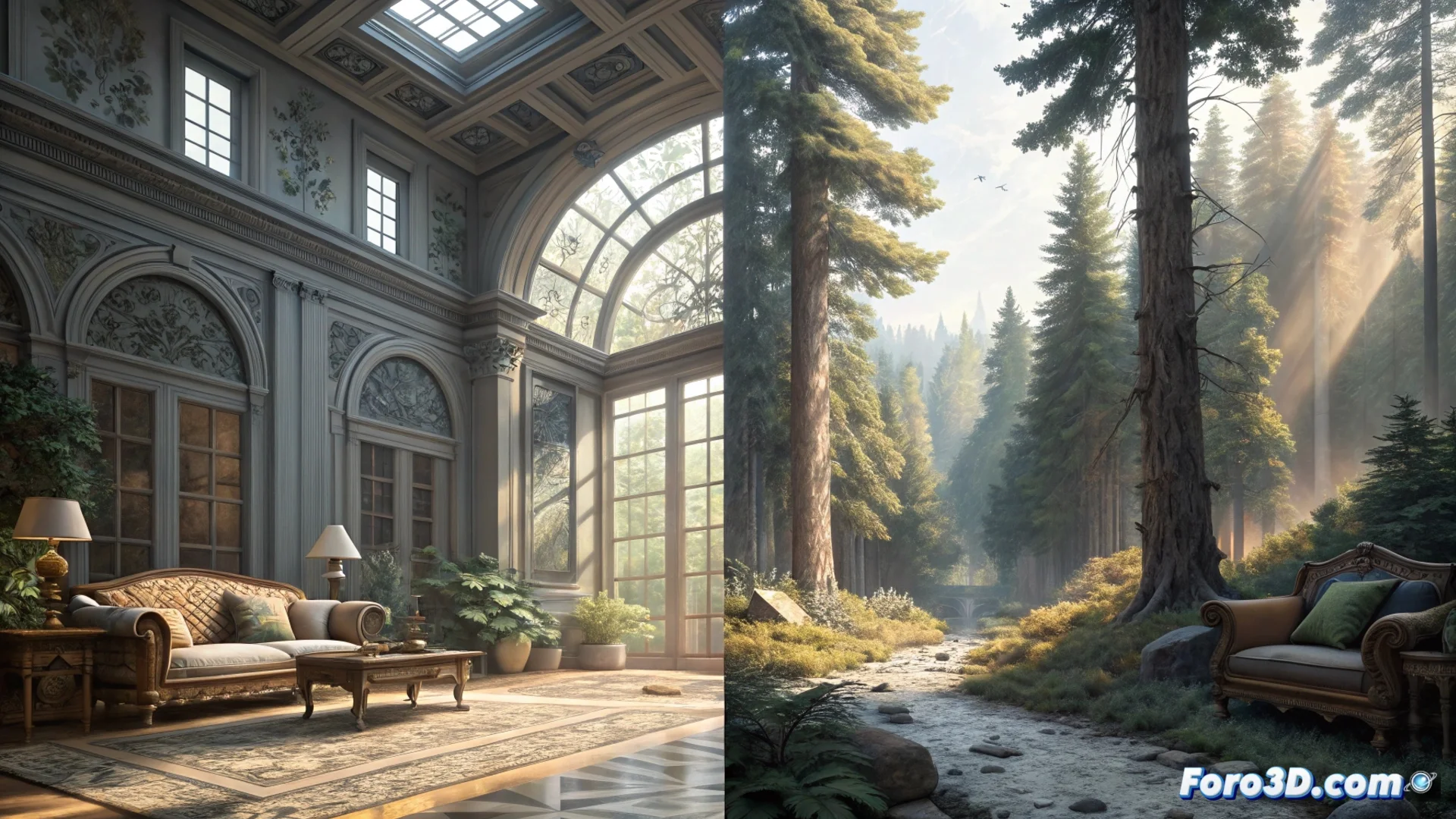
Corona Render and CryEngine: two engines for complex scenes
In the 3D realm, choosing the right rendering engine defines the final result. Two powerful solutions, Corona Render and CryEngine, tackle complexity from opposite perspectives: one seeks static physical fidelity and the other, dynamic interactivity. Understanding their fundamentals is key to optimizing any project 🎯.
Corona Render: precision and realism for architecture and product
Corona Render specializes in producing photorealistic images for architecture and product visualization. Its core uses progressive ray tracing that continuously refines the image, effectively eliminating noise, especially in interiors with complex natural lighting. It handles very dense geometry and extensive material libraries without excessive memory consumption. Its integration with 3ds Max and Cinema 4D allows intuitive setup of lights and materials. However, rendering long animated sequences can demand considerable computation time per frame.
Corona Render's key strengths:- Progressive rendering: The image improves over time, ideal for previewing and reducing noise in interiors.
- Handles dense geometry and complex materials efficiently with memory.
- Agile workflow in 3ds Max and Cinema 4D with material libraries and physical lights.
For an architectural renderer, using CryEngine for a house might feel like using a flamethrower to cook, while a game developer trying Corona for a forest will miss being able to adjust the sun instantly.
CryEngine: power for interactive and extensive worlds
CryEngine is designed to create open worlds and video game experiences. Its strength lies in managing vast landscapes, advanced particle systems, and lights that update in real time. It uses a blend of rendering techniques to achieve high performance in exteriors with dense vegetation and atmospheric effects. Its global illumination updates quickly, which is vital for maintaining interactivity. However, matching Corona's photometric realism in detailed interiors requires manually adjusting many parameters and configuring shaders with greater effort.
CryEngine's key strengths:- Optimized for dynamic and extensive environments, with efficient management of draw calls and level of detail (LOD).
- Global illumination and shadow systems that update quickly, essential for interactivity.
- Offers a faithful preview within the editor and integrated tools for optimizing performance in real time.
Choose based on the main workflow
The decision between Corona Render and CryEngine depends on the main objective. Artists modeling architecture or products value that Corona delivers predictable and high-quality results with fewer technical adjustments, speeding up the process. On the other hand, developers creating interactive experiences or large virtual environments prefer CryEngine for its real-time preview and tools for managing performance and scale. Both can handle complex scenes, but the nature of that complexity differs: high-density meshes and physical lights versus scalable shadow systems and real-time resource management 🤔.