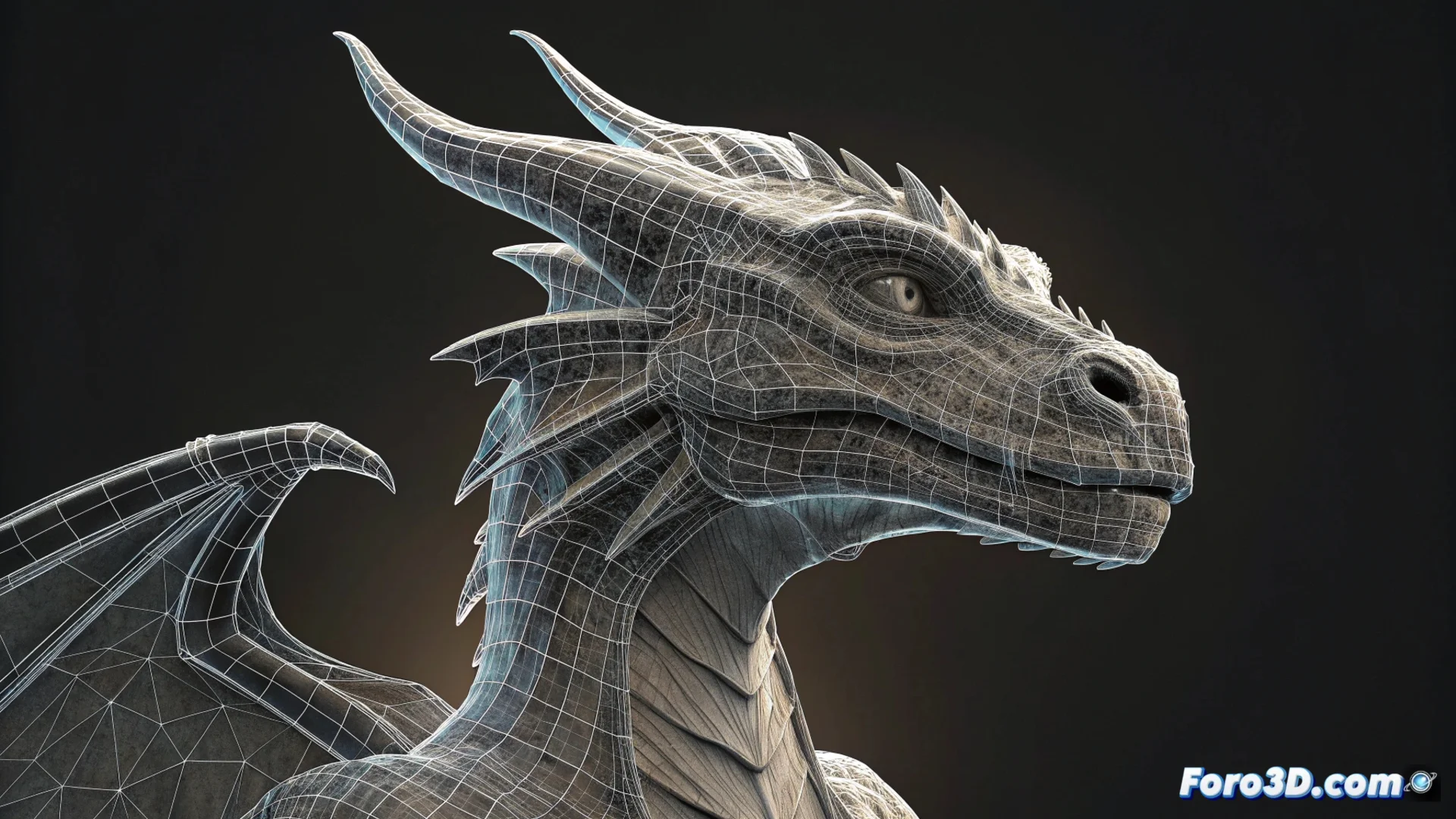
Conformal UV Mapping: Preserving Angles When Unwrapping 3D Geometry
In the 3D workflow, unfolding a mesh into a two-dimensional plane is a crucial step. Among existing methods, conformal UV mapping stands out for its precise mathematical goal: preserving angles of the original geometry during transformation. This creates a layout where faces intersect similarly in 2D and 3D, often sacrificing area uniformity to achieve it. It is the technical choice when the direction of a pattern or texture is more important than constant pixel size. 🧩
The Mathematics Behind Angle Preservation
The core of this technique is a optimization problem. Algorithms calculate UV coordinates for each vertex by minimizing an angular error metric, often called conformal energy. Methods like Least Squares Conformal Mapping (LSCM) are pillars in software like Blender or Maya. These systems solve large-scale linear equations to produce a transformation that is locally conformal, meaning it preserves angles in small regions. Processing complex meshes requires computational power, so artists often isolate shells or parts before applying the algorithm for better control. 🔢
Key Features of the Process:- Minimize angular distortion: The main goal is for angles between edges in 3D to be faithfully replicated in UV space.
- Accept area stretching: To preserve angles, the method allows triangles to expand or compress significantly.
- Based on holomorphic functions: The underlying mathematical theory comes from complex analysis and conformal mapping.
The dream of a UV plane that perfectly preserves both angles and areas is mathematically impossible for most surfaces, forcing a choice of which property to prioritize.
Where to Apply This Technique in Real Projects
This approach is particularly valuable for texturing organic assets like characters, creatures, or clothing. In these models, deformations during animation can make angular distortion from traditional mapping very evident and unsightly. It is also useful for architectural elements with many precise angular details, where lines must remain straight and corners sharp. However, the inherent area stretching can be a problem if constant texel density is needed for, say, a repetitive pattern. 🎨
Practical Workflows and Solutions:- Combine techniques: Conformal mapping is often used as a base, then packing is adjusted or area is redistributed in later steps to balance distortions.
- Isolate components: Unwrapping complex mesh parts separately (like a character's head or hands) allows cleaner, more controlled results.
- Prioritize based on texture: Ideal for hand-painted textures, directional brush strokes, or linear patterns where orientation is critical.
Balance Between Angle and Area
Conformal UV mapping represents a fundamental technical decision in the texturing pipeline. It offers exceptional fidelity for shape and direction at the cost of varying texel sizes. Understanding its mathematical principles and practical limitations, such as Gauss's theorem prohibiting a perfect mapping for a sphere, allows artists to make informed decisions. Integrating it intelligently with other unwrapping strategies is key to producing visually coherent and technically solid assets. ⚖️