Computed Tomography: Fundamentals and Applications
Computed tomography (CT) is an advanced medical imaging technique. It does not limit itself to capturing a single projection, but rather integrates a series of X-rays taken from various angles. A powerful computer system processes this data to construct precise cross-sectional slices of internal structures, revealing details that a conventional radiograph cannot show 🏥.
How Does the CT Equipment Capture Images?
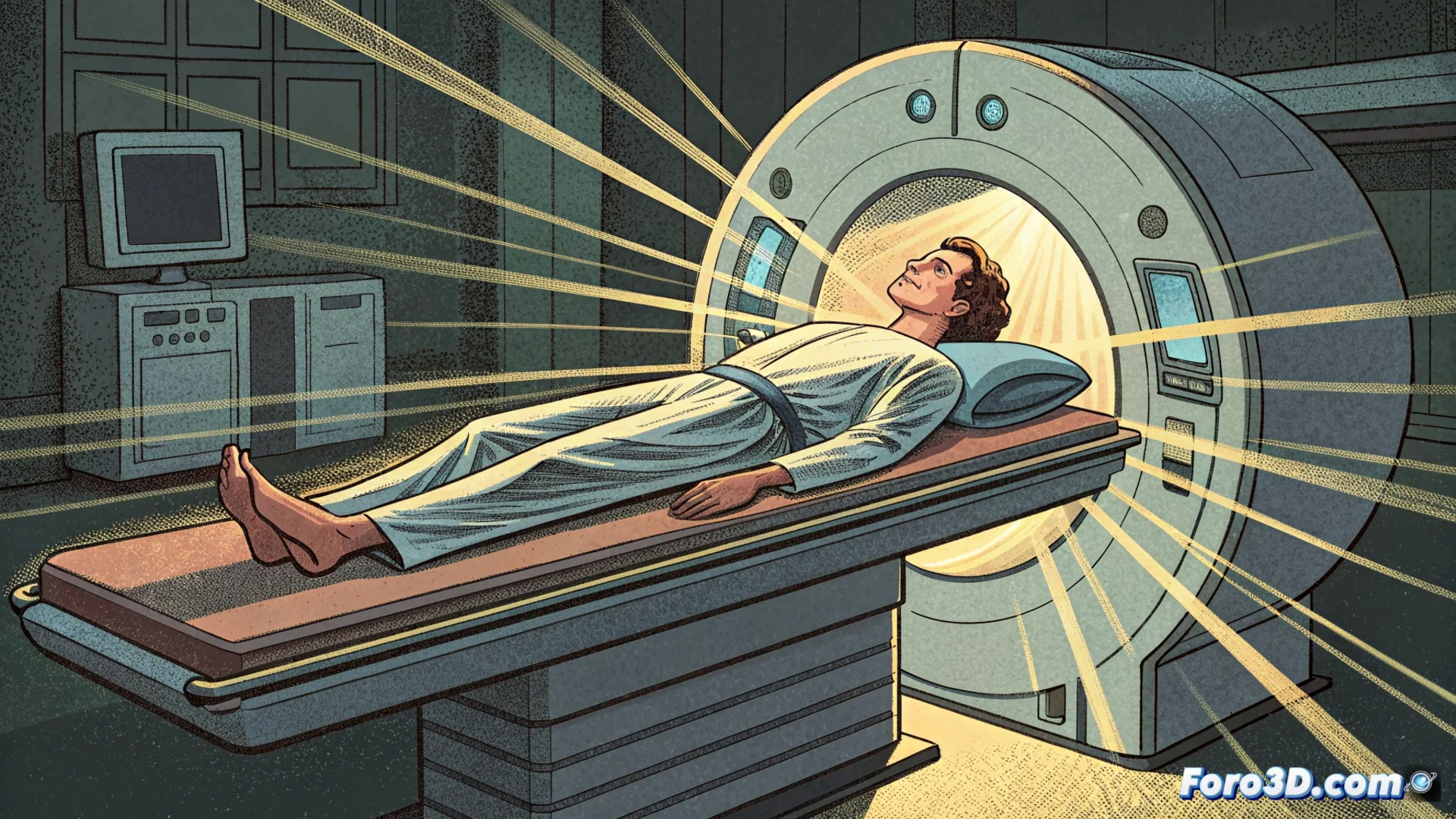
The process begins when the patient is placed on a table that is inserted into a large ring called the gantry. Inside it, an X-ray tube rotates at high speed around the body. This movement allows the emission of thin beams of radiation that pass through it. Specialized detectors on the opposite side record the amount of radiation not absorbed by the tissues. Subsequently, the computer applies complex mathematical algorithms to convert these measurements into a composite image, either in 2D or a 3D model.
Key Elements of the Procedure:- Motorized Table: Slides in a controlled manner to scan different areas of the body.
- Rotating X-ray Tube: Rotates inside the gantry to obtain the multiple necessary projections.
- Array of Detectors: Capture the X-ray attenuation data after passing through the body.
CT does not read minds; it reveals internal anatomy with great precision, facilitating an objective diagnosis.
Main Uses in Clinical Practice
Physicians request this study for multiple purposes. It is a fundamental tool for diagnosing diseases, planning surgical interventions with accuracy, and guiding interventional procedures such as punctures or biopsies. Its speed makes it indispensable in emergencies to evaluate trauma and possible internal injuries after accidents.
Specific Diagnostic Applications:- Oncology: To locate tumors, measure their size, and assess their extent.
- Neurology: To detect cerebral hemorrhages, clots, or cerebrovascular accidents.
- Traumatology: To visualize complex fractures, especially in bones like the spine or pelvis.
A Realistic View of the Technology
It is crucial to understand that this scanner has no supernatural capabilities. Its function is to show the physical structure of the body with exceptional detail. It provides a precise anatomical representation of organs, blood vessels, and bones, helping professionals make informed decisions to treat patients effectively 🔍.