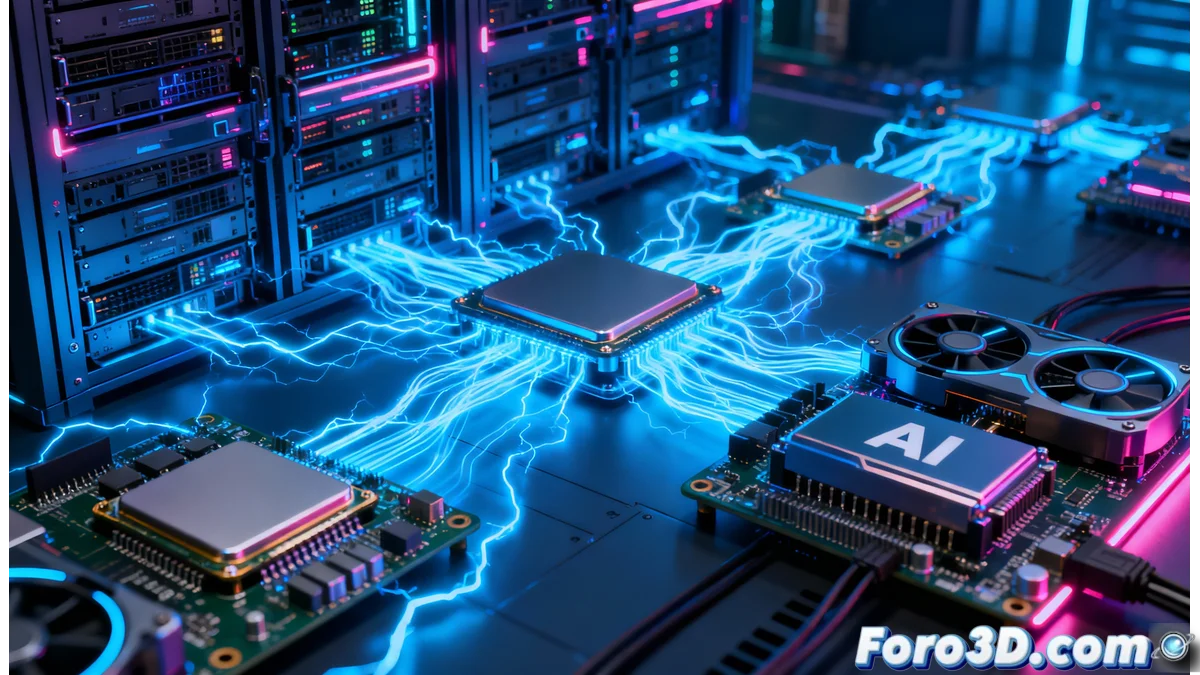
Compute Express Link: Revolutionizing Hardware Interconnection
Contemporary computational architectures face growing challenges in information transfer between diverse components. Compute Express Link emerges as an innovative response through an ultra-fast interconnection protocol that operates over the PCI Express infrastructure. This technology enables processors, graphics units, and specialized accelerators to share memory resources with maximum efficiency, overcoming traditional limitations and dramatically optimizing performance in demanding applications 🚀.
Multilayer Architecture of the CXL Standard
The protocol establishes three fundamental mechanisms that operate synergistically: CXL.io ensures full compatibility with standard PCIe devices, CXL.cache authorizes devices to access the host's memory while maintaining coherence, while CXL.memory empowers the processor to use the memory of connected devices. This layered structure enables coherent communication between different types of processors, preserving energy efficiency and minimizing latency in time-sensitive operations ⚡.
Fundamental Protocols:- CXL.io - Provides full interoperability with the existing PCIe ecosystem
- CXL.cache - Enables coherent access to the host's memory from connected devices
- CXL.memory - Allows the main processor to use memory from peripheral devices
The true revolution of CXL lies in its ability to create unified memory pools between different types of processors, eliminating traditional architectural barriers.
Applications in Heterogeneous Computing
In diversified processing environments such as modern data centers and artificial intelligence systems, CXL demonstrates its transformative potential by facilitating shared memory pooling between CPU, GPU, and specialized accelerators. This materializes in quantifiable improvements in processing machine learning models, advanced computational simulations, and big data analysis. The technology substantially reduces the need to duplicate information in separate memories, optimizing resource utilization and significantly reducing operational costs 💰.
Competitive Advantages:- Coherent shared memory between different processing architectures
- Drastic reduction in data replication across multiple memories
- Optimization of existing hardware resources without requiring massive replacements
Paradox of Technological Implementation
It is particularly interesting how a standard designed to radically simplify hardware interconnection requires such sophisticated specifications that demand specialized engineering teams for its correct implementation. This apparent contradiction underscores the inherent complexity of modern computational systems, where functional simplicity often emerges from intricately crafted technical implementations 🧩.