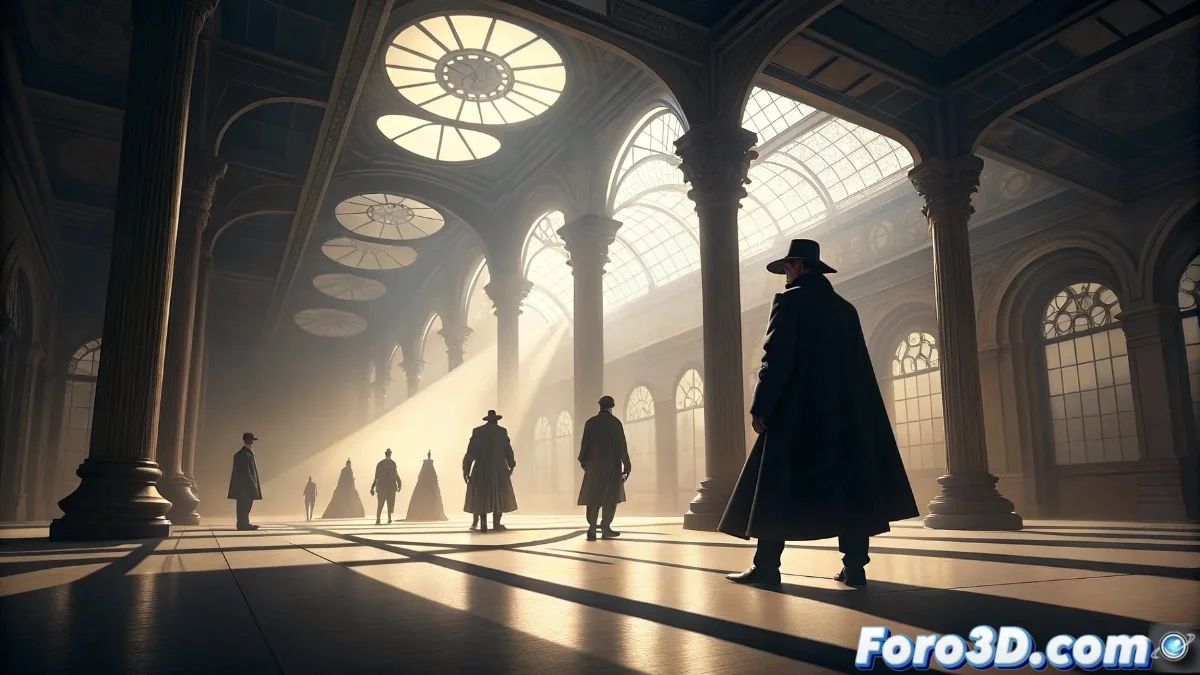
Composition from Shadow in Visual Media
The composition from shadow technique represents an innovative approach to inferring the spatial arrangement of visual elements through the exclusive analysis of their projected silhouettes. 🎭 This methodology gains special relevance in disciplines such as 3D animation, video game design, and cinematography, where the precise organization of components defines the entire visual narrative. By examining how light interacts with objects and characters, we can reconstruct their relative positions without visualizing them directly, generating scenes imbued with mystery and dimensional depth.
Fundamental Principles of Light Projection
To master this technique, it is crucial to understand the fundamentals of shadow projection. The direction, intensity, and quality of the light source directly determine the characteristics of the generated silhouettes. A directional light produces sharp shadows that precisely reveal the shape and orientation of the object, while a diffuse light creates blurry edges that imply distance and atmospheric ambiance. The angle of light incidence allows us to mentally triangulate the location of the emitting object, establishing coherent spatial relationships within the compositional scheme.
Key Aspects of Lighting:- The direction of light defines the orientation and length of projected shadows
- Light intensity affects the contrast and definition of the silhouette's edges
- The quality of light (hard or soft) determines the realism and atmosphere of the scene
Shadows are not simply the absence of light, but narrative elements that structure the visual space and guide the viewer's perception.
Implementation in Contemporary Visual Productions
In the cinematic realm and video game development, this technique is used to create high emotional impact sequences. Filmmakers like Alfred Hitchcock masterfully employed shadows to imply presences without physically showing the characters, generating psychological tension in the audience. In modern game engines, global illumination systems calculate shadow behavior in real-time based on the position of each element, allowing designers to place objects so that their projected silhouettes direct the player's attention or reveal significant contextual information. The shadow transcends its basic optical function to become an active compositional element that structures the entire scene.
Practical Applications in Different Media:- In film: creation of suspense and mystery atmospheres through suggestive silhouettes
- In video games: visual guidance of the player through directional shadows
- In 3D animation: establishment of spatial relationships between characters and settings
Technical Considerations and Common Challenges
Naturally, this methodology presents specific peculiarities when implemented in real projects. It is common to discover, after hours of adjusting an element's position based on its shadow, that one has been working with the directional light oriented opposite to what was planned. Composition from shadow can be as revealing as it is deceptive when we do not consistently verify our reference points and lighting configurations. This technique demands a deep understanding of optical principles and meticulous attention to detail throughout the creative process. 🔦