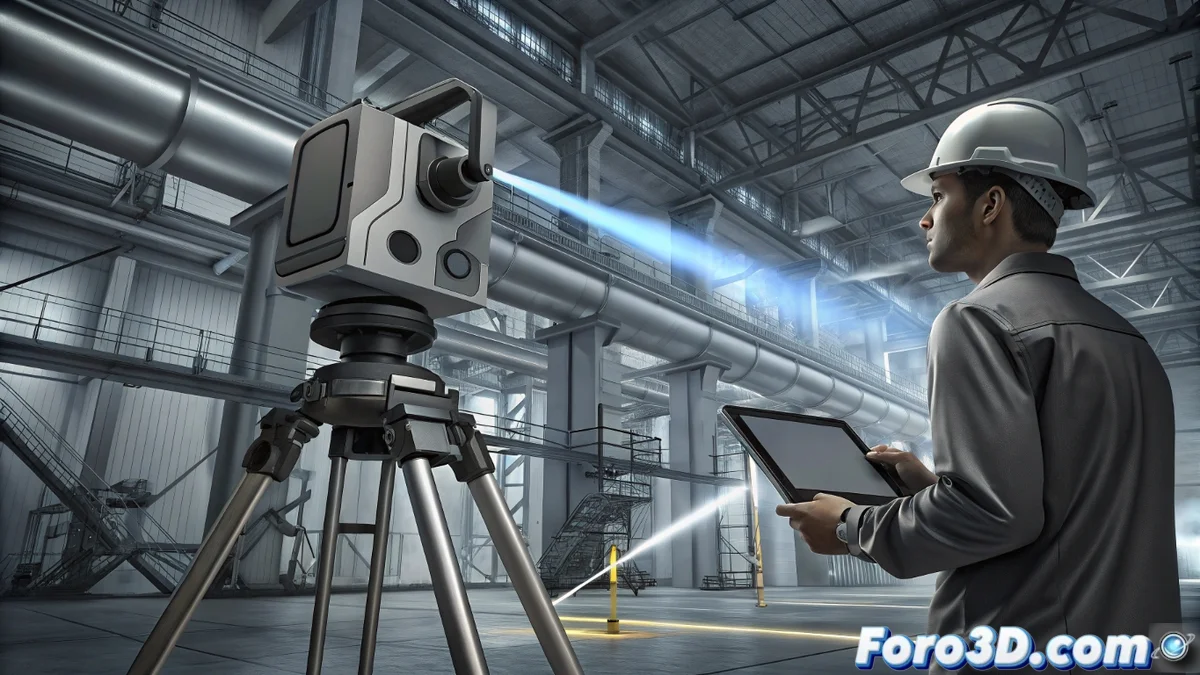
Components and Operation of the FARO Scene 3D Scanner Hardware
The FARO 3D capture system is based on a set of specialized hardware that digitizes environments and objects with great accuracy. This equipment, which goes beyond the main measuring device, requires integration with FARO Scene software to produce useful three-dimensional models. 🛠️
Key Elements of the Scanning System
The heart of the system is the laser scanner, which can be an articulated arm or a total station. This device projects a beam that measures distances and angles, generating a dense point cloud of the scanned geometry. For the process to be effective, the hardware includes essential auxiliary components.
Fundamental Accessories for Registration:- Reference Spheres and Targets: Serve as common control points to automatically align scans from different positions.
- Leveling Plates: Ensure the correct orientation and stability of the scanner during capture.
- Rugged Laptop: Runs FARO Scene software to monitor capture in real time and manage data.
The millimeter precision of the system allows capturing millions of points per second, streamlining the workflow in complex projects.
Data Capture and Registration Process
The operator places the scanner in multiple locations around the target area. At each point, the device rotates and measures autonomously, recording everything its sensor can detect. The spheres placed in the scene are crucial for subsequent registration.
Main Phases of Fieldwork:- Place Targets: Spheres or targets are distributed in the scene to be visible from multiple scanner positions.
- Perform Multiple Scans: Point clouds are captured from different angles to cover the entire area of interest.
- Monitor in Real Time: From the laptop, capture quality is verified and next positions are planned.
Software Integration and Final Result
Subsequently, FARO Scene software processes all captures. It uses common control points to join the point clouds into a single coherent 3D model, correcting position discrepancies. The result is a precise digital representation ready for export to CAD or BIM programs. The paradox of the process is often that keeping accessories clean, like dusting the spheres, can take as much time as scanning a historical monument. 📐