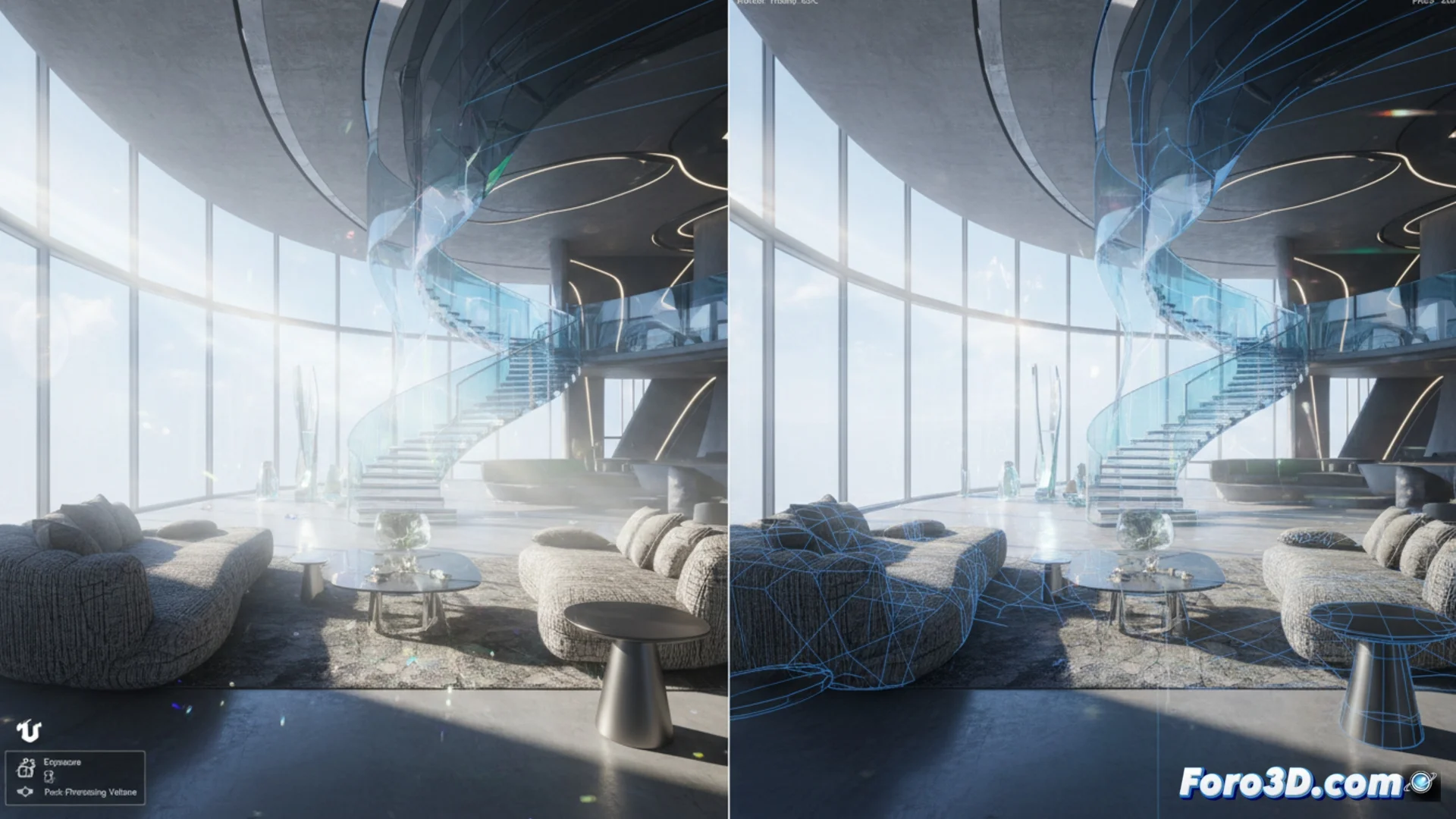
Comparing Render Engines: Cycles vs Unreal Engine in Complex Projects
When working with detailed digital environments, choosing the right render engine is crucial. Cycles and Unreal Engine embody opposing philosophies: one seeks absolute physical precision, and the other, fluid and instant responsiveness. Understanding their fundamental differences helps select the ideal tool for each project. 🎯
Divergent Technical Approaches: Physical Precision versus Interactive Speed
Cycles operates as a pure ray tracing engine. It calculates how light behaves in reality, simulating each photon to generate images of the highest fidelity. This process is extremely demanding on the processor and graphics card, making it so that creating a single frame can take hours. On the other hand, Unreal Engine is built to be fast. It combines rasterization techniques with some ray tracing and leverages precomputed lighting systems. This allows it to display complex scenes interactively, which is essential for video games or real-time experiences. ⚡
Key Differences in Handling Complexity:- Cycles: Manages thousands of polygons in great detail, complex materials like frosted glass or polished metal, and dense volumetric effects like fog or smoke.
- Unreal Engine: To maintain a high frame rate, it simplifies certain real-time calculations. Its strength is managing vast worlds and effects that change instantly, like dynamic lights or particles.
- Final Quality: With meticulous asset preparation and good optimization, Unreal's results can approach offline rendering, but the path to achieve it is different.
The final decision is often clear: do you prefer waiting hours for a perfect image or need seconds for a convincing preview you can explore?
Workflows and Hardware Demands
The way of working with each engine also contrasts. Cycles is integrated within Blender, offering a unified environment for modeling, texturing, and rendering. It is an all-in-one solution that, for rendering, demands a lot of RAM memory and raw computing power. In contrast, Unreal Engine primarily acts as a final assembler. Artists produce models and textures in external software (like Blender, Maya, or Substance) and then import them into Unreal to assemble the scene, adjust lighting, and optimize the entire set. 🛠️
How They Manage System Resources:- Cycles: Uses all available resources (CPU and GPU) to calculate the image with the greatest possible precision, without prioritizing real-time fluidity.
- Unreal Engine: Manages video memory (VRAM) and other resources very aggressively. Its goal is to ensure stable performance, even on systems with less powerful hardware, sacrificing some details if necessary.
- Integration: Cycles allows a more closed creation cycle within Blender. Unreal requires a more fragmented but specialized pipeline.
Conclusion: Choose According to the Project's Needs
There is no universally superior engine. The choice between Cycles and Unreal Engine is defined by the project's main objective. If you seek the highest physical realism for a static image or cinematic animation, and render time is not a limit, Cycles is the ideal option. If, on the other hand, you need to interact with the scene, create virtual tours, or develop immersive experiences where response speed is paramount, Unreal Engine is the tool designed for that. Understanding this dichotomy between visual fidelity and interactive speed is the first step to making the right decision. 🤔