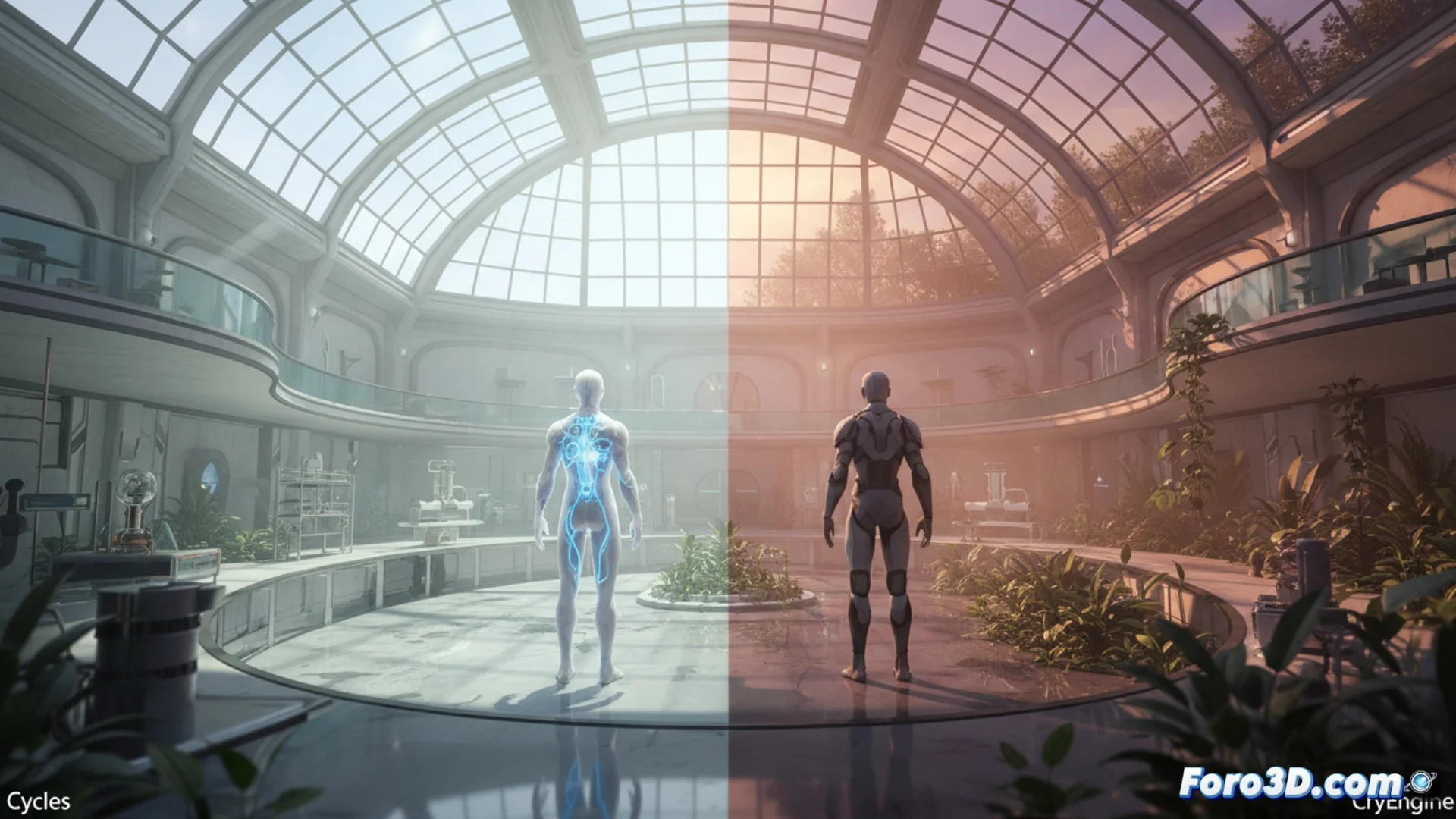
Compare Rendering Engines: Cycles vs CryEngine
In the world of digital creation, choosing the right rendering engine defines the final result. Two powerful options, but with opposing philosophies, are Cycles and CryEngine. One prioritizes physical accuracy, the other interactive speed. Understanding their differences is key for any project 🎨.
Cycles: physical accuracy and artistic control
Cycles operates within Blender as a ray tracing-based engine. Its native integration allows modifying materials, lights, and geometry while viewing a progressive preview. To handle scenes with a lot of geometry, the user must optimize actively, adjusting the number of samples or using acceleration hardware. Its strength is the realism it achieves in global illumination and textures.
Main features of Cycles:- Renders with ray tracing to achieve advanced physical realism.
- Integrates fully into Blender's workflow, allowing real-time adjustments.
- Requires the artist to optimize the scene and configure parameters for very complex scenes.
Cycles sacrifices execution speed to achieve unbeatable lighting and material quality.
CryEngine: real-time speed for interactivity
CryEngine was built to generate real-time graphics, focused on video games and interactive experiences. Its architecture seeks high performance while maintaining visual fidelity in large scenes. It employs techniques like aggressive levels of detail, screen-space occlusion, and an optimized shading pipeline. Its global illumination uses approximate methods, trading some accuracy for speed ⚡.
Main features of CryEngine:- Designed to render in real-time at high frame rates.
- Implements automatic optimization techniques like aggressive LOD to handle extensive worlds.
- Simulates global illumination with approximate methods that prioritize interactivity.
How to choose between them?
The choice is not universal and totally depends on the final objective of the project. Cycles is the usual option for producing still images or animations where render time is not the main limitation and maximum physical realism is sought. On the other hand, CryEngine is chosen when the project needs the scene to render interactively at high speed, such as in video game development or real-time architectural visualizations 🎯.
While an artist in Cycles may wait hours to see a final frame, a developer in CryEngine needs to generate that same frame in milliseconds. This fundamental difference sometimes means that distant elements, like trees, are drastically simplified to maintain performance. Each engine addresses the challenge of complexity with a different philosophy: physical accuracy vs execution speed.