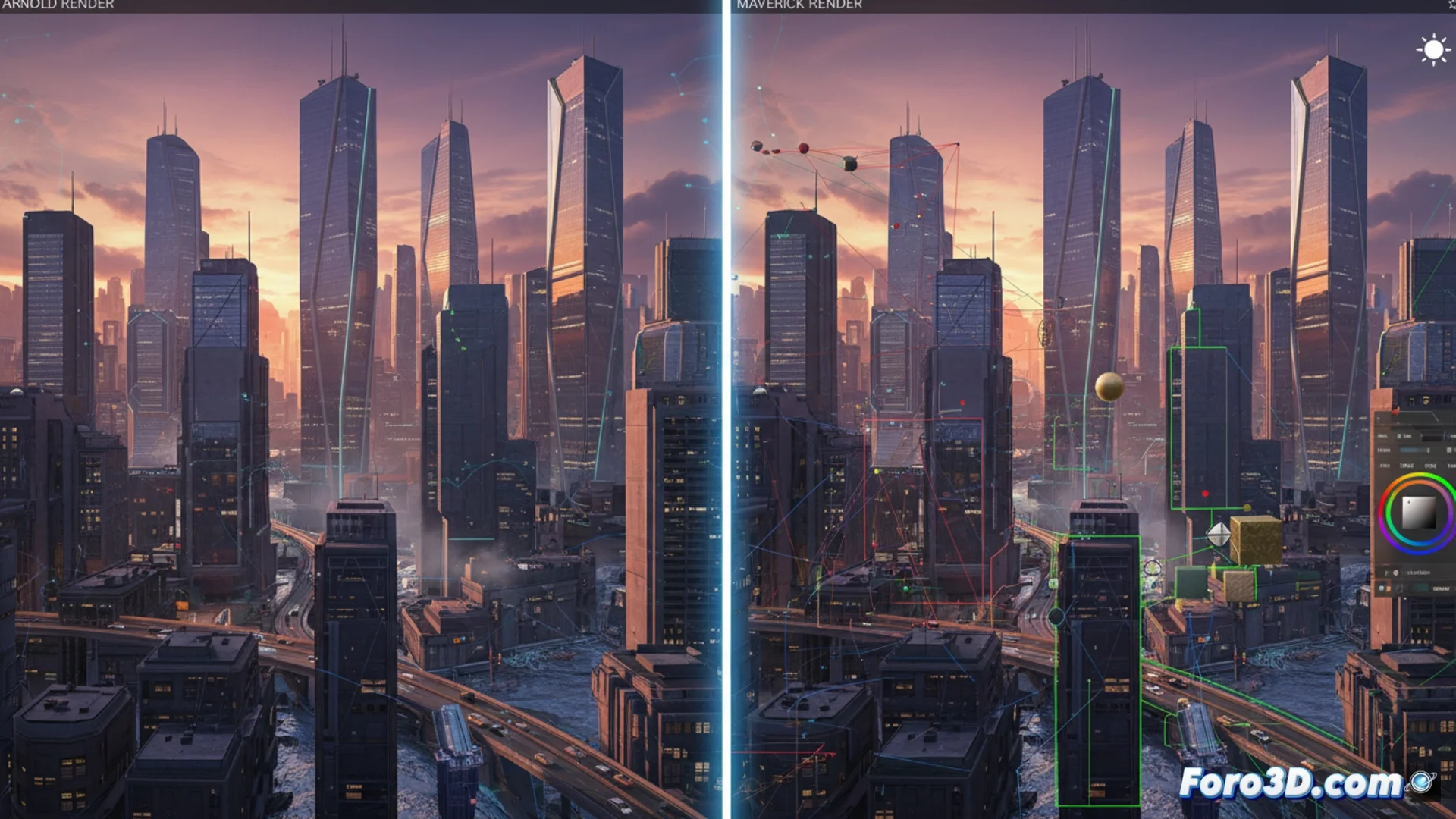
Comparing Arnold Render and Maverick Render: two rendering philosophies
In the world of computer graphics, choosing a rendering engine is key. Arnold Render and Maverick Render represent two different paths for creating final images. While one is based on rigorously simulating light physically, the other seeks agility and immediate interaction. Understanding their differences helps select the right tool for each project. 🎨
Opposing rendering architectures
The technical base of each engine defines its behavior. Arnold Render works as a pure ray tracing engine, integrated into software like Maya or Houdini. This method seeks to replicate exactly how light behaves, making it very predictable and solid when handling very dense geometries or extensive volumetric effects. For its part, Maverick Render employs a hybrid architecture that mixes ray tracing with rasterization. This combination allows it to interact with heavy scenes directly in its viewport, enabling adjustments to lights and seeing changes instantly.
Main differences in workflow:- Arnold: Offers a very comprehensive node system for building materials, but calculating noise-free images can take longer in highly complex scenes.
- Maverick: Facilitates a fast iterative process; its real-time preview accelerates decisions on lighting and textures before launching the final render.
- Choice: Depends on whether the project needs extreme physical fidelity or the ability to iterate quickly.
An artist can spend many hours optimizing a scene to render quickly, only for a client to then request changing the color of a curtain and alter all previous calculations.
Approach to lighting and building materials
The way light and surfaces are handled is another point of divergence. Arnold approaches lighting from a physical point of view, generating notable realism but requiring the artist to configure the scene carefully to control noise and processing times. Its standard shaders are powerful for simulating complex surfaces. Maverick, on the other hand, proposes a more interactive workflow; its real-time engine shows immediate modifications, even when using complex displacements or many objects. Its library of materials and lights is optimized for quick response, although the final result may require touch-ups to match Arnold's physical precision in some situations. 💡
Handling heavy scenes and performance
When working with millions of polygons, each engine's performance varies. Arnold distributes memory load efficiently, but the time to process each frame can be high. Maverick handles large volumes of geometry more agilely in the preview phase, using techniques like automatic level of detail adjustment. For the final render, both can use multiple GPUs, but Maverick was designed from the start to leverage modern graphics hardware, while Arnold has progressively added this support.
Key aspects in performance:- Memory and geometry: Arnold manages it well, but with high calculation times. Maverick is more agile in preview.
- GPU acceleration: Maverick is more natively oriented to use GPUs, Arnold has integrated it over time.
- Priority: The final decision usually comes down to valuing whether fast iteration or absolute physical precision is more important.
Conclusion: choose according to project needs
In the end, Arnold Render and Maverick Render are valid tools for different contexts. Arnold excels when the goal is to achieve impeccable physical realism and time can be invested in calculating. Maverick shines in environments where ideas need to be tested quickly, parameters adjusted on the fly, and interactive response maintained even with complex scenes. The choice is not which is better overall, but which best fits the workflow, deadlines, and specific visual requirements of each production. 🤔