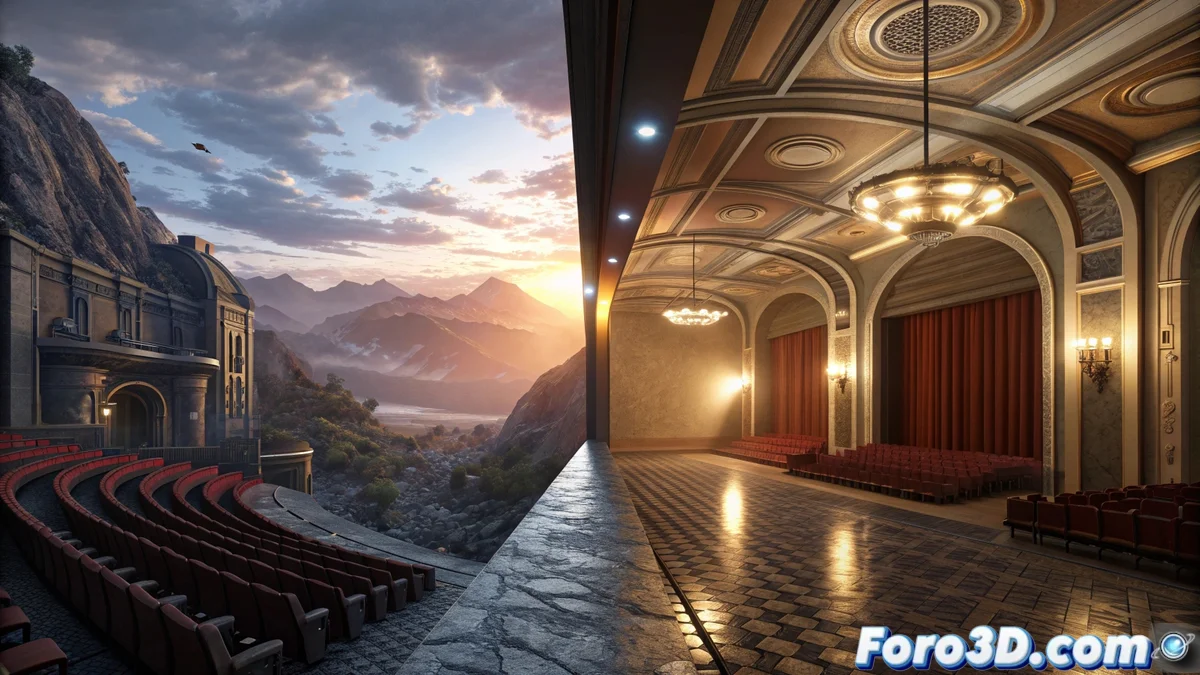
Comparing Lighting in Cinema 4D with Redshift and Unreal Engine with Lumen
Creating convincing digital images largely depends on how light is simulated. Two contemporary technologies lead this field with distinct approaches: the Redshift render engine within Cinema 4D and the Lumen system integrated into Unreal Engine. Both calculate how light bounces and affects materials, but their fundamental goals make a crucial difference for artists and developers. 🎨
Redshift in Cinema 4D: Precision and Control for the Final Result
Redshift operates as a hybrid production render engine. It combines ray tracing with rasterization to achieve meticulous control over every aspect of lighting. Its philosophy focuses on delivering maximum physically-based image quality, making it ideal for film, VFX, or still images where detail is paramount. The artist adjusts parameters, defines samples, and then processes the frame—a method that is not interactive but grants total authority over the result.
Main Features of Redshift:- Offers absolute control over light, material, and render parameters.
- Processes global illumination, reflections, and refractions with high physical fidelity.
- Its workflow is iterative, based on setting up and waiting for rendering.
Redshift prioritizes control and final quality, ideal for productions where render time is secondary to precision.
Lumen in Unreal Engine: Instant Iteration for Dynamic Environments
Lumen is Unreal Engine 5's dynamic global illumination system. Its main advantage is immediacy. Any change in a light source (position, color, intensity) is reflected instantly in the editor view, without needing to process. This greatly accelerates the process of testing ideas and adjusting the visual environment. It uses software and hardware ray tracing to simulate bouncing light, enabling complex scenes that update in real time, a fundamental requirement for video games and interactive experiences.
Main Features of Lumen:- Provides immediate visual feedback in the editor.
- Allows very rapid iteration and experimentation with lighting.
- Designed to maintain high performance in interactive applications.
Choosing Between Control or Speed: A Complementary Approach
The decision between using Redshift or Lumen often comes down to a practical question: do you need perfect control over every frame, even if it means waiting, or do you require seeing changes instantly to make quick decisions? In practice, these technologies are not mutually exclusive. Many studios implement a hybrid workflow: they use Unreal Engine with Lumen for previsualization, prototyping, and creating interactive experiences, and then employ Cinema 4D with Redshift to produce final high-quality renders for linear media. This synergy shows that understanding the strengths of each system is key to optimizing any visual creation pipeline. 💡