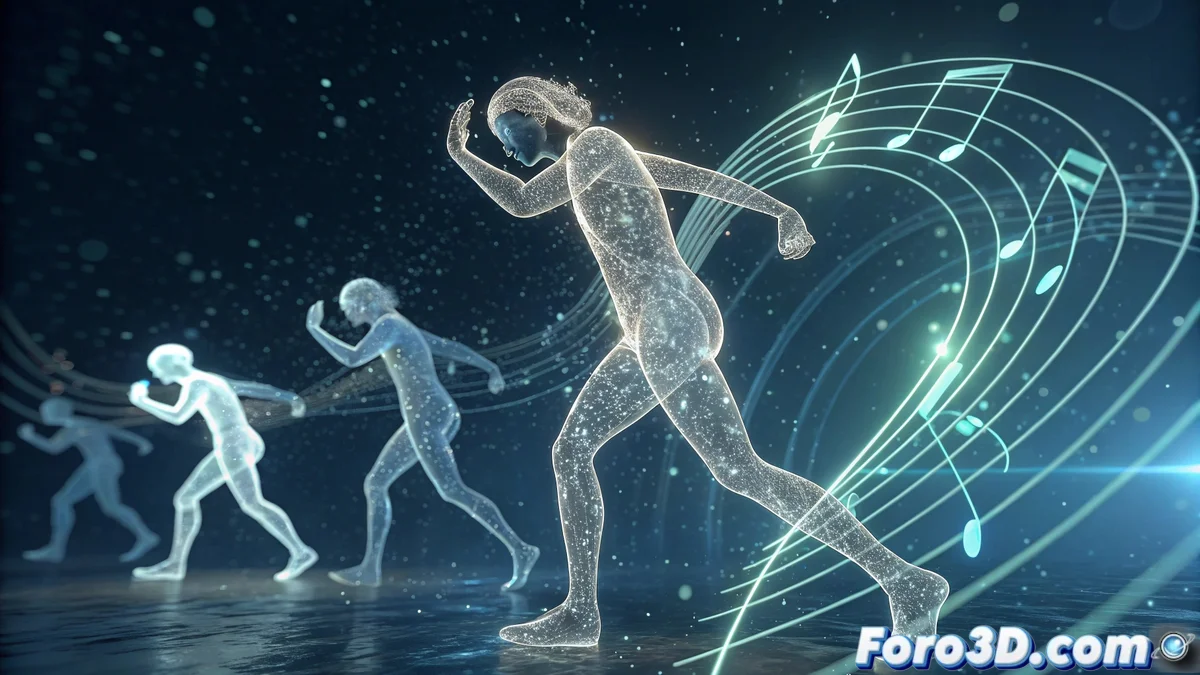
Choreography and Music as the Soul of 3D Animation
Three-dimensional animation reaches its true essence when it transcends purely technical aspects and embraces concepts of choreography and music. These elements not only organize movement in time but also inject unique personality and deep emotions into every animated action. Contemporary creators act as visual orchestra conductors, harmonizing internal and external rhythms to produce sequences that seem to breathe with authenticity. This fusion turns mechanical animations into unforgettable kinetic experiences, where time emerges as another protagonist within the visual narrative 🎭.
Choreographic Fundamentals in Digital Movement
Choreography provides a complete language for understanding how movements intertwine in space-time. In the realm of 3D animation, this manifests in the creation of defined silhouettes, believable anticipations, and smooth transitions that guide the viewer's attention. Virtual characters gain visual weight and stage presence when their actions replicate principles of muscle tension and relaxation, comparable to the techniques of a professional dancer. The overlap of movements and follow-through find their ideal equivalent in how a choreographer designs sequences that flow naturally, generating the illusion of organic life through mathematical algorithms.
Key Aspects of Digital Choreography:- Design of clear silhouettes that communicate intention and emotion
- Convincing anticipations that prepare the viewer for important actions
- Fluid transitions that maintain continuity and guide the gaze
The true magic happens when mathematical algorithms breathe to the beat of choreographic principles, creating the illusion of life where only code exists.
Musical Rhythm as Emotional Structure
Music establishes the temporal framework upon which emotions in motion are built. By analyzing a musical composition, the animator identifies main beats, syncopations, and harmonic progressions, which they then transform into patterns of action. A character can accelerate its tempo during musical crescendos or execute slow, deliberate movements in pianissimo passages. The lip and body synchronization with the soundtrack establishes a multisensory cohesion that deepens audience immersion. Tools like the animation curve editor become equivalents of musical instruments, where each keyframe represents a note within the visual score.
Musical Elements Applied to Animation:- Identification of main beats and syncopations to structure timing
- Translation of harmonic progressions to emotional arcs in movement
- Precise synchronization between visual action and sonic elements
The Paradox of the Digital Creator
The humorous challenge arises when you try to convey grace and elegance to your digital creations while you yourself struggle with equipment cables or your posture in the office chair. The irony of designing fluid choreographies from a desk never fails to add a touch of humor to the creative process, reminding us that behind every perfect movement there is an artist with their own earthly quirks 😄.