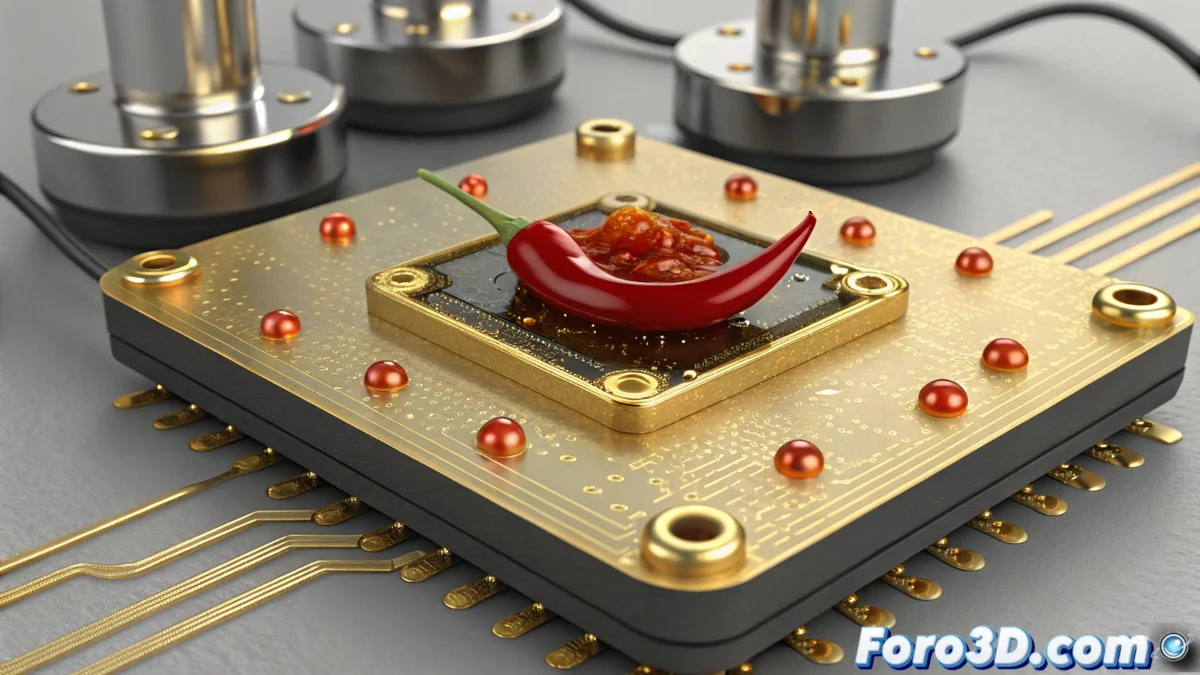
Chinese Scientists Develop Artificial Tongue to Measure Spiciness
A research team in China has presented an innovative system that accurately evaluates how spicy a food is. This device, known as an artificial tongue, identifies and measures capsaicin, the substance that causes the burning sensation in chiles and other products. The technology uses bioinspired sensors that replicate how human taste buds perceive this chemical compound. Its goal is to provide objective and repeatable data, something that tasting panels do not always achieve due to their subjectivity and fatigue. 🔬
Operation of the Biomimetic System
The artificial tongue is not an organ, but an analysis platform. It integrates a series of electrochemical sensors that have special materials mimicking taste cell membranes. When a food sample is placed in contact with these sensors, capsaicin adheres and generates a specific electrical signal. An algorithm interprets this signal and converts it into a value on the Scoville scale, the universal standard for quantifying spiciness. This procedure only takes a few minutes and can process many samples in a row without losing sensitivity.
Key Features of the Device:- Uses a matrix of sensors coated with materials that simulate taste buds.
- Automatically translates the electrochemical signal into a Scoville scale score.
- Provides results in minutes and maintains accuracy in consecutive analyses.
The biggest challenge for this invention may not be technical, but convincing spice enthusiasts to trust a chip more than the direct experience of tasting a habanero.
Applications Beyond the Food Industry
Although its most obvious use is in the food sector to control the quality and uniformity of sauces, condiments, and processed products, its creators see greater potential. In the field of pharmacology, it could be used to examine medications that include capsaicin for pain relief. In food safety, it would help identify adulterations or cross-contaminations in production lines for foods. The team is also researching how to adapt this technology to detect other compounds, such as bitter or astringent ones, which would significantly expand its utility.
Potential Areas of Use:- Quality control in the production of spicy foods and condiments.
- Analysis of topical drugs that use capsaicin as an active ingredient.
- Detection of contaminants or undeclared ingredients in industrial processes.
Impact and Future Prospects
This technology represents an advance toward total objectivity in food sensory evaluation. By offering a quantifiable and reproducible measure, it can standardize how companies classify the spiciness of their products. Future development could focus on making the device more accessible and exploring its capacity to detect other flavors. The debate on whether it will replace or complement the human taster remains open, but its precision is undeniable. 🚀