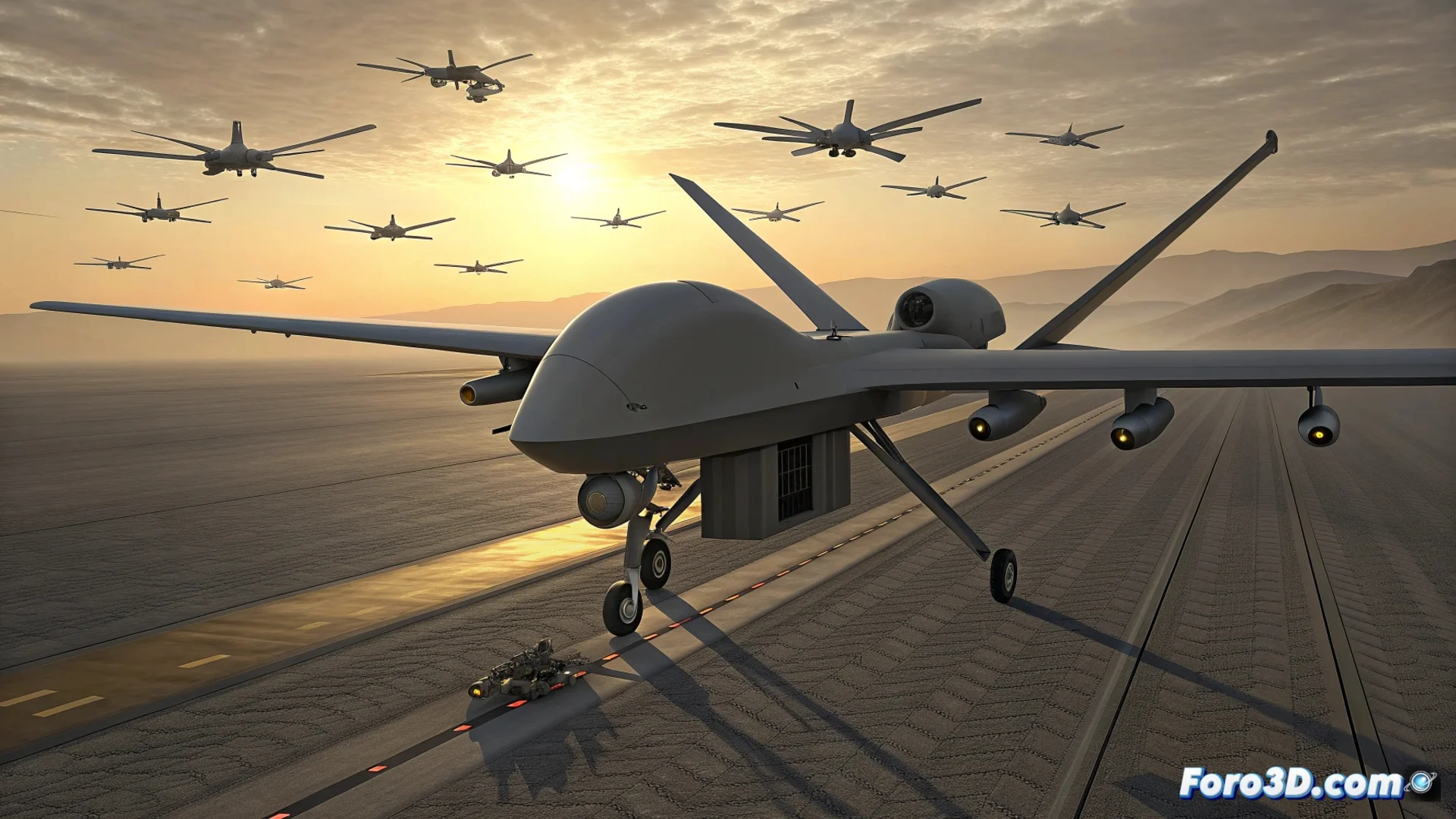
China Successfully Tests Its First Drone Carrier Jiu Tian
The Chinese aerospace program reached a new milestone by conducting the first flight of its Jiu Tian system, an unmanned aerial vehicle that functions as a mothership platform for other drones. This test confirms rapid progress in autonomous aerial swarm technologies 🚁.
An Operational Aerial Nest
The Jiu Tian concept is based on operating as a mobile air base. Its internal design allows storing multiple drones of different configurations and releasing them in mid-flight to execute synchronized missions. This significantly extends the range and tactical versatility of the swarms.
Key features of the system:- Transports and deploys smaller drones in mid-flight.
- Extends operational range by bringing drones close to the target.
- Allows coordinating complex missions with multiple vehicles.
This type of system is being researched in several countries for surveillance, reconnaissance, and possibly attack operations.
Context and Strategic Applications
The development of Jiu Tian responds to a global trend to explore automated aerial capabilities. China seeks to position itself at the forefront of this technology, although precise technical details such as its total autonomy or exact transport capacity have not been officially revealed.
Possible future uses:- Long-duration surveillance and reconnaissance missions.
- Coordinated swarm operations for various purposes.
- Aerial logistics and support for other unmanned systems.
The Future of Drone Logistics
An innovative aspect suggested by this project is the possibility that the mothership drone not only transports but also recharges or recovers smaller drones. This could solve the problem of limited autonomy, allowing drones to land on the mother platform to recharge batteries during the mission, instead of having to return to a ground base 🔋.