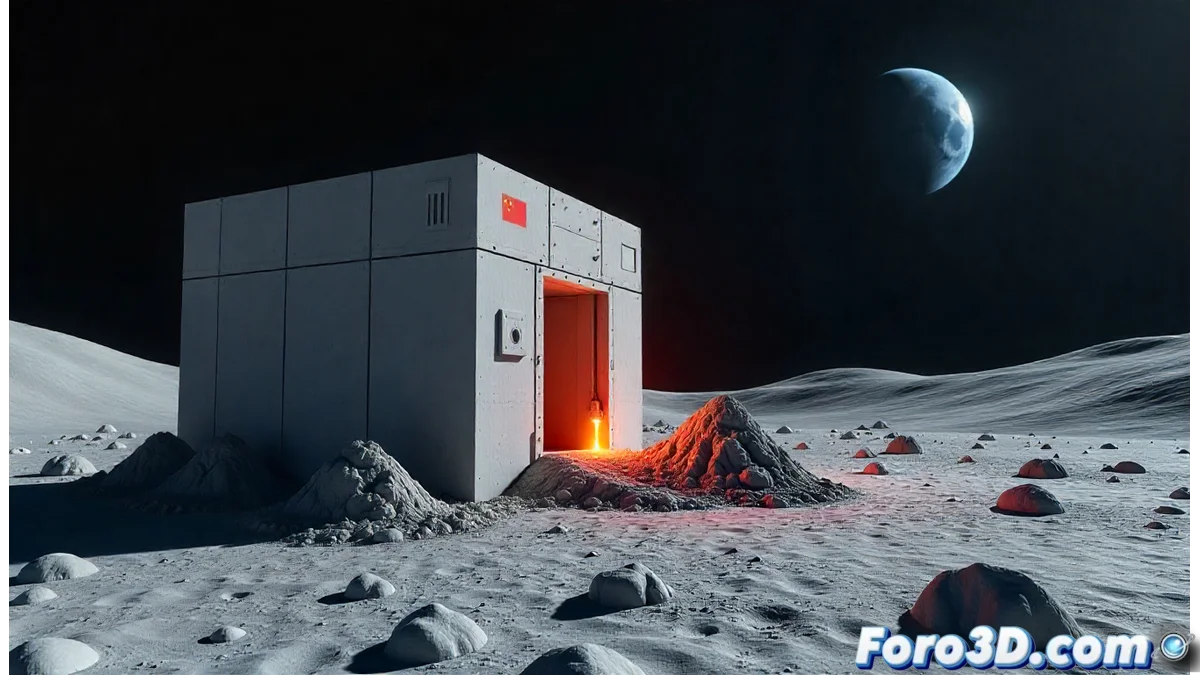
A team of Chinese scientists has achieved what until recently seemed like science fiction: developing a prototype 3D printer capable of using real lunar regolith to build structures. This breakthrough could solve one of the biggest challenges for establishing permanent bases on our natural satellite. 🌕
The technology allows for the manufacturing of construction components directly on the lunar surface using the dust that covers the terrain, eliminating the need to transport massive construction materials from Earth. What once required costly shipments could now be done in situ using local resources.
Building on the Moon with what the Moon itself provides
The Technical Challenge of Lunar Regolith
Regolith is not a conventional construction material. Its extremely sharp particles and the absence of a lunar atmosphere present unique challenges that the Chinese team has had to overcome through specific innovations in the printing process.
Crucial technical adaptations:
- Hermetic feeding system to prevent contamination
- Reinforced nozzles resistant to abrasion
- Optimized laser sintering process
- Temperature control for extreme lunar conditions
Manufacturing Process in a Lunar Environment
The printer uses a selective laser sintering technique that fuses the regolith particles without the need to add additional materials. The process creates solid structures capable of withstanding the extreme conditions of the lunar environment, including solar radiation and variable temperatures.
Advantages of in-situ manufacturing:
- 90% reduction in launch mass
- Capacity for continuous repair and expansion
- Adaptation to specific local conditions
- Long-term sustainability
Implications for Space Exploration
This development not only benefits China but accelerates the plans of all space agencies interested in lunar exploration. The ability to build using local resources is the holy grail for any permanent extraterrestrial settlement.
And so, while some print figurines and prototypes on Earth, Chinese scientists demonstrate that the same technology could one day build the foundations of the first city outside our planet. The beautiful paradox that the dust beneath our feet could be the key to reaching further into the cosmos. 🚀