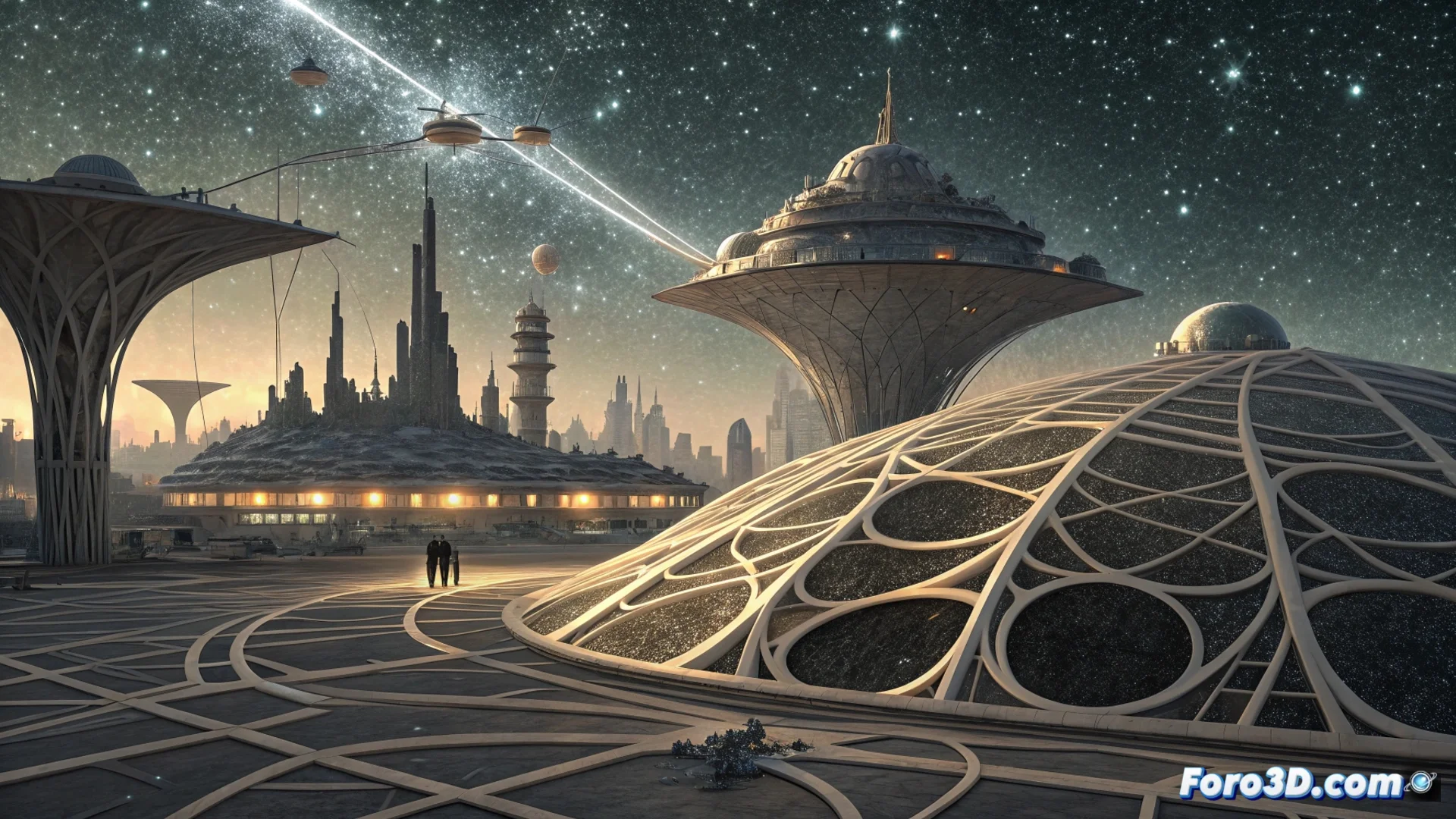
Children of Time: an evolutionary clash between humans and arachnids
In Children of Time, Adrian Tchaikovsky weaves a narrative where the destinies of two species collide. The last remnants of humanity, confined to a generational ship, desperately seek a new world. What they find is a planet altered by an experiment gone wrong, where a virus intended for primates ended up catalyzing intelligence in spiders. 🕷️
The rise of a radically alien civilization
The work stands out for building an alien society from its biological foundations. The arachnid civilization does not think or communicate like us; their world is based on touch, vibrations, and a psychology that rejects anthropomorphism. Tchaikovsky details how these beings develop technology, organize their community, and advance their science, offering an internal perspective that spans centuries of their history.
Pillars of arachnid society:- Tactile communication: Their language and information exchange depend on perceiving vibrations and physical contacts.
- Organic technology: They develop tools and structures that emerge from their own biology and environment.
- Complex social structure: They organize their civilization around roles and a hierarchy that reflects their colonial nature.
Perhaps after reading it, looking at a spider web in the corner of the room will never be the same.
Two evolutionary paths on a collision course
The plot follows a dual narrative arc: the slow decay of humans in space and the dizzying progress of spiders on the planet. This is not a story of friendly "first contact," but an existential dispute for a single home. The convergence is inevitable, posing a conflict where communication, or the impossibility of it, acts as a fundamental barrier.
Central themes of the work:- Inheritance and adaptation: It examines how species inherit and modify knowledge to survive.
- Fear of the different: It analyzes how fear and misunderstanding can define the fate of entire civilizations.
- Survival vs. right: It questions which species can claim a world and under what premises of superiority.
A reflection on intelligence and home
Children of Time transcends simple conflict to offer a profound reflection on evolution and the nature of civilization. It balances epic scale with personal moments from its characters, human and non-human, while forcing us to reconsider our place in the universe. The work demonstrates that intelligence can flourish in unimaginable forms, and that the right to a home is the oldest conflict of all. 🌌