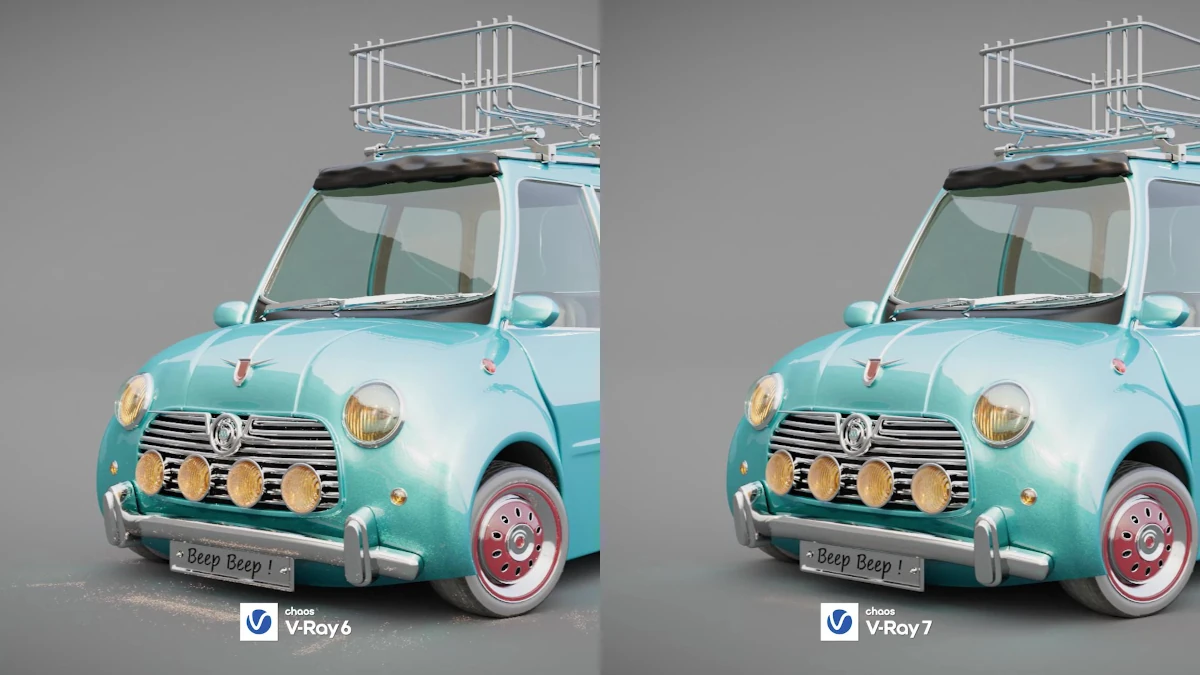
Chaos has released V-Ray 7 for Cinema 4D, the new major version of its production rendering engine. This update brings significant improvements such as support for rendering 3D Gaussian Splats, native compatibility with OpenPBR, and optimizations in V-Ray GPU, the V-Ray Frame Buffer, and Chaos Scatter. With this, Cinema 4D becomes the third DCC application to receive V-Ray 7 integration, following the versions for 3ds Max and SketchUp released last year.
Support for 3D Gaussian Splats
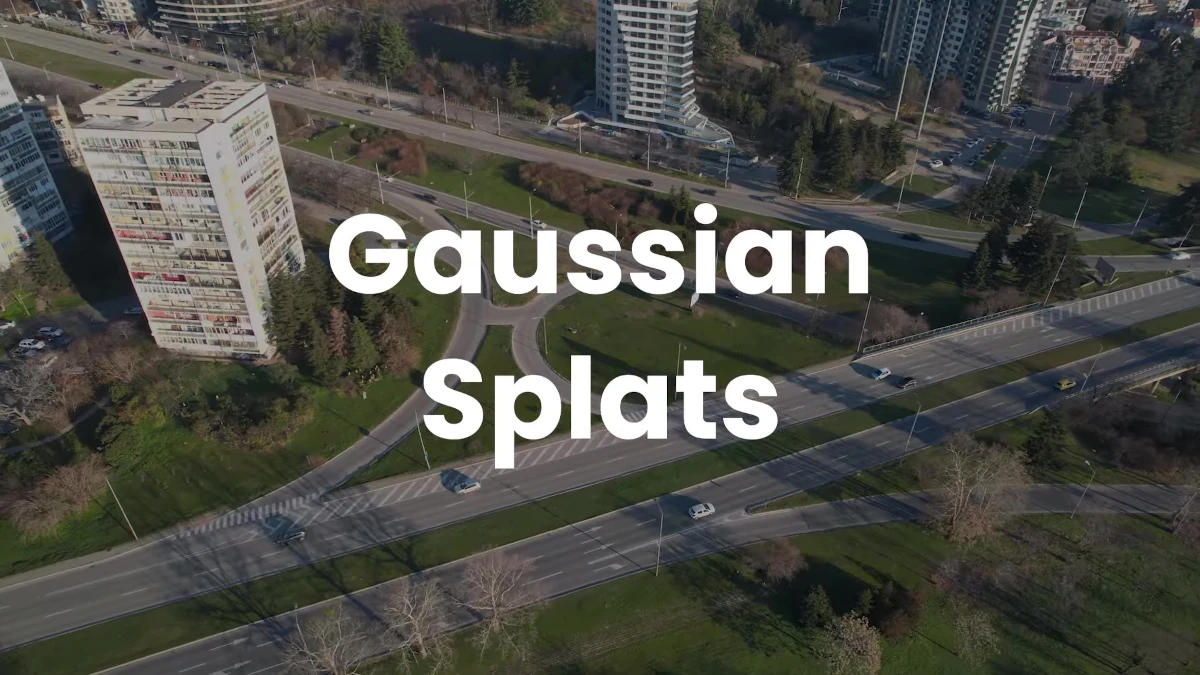
Among the new features, support for 3D Gaussian Splats stands out, an innovative 3D scanning method that allows high-quality reconstructions of real-world objects or scenes from photos or videos. Although there are free third-party plugins to render 3DGS data in Blender, Unity, and Unreal Engine, V-Ray is one of the first CG applications to support this technology natively. This functionality is aimed at both architectural visualization and visual effects studios, being an excellent option for creating detailed background environments.
Lighting and Rendering
Regarding lighting and rendering, V-Ray 7 for Cinema 4D introduces support for light fixtures. Users can now import baked lighting data from real light fixtures in V-Ray's .vlw format, allowing them to recreate lighting in interior scenes with greater accuracy. The V-Ray Sun and Sky system has also been updated to support the PRG Clear Sky model from Corona, another Chaos rendering engine, which generates more realistic lighting effects, especially at dawn, dusk, and when rendering the sky from higher altitudes. Additionally, the light flare removal algorithm, known as firefly removal, has also been updated.
V-Ray GPU
Regarding V-Ray GPU, this version introduces initial support for caustics, bringing this hybrid CPU and GPU rendering engine closer to feature parity with the main CPU engine. It also now supports Apple's Metal API, improving performance on macOS, achieving up to three times faster speeds on MacBooks with M4 processors.
V-Ray Frame Buffer
The V-Ray Frame Buffer has also been updated, with the inclusion of a new vignette layer, which allows applying vignette effects to renders, and now supports rendering free regions, allowing arbitrary areas to be specified to resolve key parts of an image more quickly.
Chaos Scatter Updates
In the area of Chaos Scatter, the object scattering system, improvements have been added such as edge trimming to limit instances to the necessary areas of the scene, as well as support for predefined random distribution patterns. Export times for scenes that make intensive use of scattering have also been reduced, along with the size of the generated .vrscene files.
Support for OpenPBR
V-Ray 7 also introduces support for the new OpenPBR standard, an open material system designed to facilitate visual development in visual effects. With this integration, materials developed in one application can be displayed identically in others that also support OpenPBR. This standard is already present in 3ds Max and Maya, and will also be included in the next version of V-Ray for Maya.
Improvements in Interoperability
Other improvements include enhanced interoperability with other rendering engines like Redshift and the ability to render Redshift lights and export textures from Redshift Dome Lights. Support for the Substance Archive format has also been added, allowing materials created in Substance 3D Designer or downloaded from online libraries to be rendered.
Cloud Tools and Chaos Cosmos
Regarding cloud collaboration tools, Chaos Cloud now allows artists to upload images directly from the VFB for review, facilitating comments and annotations from clients and supervisors. The functionality to create virtual tours of 3D environments has also been added, with the option to add navigation points and text or image annotations to highlight important details.
Finally, Chaos Cosmos, V-Ray's online asset library, has been improved by incorporating asset variants, allowing switching between different versions of the same object without having to reimport it into the scene, such as seasonal changes in trees and plants.
These new features make V-Ray 7 for Cinema 4D an even more powerful and efficient tool, ideal for design professionals, architectural visualization, and visual effects.