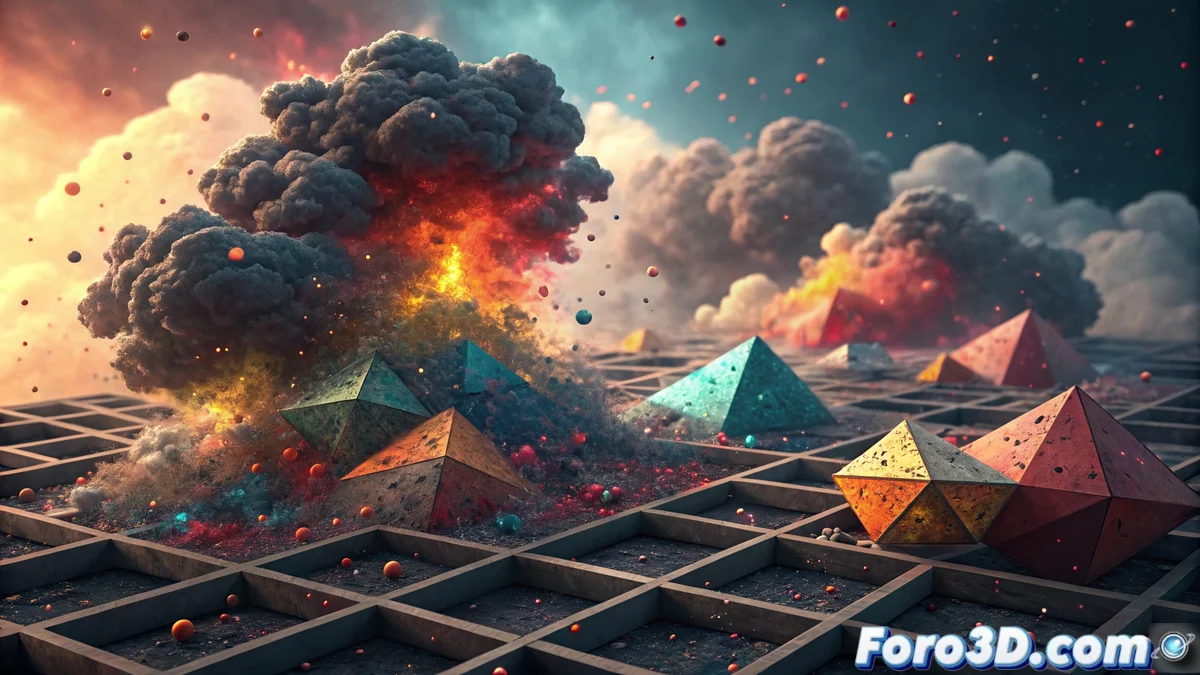
Chaos as a Creative Engine in Contemporary 3D Art
In the realm of modern 3D art, chaos has emerged as a transformative influence that challenges meticulous approaches. Many creators find that by freeing themselves from rigid structures and allowing randomness to participate in their workflow, results emerge that traditional methods would never anticipate. This organic methodology does not imply a lack of direction, but rather a continuous exchange with the unforeseen, where mistakes turn into advantages and deviations from the initial plan reveal visual landscapes never seen before. 🎨
The Elegance of Non-Linear Approaches
When an artist stops seeking total control over every variable, they begin to appreciate the benefits of complex systems. A shader influenced by arbitrary forces, a mesh altered by indeterminate physical algorithms, or a texture created with procedural noise can be the source of entirely innovative visual ideas. This perspective prioritizes the process over the result, letting the piece develop naturally through the interaction between the author's choices and the integrated chaotic components. Rendering thus becomes an exploration experience, where each frame reveals unique arrangements of forms, lighting, and materials. ✨
Advantages of Non-Linear Systems:- Generation of original visual concepts from random parameters
- Natural evolution of the work through interaction with unpredictable elements
- Discovery of unique combinations during rendering
The true creative journey begins when we let go of the reins and allow the unexpected to take part in the artistic conversation.
Digital Tools for Managing Unpredictability
3D modeling and compositing applications have progressively incorporated utilities that promote this creative connection with disorder. Stochastic modifiers, particle systems driven by turbulence, simulation engines with uncertain factors, and procedural texture nodes make it possible to include elements of controlled chance at any stage of the pipeline. These tools do not replace the creator's vision, but rather expand their expressive range by adding spontaneous variations that lend humanity to the final product. The artist defines starting conditions and rules of behavior, but entrusts the software with the concrete execution, achieving a symbiosis between purpose and surprise that enriches the creative act. 🛠️
Technical Resources for Controlled Chaos:- Random modifiers that introduce diversity in geometries and transformations
- Particle systems with turbulent behaviors for natural dynamics
- Procedural texture nodes to generate unique patterns automatically
The Value of Getting Lost in the Creative Labyrinth
Often, the most effective path to innovation consists of deliberately venturing into the tangle of alternatives, where a render that seemed destined for failure accidentally becomes the most praised work. This demonstrates that even in digital chaos there is a logic, although it lies precisely in lacking an overly rigid method. Embracing uncertainty is not synonymous with a lack of control, but rather the wisdom to seize the opportunities that arise when planning gives way to guided improvisation. 🌪️