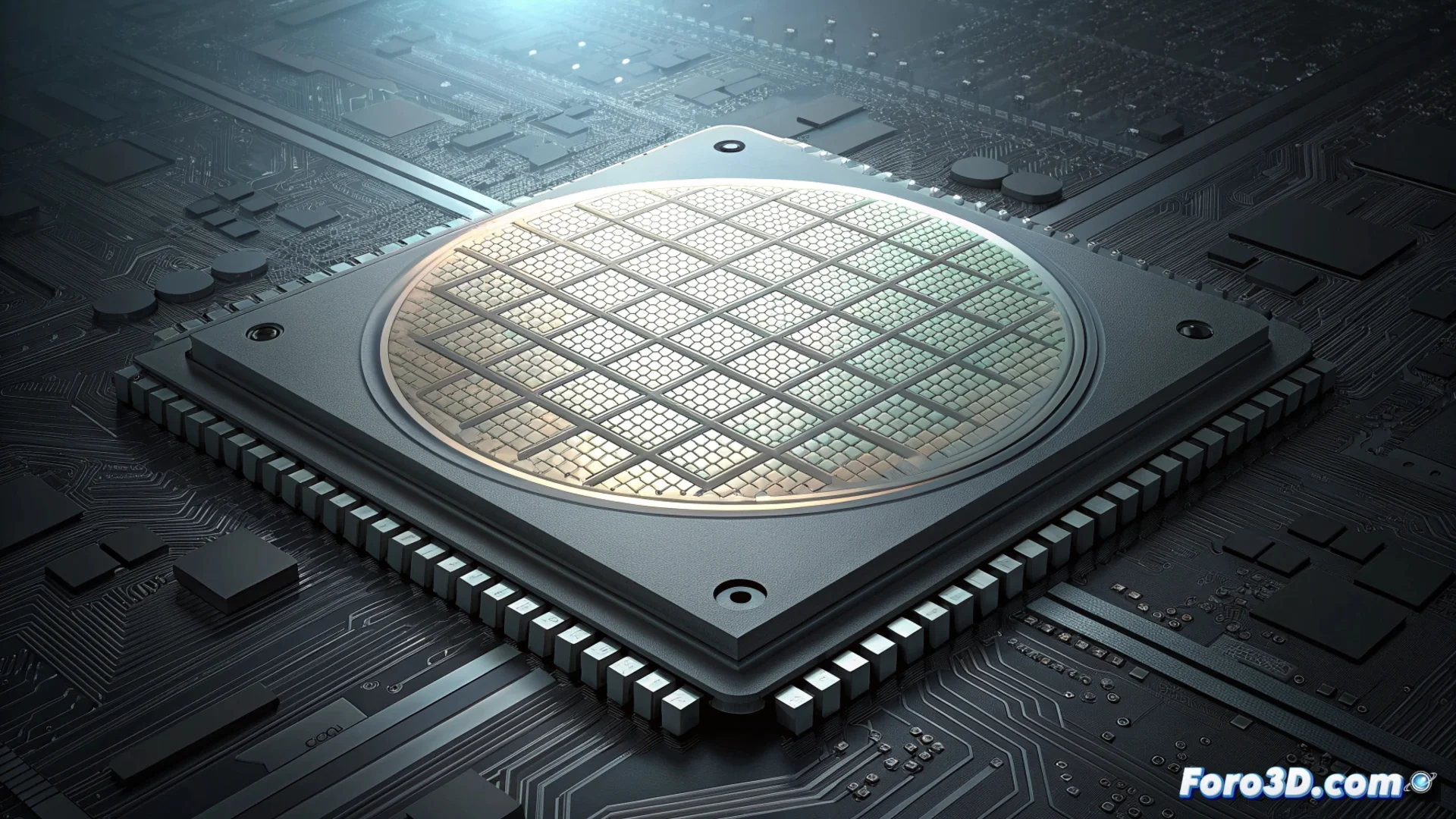
Cerebras Systems presents the WSE-3, the world's largest processor
The company Cerebras Systems has officially unveiled the WSE-3 (Wafer Scale Engine 3), the third iteration of its revolutionary wafer-scale processor concept. This silicon colossus maintains its record as the largest chip that exists, manufactured on a single 300-millimeter wafer. Its design integrates an unprecedented 4 trillion transistors and 900,000 compute cores, all specifically optimized to load and execute artificial intelligence models. This monstrous architecture allows treating extremely complex language models as if they were a single entity, radically simplifying the workflow by avoiding the need to distribute tasks across thousands of separate GPUs. 🚀
A quantum leap in performance and efficiency
Compared directly to its predecessor, the WSE-2, the new chip achieves double the computational performance while maintaining identical power consumption and without altering its physical dimensions. This advance is achieved through a more advanced manufacturing process and a significantly improved memory architecture. The system is designed to eliminate the bottlenecks that typically slow down the training of large-scale AI models, concentrating massive computing power in a single physical device. Its approach solves at the root one of the biggest obstacles in high-performance computing for AI: the complexity of connecting and coordinating thousands of smaller chips. 💡
Key features of the WSE-3:- Single wafer fabrication: Produced on a single 300 mm silicon wafer, without cutting it.
- Transistor density: Houses 4 trillion transistors for extremely dense computation.
- Specialized cores: Features 900,000 cores specifically designed to optimize AI workloads.
It is a piece of engineering that redefines what "large" means in the semiconductor industry.
The architecture that unifies everything
The main advantage of the WSE-3 lies in its unified architecture. It features a unified memory space and a high-speed interconnection network integrated directly into the chip. This allows its hundreds of thousands of cores to communicate with each other with exceptional efficiency, without suffering the delays and software overhead inherent in managing a traditional GPU cluster. For developers, this translates into the ability to program for a single hardware instance, instead of having to organize and coordinate work across thousands of independent processors, which drastically accelerates the time to develop and deploy models. ⚙️
Benefits of the unified architecture:- Simplifies programming: Developers interact with a single system, not a distributed cluster.
- Reduces latency: Communication between cores is ultra-fast as they are all on the same chip.
- Eliminates software overhead: No complex software is needed to manage parallelization between devices.
Redefining the limits of engineering
The WSE-3 is not just a chip; it is a complete system that requires custom engineering solutions, such as a dedicated liquid cooling system. Additionally, it incorporates hardware-level redundancy, meaning that a manufacturing defect in the wafer does not render the entire device useless, as affected sections can be isolated. This approach not only represents a monumental technical achievement but also establishes a new paradigm on how hardware can be built to address the most demanding challenges of today's artificial intelligence, consolidating its place as a radically different solution in a market dominated by traditional architectures. 🏆