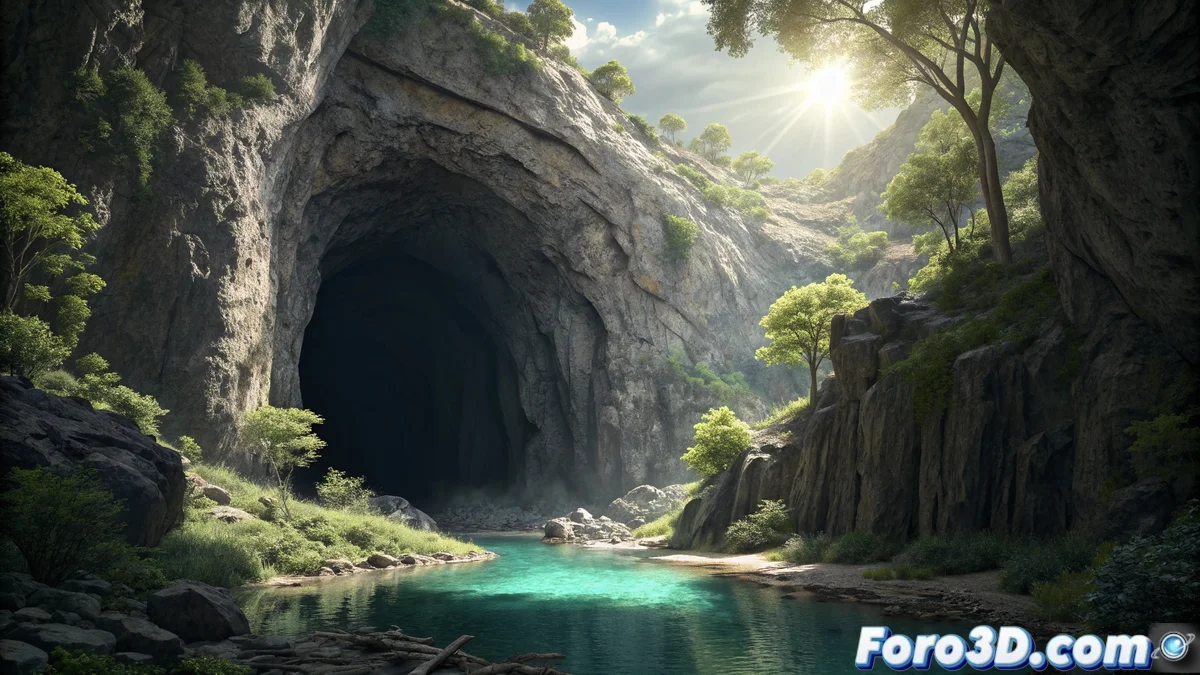
Cave of the Cat: The Secret Hideout of Bandits
Hidden in the Sierra de Grazalema in Malaga lies one of the most fascinating underground systems in Andalusia: the Cave of the Cat. This enormous karst cavity, formed by the Gaduares River, served for centuries as the perfect refuge for bandits and smugglers who used its labyrinthine galleries to hide from the law. Legends speak of treasures hidden in its most inaccessible nooks, loot that was never recovered and still awaits discovery beneath the spectacular stalactite and stalagmite formations. The constant sound of the underground river and the near-total darkness create a perfect atmosphere for environmental 3D modeling. 🕯️
The Geology of Smuggling
What makes the Cave of the Cat unique is the combination of its impressive geological value and its human history of marginality and rebellion. The calcareous formations, sculpted over millennia by the action of water, create natural chambers that resemble the halls of underground cathedrals. The bandits of the 19th century and the smugglers of the 20th found in this stone labyrinth the perfect hiding place, knowing that the multiple exits and complex topography gave them an advantage over their pursuers. This duality between natural beauty and human history makes it an ideal subject for 3ds Max, where modeling precision can capture both aspects.
Modeling the Underground World in 3ds Max
Recreating the atmosphere of the Cave of the Cat requires an approach that combines organic modeling techniques with specialized lighting and material systems. 3ds Max offers all the necessary tools to capture the essence of this unique environment.
Creating the Cave's Base Structure
Start with ProBoolean objects applied to basic geometry to create the irregular shapes of the main galleries. Use the Displace modifier with procedural noise maps to generate the eroded texture characteristic of limestone. For the large chambers, use Loft with variable profiles to create organic cavities. Set the scale based on the cave's actual dimensions, which exceed four kilometers in length.
Modifiers for Structures:- displace for natural erosion
- noise for irregularities
- proboolean for complex shapes
- meshsmooth for organic smoothing
Karst Formations and Geological Details
For stalactites and stalagmites, use the Compound Objects system with Scatter applied to custom conical geometry. Configure the distribution based on realistic drip areas. Curtains and columns are modeled with Loft applied to curved splines. Use the Bend modifier to create the slanted formations characteristic of karst caves. Details of fluvial erosion are added with Push modifiers applied selectively.
In 3ds Max, the key to believable caves is breaking symmetry and adding controlled chaos.
Underground Water System
For the Gaduares River, create a NURBS surface that follows the course of the main gallery. Apply an Arch & Design material with high transparency and reflection, adjusting the refraction index to that of water. Use Noise maps in the bump channel to simulate surface ripples. For foam and turbulence effects, use PFlow particle systems with strategic emitters near rocks. The water lighting should interact by creating reflections and refractions on the cave walls.
Aquatic Elements:- arch & design materials for water
- particle flow for foam
- noise maps for movement
- raytrace for realistic reflections