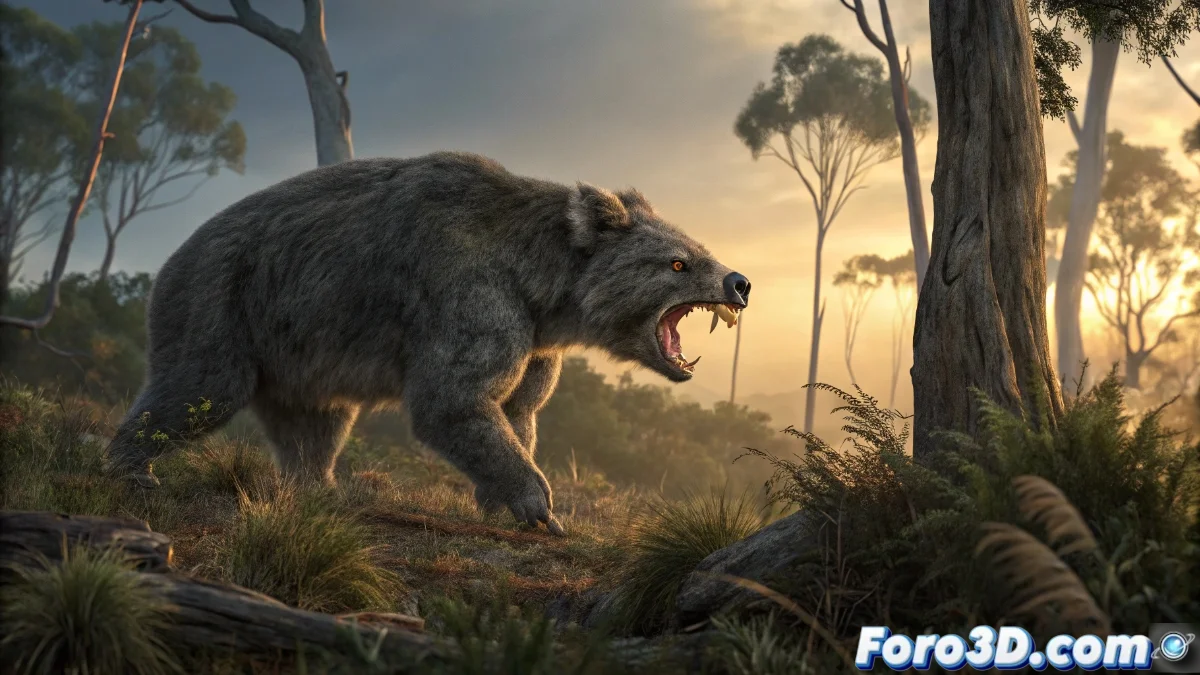
The carnivorous ancestor of the koala: Wakaleo schouteni 🦘
Modern koalas, known for their diet based on eucalyptus leaves, hide a surprising past. Their direct ancestor was an active predator with sharp fangs and a morphology adapted for hunting, challenging our view on the evolution of Australian marsupials 🌿.
Anatomy of a prehistoric hunter
Identified as Wakaleo schouteni, this marsupial inhabited Australian forests about 24 million years ago. Its fossil remains show key adaptations for predation, such as robust forelimbs for holding prey and a powerful jaw. The upper fangs, curved and blade-shaped, evidence a carnivorous diet, in absolute contrast to the herbivorous habits of its current descendants.
Distinctive features of Wakaleo schouteni:- Dentition with sharp fangs for tearing meat efficiently
- Robust forelimbs that suggested prey-holding capacity
- Jaw designed to generate a powerful bite, ideal for active hunting
The transformation from carnivore to herbivore in koalas reflects deep adaptations to drastic environmental changes.
The enigma of the evolutionary transition
Scientists propose that the dietary transition may have been due to alterations in the Australian ecosystem. Competition with other predators and the emergence of new plant food sources would have driven this extreme specialization. Modern koalas are the result of this process, where they lost their hunting instincts to exploit uncontested resources, despite their low nutritional value.
Key factors in dietary evolution:- Competition with more efficient predators that reduced access to prey
- Increasing availability of plant resources such as eucalyptus leaves
- Adaptive advantage in specializing in a unique ecological niche without rivals
Reflections on a surprising past
It is ironic that these animals, which today spend up to 20 hours a day descending trees, come from agile and hunting ancestors. This discovery underscores that evolutionary appearances can be deceiving, and the fossil record continues to reveal amazing surprises about natural history 🌍.