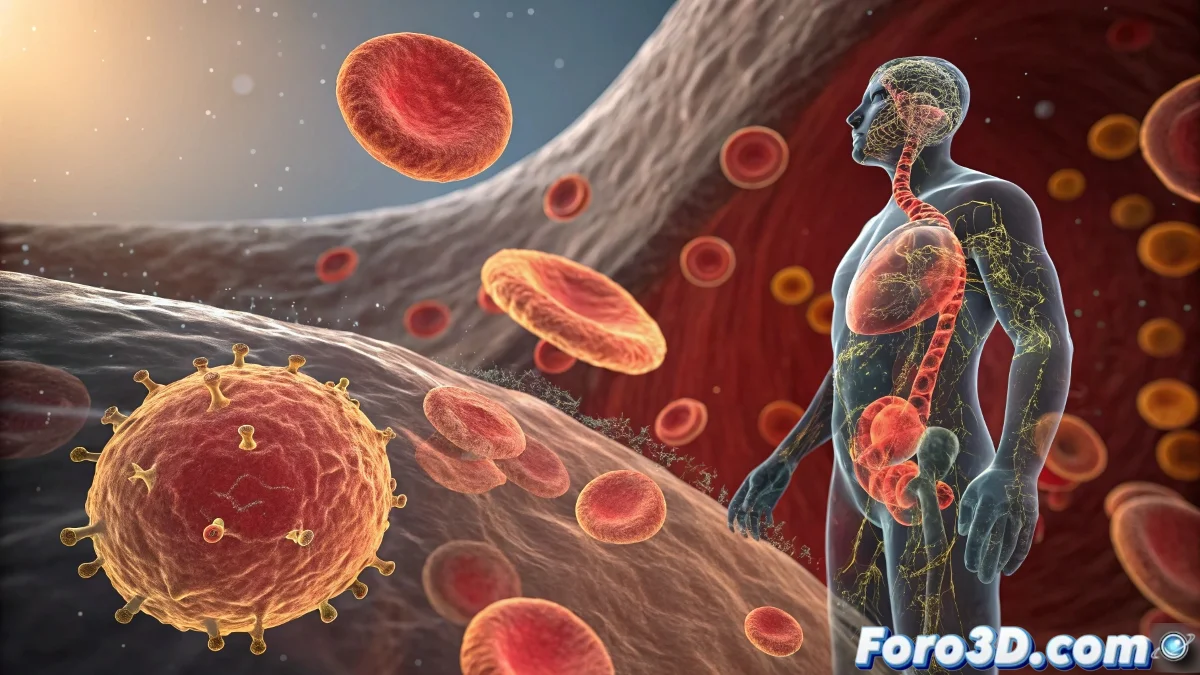
Candida auris in Spain and its Representation in 3ds Max
A health alert is spreading across Europe and Spain is at the epicenter 🔬. A recent European report warns about the concerning increase in cases of the Candida auris bacteria in our country, which accounts for nearly half of the cases detected on the continent. This multidrug-resistant yeast represents a significant health challenge due to its resistance to multiple antifungal drugs and its ease of spread in hospital settings. While authorities recommend strict hygiene and control measures, we 3D artists can address this topic from a visual perspective, recreating the behavior of this bacteria in 3ds Max to better understand its spread and raise awareness about its impact.
When you model bacteria with more detail than you'd ever want to face in real life.
Modeling the Bacteria and its Colonies
To visually represent Candida auris in 3ds Max, we can model the bacterial bodies as capsules or slightly deformed spheres, capturing their characteristic morphology. The key is to group these units into colonies that simulate their natural growth, using instancing to optimize the scene when working with thousands of units. We apply modifiers like Noise and Turbosmooth to add organic irregularities to each bacterium, avoiding the geometric perfection that would betray its digital origin. Scale and proportion must remain consistent to achieve a scientifically plausible, though artistically interpreted, representation. 🦠
Particle Systems for Propagation Simulation
The real magic happens when using Particle Flow to simulate the movement and multiplication of bacterial colonies. We configure a particle system where each unit moves randomly but believably, interacting with others through repulsion and attraction forces that simulate real biological behavior. We add operators to control the reproduction rate, movement speed, and lifespan of each particle, creating a dynamic simulation that visualizes proliferation in an intuitive and visually impactful way. The result is an organic and constantly evolving representation of the bacterial colony.
Conceptual Environment and Materials
The environment is conceived as a conceptual space that represents tissues or organs using planes and procedural textures. We use translucent materials with a degree of sub-surface scattering to simulate the organic appearance of the medium where the bacteria develop. Textures are generated procedurally using noise maps and gradient ramps to create an impression of depth and biological complexity. This abstract yet suggestive approach allows the focus to remain on the bacterial colonies while maintaining the microbiological context necessary for understanding the scene.
Scientific Lighting and Rendering
Lighting is crucial to highlight the main colony and accentuate the volume of each bacterium. We use point lights with controlled intensity to create specular highlights on the bacterial surfaces, combined with ambient lights that fill the shadows without removing drama from the scene. We configure separate render passes for the bacteria and the environment, allowing for precise control in compositing. We add subtle motion blur effects for moving bacteria and a selective glow to highlight the most relevant units, creating a visualization that balances scientific realism with communicative clarity.
We can recreate thousands of bacteria moving and multiplying in 3ds Max with total control, but there's still no way to make them disappear from hospitals with a single click... unfortunately, reality remains more complex than the best 3D software. 😉