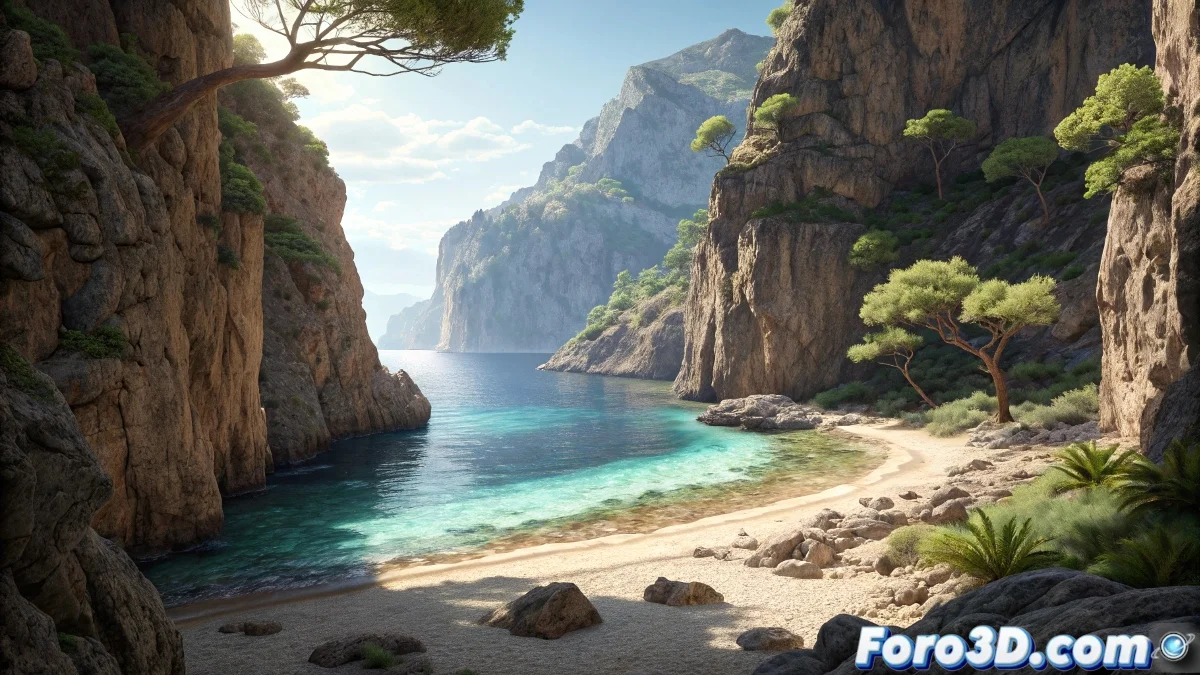
Cala de Sa Calobra: The Secret Between Cliffs
On the north coast of Mallorca, hidden among imposing cliffs, lies Cala de Sa Calobra. This hard-to-reach place, famous for its serpentine estuary and the spectacular natural tunnel leading to the sea, was for centuries the perfect refuge for Barbary pirates and smugglers. Local legends speak of ghost ships that still roam the area, laden with never-found treasures. The combination of its dramatic natural beauty and its history of mystery make it a perfect challenge for 3D modeling. ⚓
The Geography of Smuggling
What makes Sa Calobra unique is its exceptional geological formation. The Torrent de Pareis flows into the Mediterranean Sea through a narrow canyon, creating a landscape of limestone rocks eroded by millennia of water action. This natural configuration provided perfect hiding spots for vessels wanting to go unnoticed. The light filtering between the cliffs creates a play of light and shadow that accentuates the mystery of the place, ideal for recreating in 3D with an advanced rendering engine.
Building the Pirate Cove in Autodesk Maya
Recreating the dramatic essence of Sa Calobra requires a focus on organic terrain modeling and water simulation. Maya offers the perfect tools to achieve both the monumental scale and the details that bring the legend to life.
Modeling the Base Cliffs
Start by creating a base plane and apply the sculpt geometry tool deformer to raise the main cliff shapes. Use the 3D noise generator in the displacement to create the characteristic erosion of the limestone rock. For the famous natural tunnel, extrude the inner faces of the cliffs and use the lattice deformer to give it an organic curved shape. Work with controlled subdivisions to maintain mesh manageability.
Tools for the Rocky Terrain:- sculpt geometry tool for base shapes
- displacement with 3D noise for erosion
- lattice deformers for the natural tunnel
- boolean operations for caves and hollows
Creating the Water System
For the sea, use Maya's ocean system with a medium-low wave scale, appropriate for a sheltered cove. Adjust the wave length and amplitude parameters to create a gentle movement. For the Torrent de Pareis, create a nurbs surface and apply a water shader with controlled transparency and reflection. Use flow deformers to simulate the movement of fresh water meeting the sea.
In Maya, the key to believable water lies in the balance between transparency, reflection, and refraction.
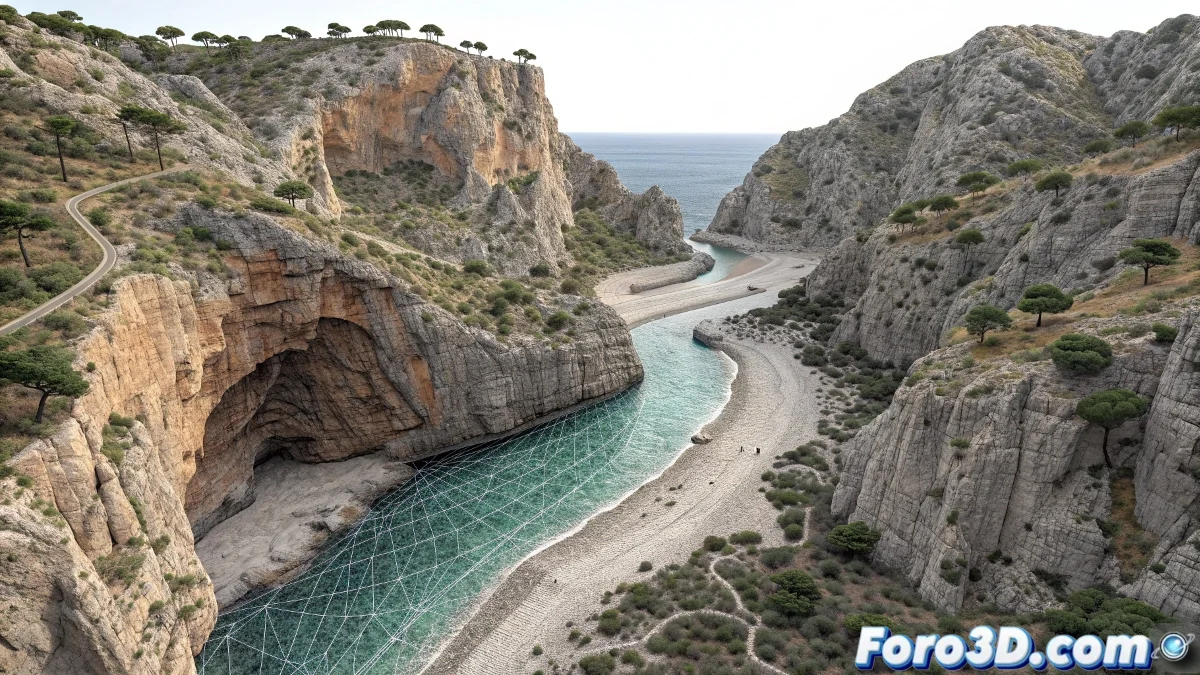
Texturing Rock Surfaces
Create aiStandardSurface materials for the limestone rocks, using high-resolution displacement maps for geometric detail and normal maps for fine roughness. For moss and vegetation areas on the cliffs, use mask maps that respond to surface inclination and proximity to water. Adjust the specular and roughness parameters to simulate different rock moisture conditions.
Material Setup:- aiStandardSurface for limestone rock
- ocean shader for sea water
- procedural textures for vegetation
- layered textures for moss areas
Dramatic Lighting and Atmosphere
Set up a directional light to simulate the setting sun