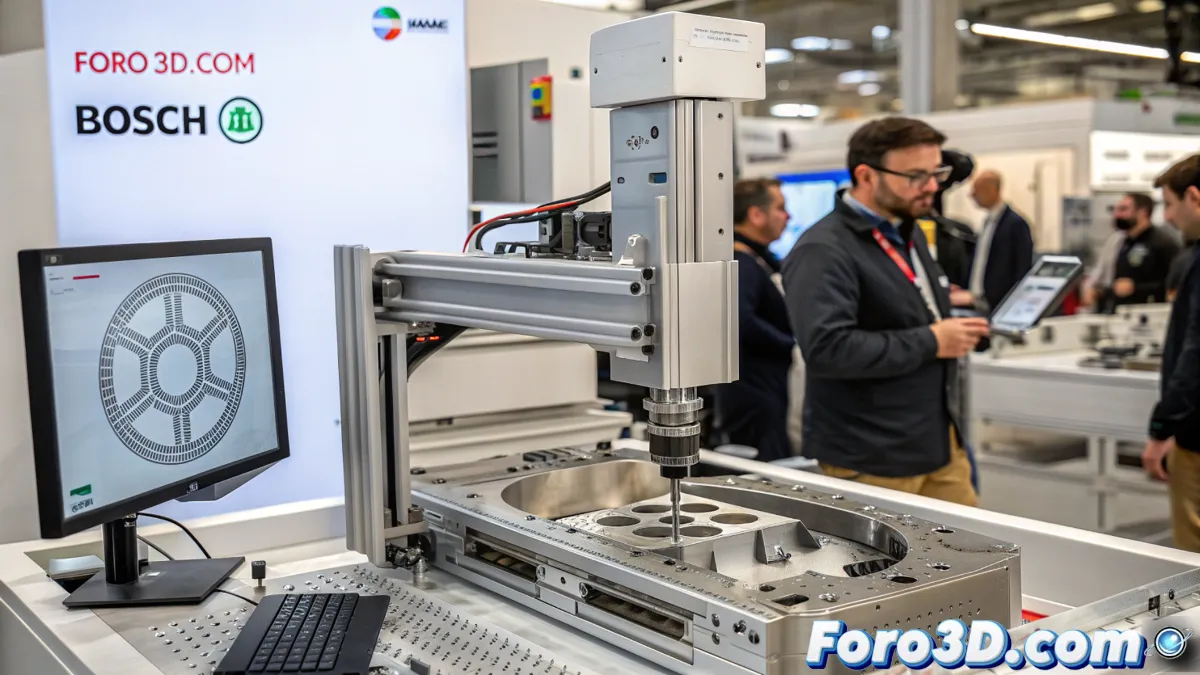
In a move that marks a milestone for the automotive industry, Bosch has inaugurated a new metal 3D printing facility in Nuremberg, Germany. This initiative positions the company as the first Tier 1 supplier in Europe to operate equipment of this category, with an investment of approximately six million euros.
A State-of-the-Art Printer
The heart of this facility is the Nikon SLM Solutions NXG XII 600 printer, equipped with twelve lasers that enable the manufacturing of metal components up to five times faster than traditional technologies. This system not only accelerates production but also offers unprecedented precision in creating complex parts.
Versatile and Sustainable Applications
The new printer is designed to manufacture parts for a wide range of applications, from hydrogen systems to housings for electric motors and racing engine blocks. Using computer-aided design files, the system melts metal powder layer by layer, allowing for the creation of intricate internal structures and curved channels that would be impossible to achieve with conventional methods.
This technology not only increases sustainability in production but also allows us to respond flexibly to fluctuations in batch sizes.
Alexander Weichsel, commercial manager of the Nuremberg plant, highlights that this technology eliminates the need for complex molds and significantly reduces lead times, enabling the manufacturing of finished components in a matter of days.
Commitment to Innovation and Sustainability
The facility not only represents an advance in automotive manufacturing but also has potential applications in sectors such as energy and aviation. Furthermore, the system operates with minimal material waste, contributing to resource conservation and more sustainable production.
- Production capacity: up to 10,000 kilograms of parts per year.
- Manufacturing speed: up to 1,000 cubic centimeters per hour.
- Production time reduction: up to 60% compared to traditional methods.
A Step Towards the Future of Manufacturing
With this investment, Bosch not only improves its ability to produce complex parts efficiently but also sets a precedent in the industry. The combination of speed, precision, and sustainability demonstrates how innovation can transform traditional manufacturing processes, opening new possibilities for the future.