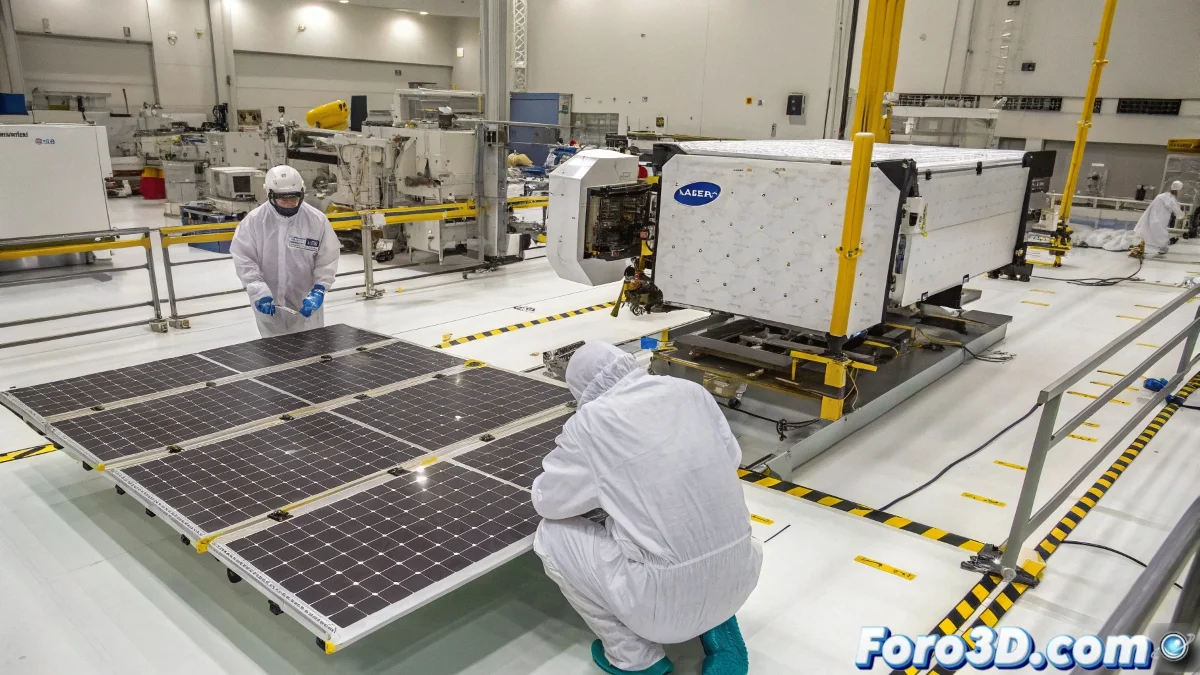
Boeing Revolutionizes Solar Panel Manufacturing with 3D Printing
Boeing has announced the development of a solar panel substrate manufactured using 3D printing, designed to accelerate production times and optimize satellite manufacturing 🛰️. According to the company, this innovation can reduce the typical construction timelines for these key large-scale space system components by up to six months. Additive manufacturing enables the creation of lightweight, high-precision structures with fewer intermediate steps, marking a milestone in aerospace industry efficiency. Because in space, every gram and every second counts 💡.
Optimizing Time and Resources in Space Manufacturing
The traditional manufacturing of substrates for solar panels requires complex and lengthy processes involving multiple stages of machining and assembly 🔧. By incorporating 3D printing, Boeing can produce these structures in a single process, reducing material, energy, and labor costs. The resulting substrates are not only lighter—crucial for space launches—but also more precise and consistent, eliminating variations that could affect in-orbit performance. A demonstration of how additive technology transforms the impossible into routine.
This innovation can reduce the typical construction timelines for key space system components by up to six months.
Impact on the Space Industry: Efficiency and Durability
This advancement not only shortens the production cycle but also enables the design of more efficient and resilient geometries specifically for space environments 🌌. Satellites incorporating these panels will benefit from better energy performance—thanks to surfaces optimized for capturing sunlight—and greater durability against radiation, extreme temperatures, and micrometeoroids. The ability to iterate rapidly on design also facilitates customization for specific missions, whether for communications, Earth observation, or deep space exploration.
Future Vision: Expansion to Other Components
The implementation of 3D printing in the aerospace industry points to a trend towards greater agility and adaptability 🚀. Boeing plans to expand these techniques to other critical components of satellites and aircraft, such as structural supports, antennas, or even parts of space habitats. This will not only improve efficiency but also enable designs previously impossible with traditional methods, such as internal lattice structures that combine lightness and strength. The future of space manufacturing is additive, and Boeing is leading the charge.
Technical Details and Key Benefits
Boeing's technology is based on several advances:
- Advanced Materials: Polymers and composites with high thermal and mechanical resistance.
- Micro Precision: Tight tolerances for perfect coupling with solar cells.
- Scalability: Processes adaptable from prototypes to mass production.
- Sustainability: Reduction of material waste compared to subtractive methods.
The Irony of Time Saved
With so much time saved, Boeing engineers might have to find themselves a new hobby while their satellites print themselves almost autonomously... though they'll probably use that extra time to design even more complex satellites 😅.