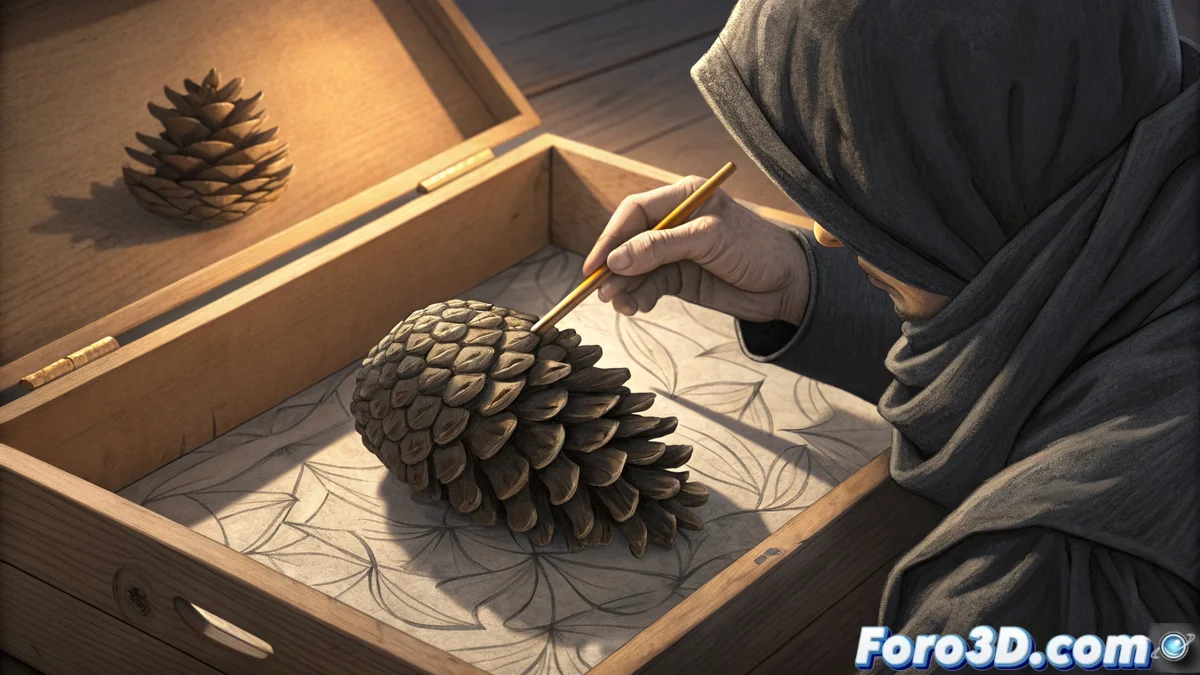
Blind Drawing Connects Touch with Stroke
This illustration method activates a sensory channel that is normally ignored. The premise is simple: you cannot see what you are drawing. Instead, you rely completely on the information your fingers gather, creating a direct bridge between physical sensation and the graphic mark on paper. 🖐️✏️
The Tactile Connection Process
To start, you need an object and a visual barrier, like a box or cloth. The exercise consists of exploring that object only with your non-dominant hand. While your fingers perceive the shape, edges, and texture, your dominant hand tries to translate that data in real time into the drawing. This radically separates the functions of each hand.
What the exploring hand perceives:- Shape and volume: Is it compact, elongated, or does it have protruding parts?
- Surface texture: Is it smooth, rough, cracked, or has repetitive patterns?
- Physical properties: Is it cold or warm to the touch? Is it heavy or light?
The hand that feels guides the hand that draws. Deprived of its usual visual guide, the creative hand responds to pure tactile signals.
Training the Mind to Visualize in 3D
This method does not aim to create a realistic drawing. Its main goal is to train your spatial perception. By relying solely on touch, your brain must connect fragmentary sensations to build a coherent mental image of the object in three dimensions. It is an intense exercise in internal visualization.
Results and benefits of the practice:- More expressive stroke: The lines tend to become more deliberate, slow, or surprisingly energetic.
- Essential abstraction: The final drawing often captures the tactile essence of the object, not its visual appearance, resulting in simplified or abstract interpretations.
- New pathways of perception: Remember that we can understand the world through many senses, not just sight.
Practical Tip for Your First Attempt
The choice of object is key to making the experience enriching. Avoid shapes that are too simple and smooth, like a ball, because they offer little tactile information. Instead, choose something with a complex and interesting texture, like a pineapple, a piece of tree bark, a bunch of keys, or a carved wooden figure. These objects will provide your fingers with plenty of data to process and your drawing with more character. 🍍