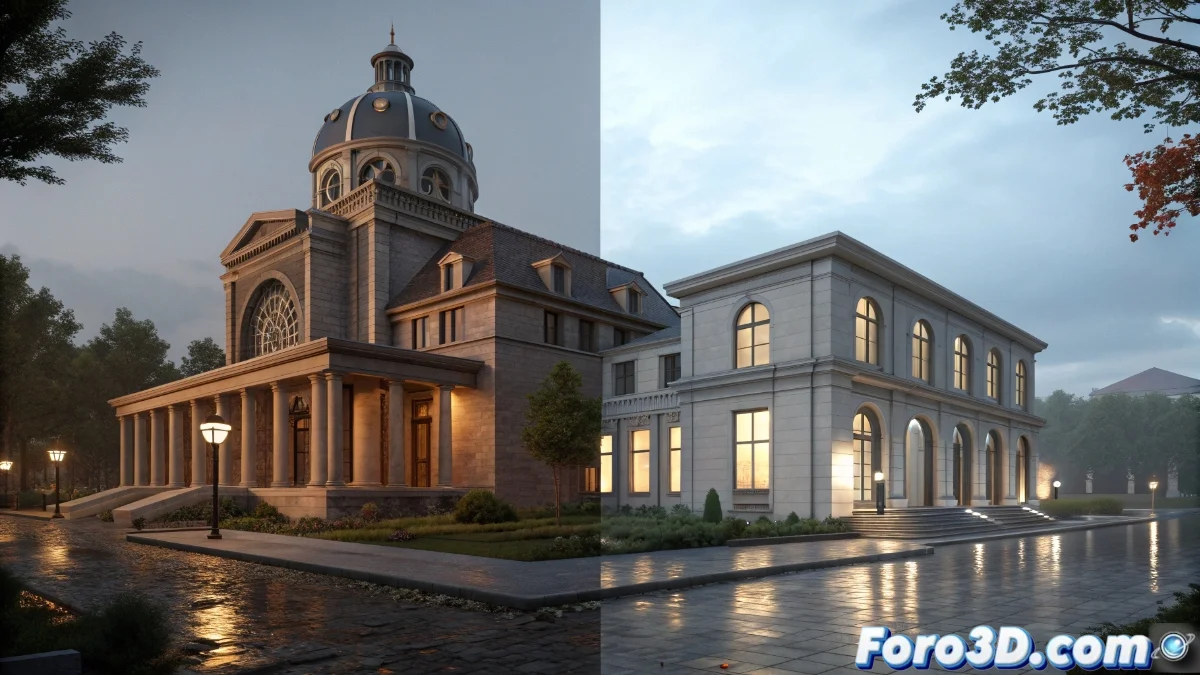
Blender Cycles vs Commercial Render Engines: Comparative Analysis
In the universe of professional 3D rendering, Blender Cycles emerges as a robust option against established solutions like V-Ray, Redshift, and OctaneRender. This native Blender path tracing engine generates images with impressive photorealism that directly rivals its paid competitors 🎨.
Visual Quality and Physical Accuracy
Cycles demonstrates exceptional capabilities in physical accuracy, handling complex materials, reflections, and refractions with quality comparable to V-Ray. However, each engine has its distinctive strengths: V-Ray dominates in architectural renders with its advanced natural lighting management, while Redshift and OctaneRender shine in interactive speed for real-time adjustments ⚡.
Key Quality Highlights:- Cycles offers global illumination and precise shadows with physically exact results
- V-Ray excels in architectural scenes with advanced daylight handling
- Redshift and OctaneRender maintain advantages in dense scenes with millions of polygons
The evolution of Cycles in noise reduction and time optimization positions it as a serious alternative to commercial options
Performance and Operational Efficiency
In the realm of render speed, Cycles relies significantly on available hardware, especially GPUs. Commercial engines like Redshift and OctaneRender are specifically optimized for GPU rendering with more stable performance in multi-GPU configurations 🚀.
Key Performance Factors:- Cycles offers competitive times in scenes of moderate complexity
- Commercial engines include more advanced integrated denoisers and support for distributed rendering
- Cycles' learning curve is more accessible for regular Blender users
Integration and Workflow
The native integration of Cycles within Blender facilitates a cohesive workflow without the need for intermediate exports. In contrast, engines like V-Ray require specific plugins for each modeling software, adding layers of complexity to the production pipeline 🔄.
Final Considerations
Selecting a render engine is akin to choosing specialized tools: Cycles represents a powerful and free option that competes in quality with commercial solutions, while the latter offer specific advantages in speed and optimization for high-level productions. The final decision will depend on the project's specific requirements, delivery deadlines, and available hardware resources 💡.