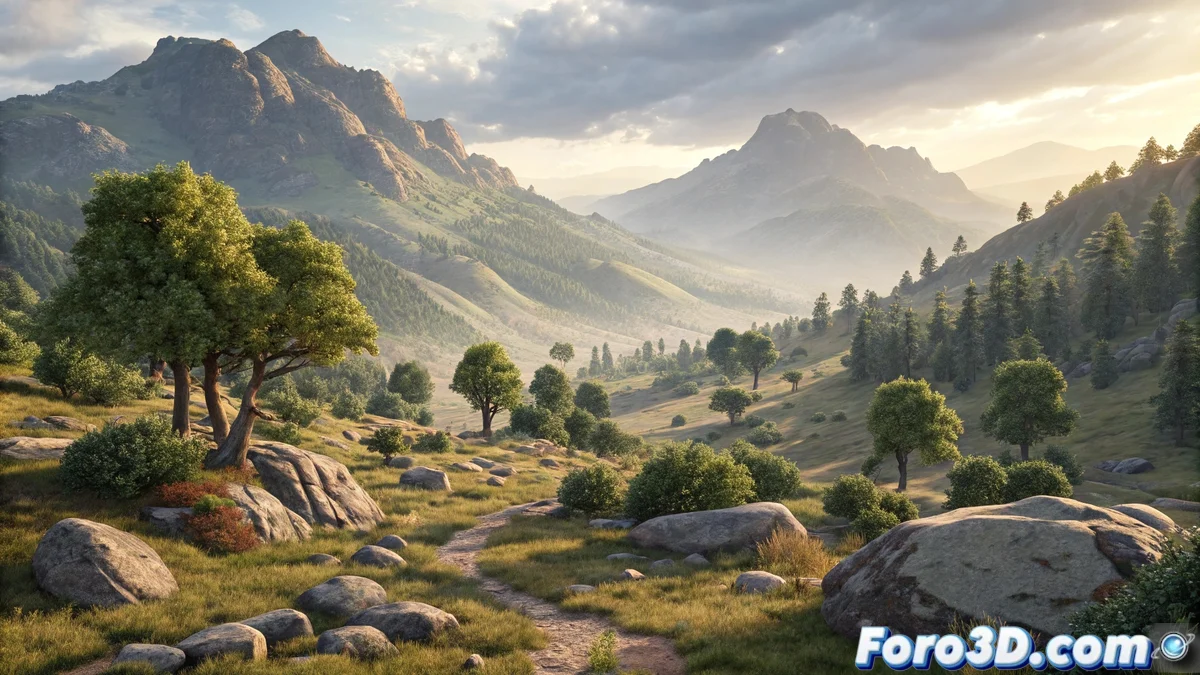
Blender 5 Revolutionizes Environment Creation with Procedural Tools
The new version of Blender incorporates a procedural set dressing system that radically changes how artists develop complete digital environments. These innovative features facilitate the automatic generation of natural and architectural elements while preserving non-destructive editing capabilities at all times. 🌱
Smart Vegetation with Adaptive Distribution
The procedural vegetation module automatically analyzes terrain characteristics and environmental conditions to place plant species in a coherent and realistic manner. Creators set parameters such as density, botanical diversity, and growth behaviors, while the engine calculates the ideal location for each plant, tree, or vegetation element, considering variables like elevation, sun exposure, and proximity to water sources. This vegetation retains its full modification capability, allowing for later refinements even after the initial generation.
Key Features of the Vegetation System:- Automatic terrain analysis for realistic botanical distribution
- Complete control over density, variety, and growth patterns
- Preservation of non-destructive editing at all stages
Artists can now create complex landscapes with natural variations that dynamically adapt to any modification in the scene
Advanced Terrain and Repetitive Object Generation
For the development of land surfaces, Blender 5 implements sophisticated algorithms that combine multiple noise layers with erosion simulation, producing results ranging from rugged mountain ranges to smooth plains. The smart repetitive objects system uses procedural rules to distribute elements such as rock formations, fallen logs, or architectural structures, avoiding monotonous patterns through automatic variations in scale, orientation, and visual appearance. All these generations retain their non-destructive nature, responding instantly to any adjustment in the control parameters.
Highlighted Terrain and Object Functionalities:- Combined noise and simulated erosion algorithms for realistic topography
- Intelligent object distribution with automatic variations
- Immediate response to parameter modifications
Optimization of the Creative Workflow
This revolutionary approach allows artists to spend less time on manual placement of individual elements and more time on the creative development of complex scenes. The unprecedented control over each procedurally generated component, combined with the ability to make adjustments at any time, establishes a new paradigm in digital environment creation. The system's efficiency is particularly evident when working with high-complexity scenes containing millions of procedural elements. 🎨