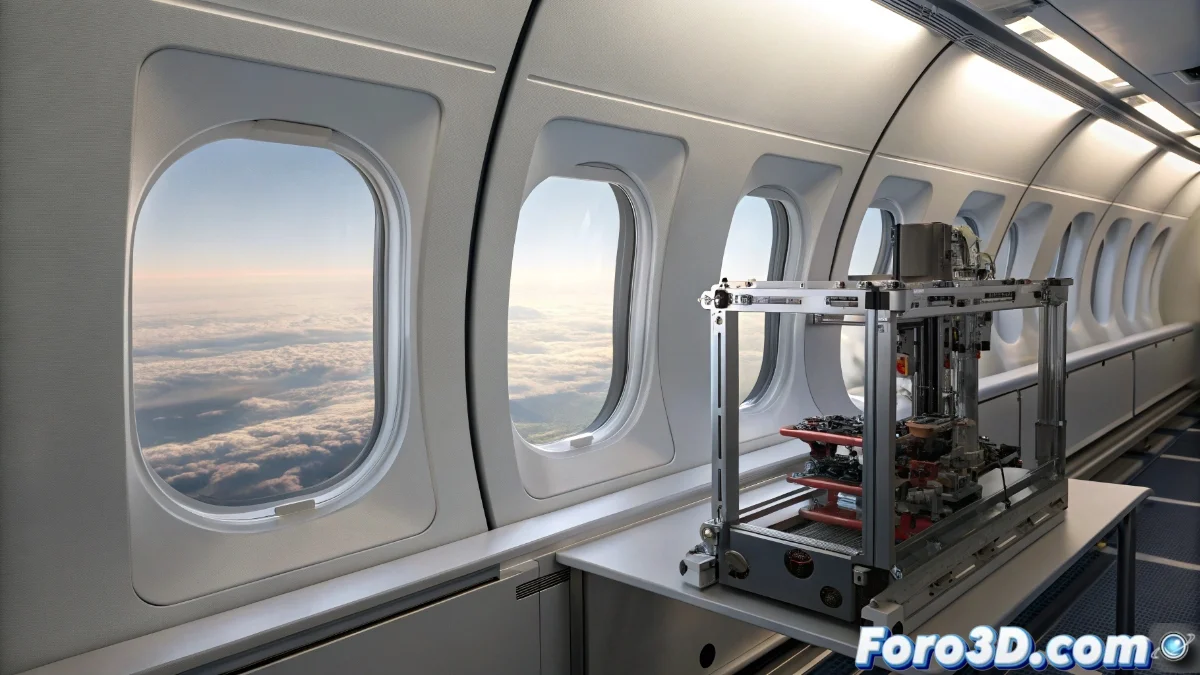
Bioprinting in Microgravity: Creating Human Muscle Tissue During Parabolic Flights
Scientists at ETH Zurich are revolutionizing the field of 3D bioprinting by demonstrating that it is possible to manufacture functional biological tissues in extreme environments. Using parabolic flights that recreate microgravity conditions, they have successfully printed human muscle structures, marking an unprecedented technological milestone 🚀
Adaptive Technology for Variable Gravitational Conditions
The Swiss research team has designed a specialized bioprinter that maintains its operational precision during transitions between microgravity and hypergravity. This innovative machine uses an advanced bioink composed of human stem cells and structural support biomaterials, managing to produce tissue constructs that retain their shape and functionality despite drastic gravitational changes.
Key Technical Features of the Bioprinter:- Automatic stabilization system to compensate for gravitational variations
- Special cartridges that maintain cell viability during maneuvers
- Optimized extrusion mechanisms for working in microenvironments
"The ability to bioprint in microgravity opens a new chapter in regenerative medicine, both for astronauts and for patients on Earth" - ETH Zurich Research Team
Transformative Applications in Space and Terrestrial Medicine
This pioneering advance has profound implications for astronaut health during prolonged space missions, where muscle tissue could be generated to treat injuries or tissue degeneration. Simultaneously, the techniques developed under microgravity conditions could revolutionize conventional bioprinting procedures, allowing for the creation of more complex and vascularized structures without the gravitational collapse that currently limits these constructs.
Potential Benefits of This Technology:- Emergency treatment for astronauts on distant missions
- Improvement in the fabrication of vascularized tissues in terrestrial laboratories
- Development of more precise tissue models for medical research
Future Perspectives of Bioprinting in Extreme Environments
Who would have imagined that the ideal scenario for printing human muscle would be an airplane performing controlled aerial maneuvers. This technological paradox demonstrates that sometimes, to advance in regenerative medicine, we must deliberately challenge conventional conditions. The success of these experiments not only validates the feasibility of space bioprinting but also suggests that reduced-gravity environments could offer unique advantages for engineering complex tissues 🌌