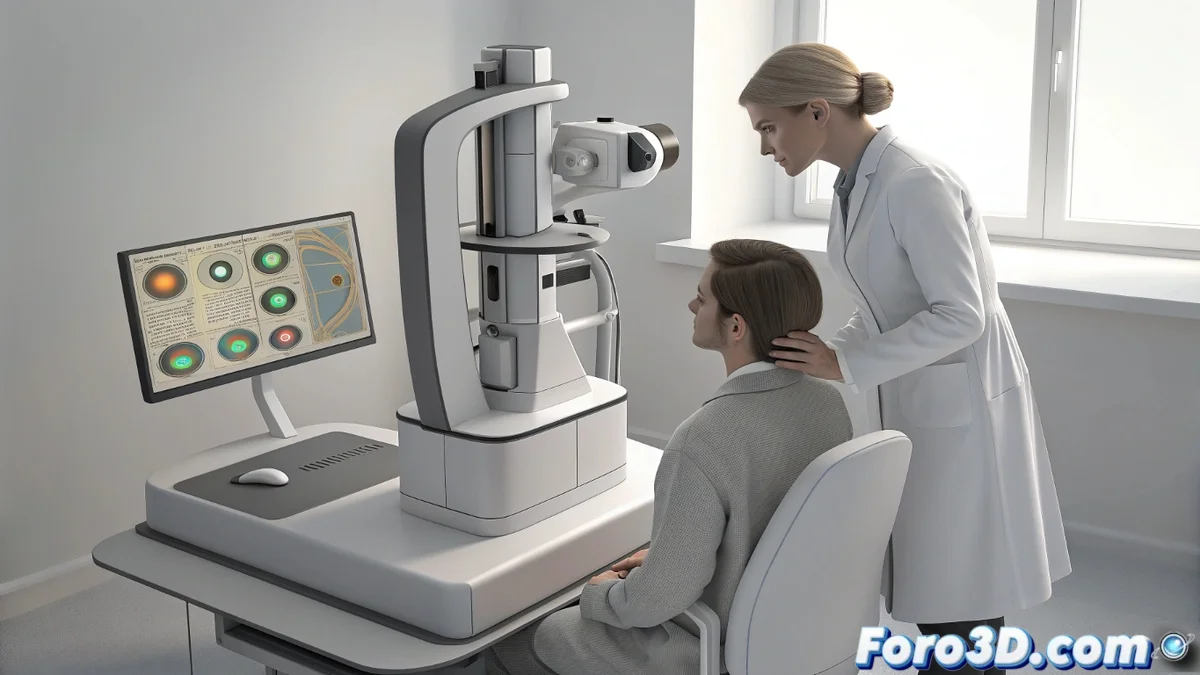
Biometric Tower in Optics: Precision for Custom Lenses
In the field of modern optometry, the biometric tower represents a significant advancement. This equipment consolidates multiple diagnostic instruments into a single workstation, allowing for accurate measurement of various eye parameters of a patient. Its central objective is to obtain the data necessary to design and produce custom-made ophthalmic lenses, a crucial step especially for complex progressive lenses. By automating the workflow, the process is streamlined and errors that may arise from using separate devices are minimized. 🔬
The Workflow of an Integrated Station
The system guides the professional through a predefined sequence. The patient places their head on a stabilizing support, and the examiner controls everything from a digital interface. The tower begins by capturing the position of the pupils and corneal topography using a specialized camera. Next, an autorefraction module objectively evaluates the eye's refractive error. More complete models may incorporate a keratometer to analyze corneal curvature and even a tonometer to check intraocular pressure. All these values are automatically combined into a unified report.
Key instruments it may include:- Video camera or topographer: To map the cornea and locate the pupillary center.
- Autorefractometer/aberrometer: Measures the prescription needed to correct vision.
- Digital keratometer: Analyzes the radii of curvature of the anterior corneal surface.
The integration of technologies into a single workflow ensures that all measurements start from the same postural reference of the patient, which is vital for data coherence.
Why These Data Are Essential for Progressive Lenses
Manufacturing a multifocal lens that offers visual clarity at all distances requires a design that adapts to the unique anatomy of each eye and its movements. The biometric tower provides precise measurements, such as the monocular pupillary distance and the segment height relative to the eyeglass frame. With this biometric information, the laboratory can carve the lens's progression channels in the optimal position, preventing the user from perceiving blurry areas or unwanted distortions. Without this precise data, adapting progressive lenses would be a less accurate and potentially longer process.
Critical parameters defined by the tower:- Corneal vertex distance: Crucial for calculating the effective power of the lens.
- Tilt (pantoscopy) and wrap (facial curve) of the frame: Affect the final position of the lens.
- Precise corneal map: Essential for custom contact lens designs.
The Interaction Between Technology and the Human Factor
Although biometric technology is extremely precise, its final effectiveness still depends on a simple biological factor: the patient keeping their head completely still for a few seconds. An involuntary movement, a strong blink, or a sneeze can compromise the data, requiring the entire sequence to be repeated. This detail underscores that even the most advanced equipment must deal with the variables of human biology. The system's precision is therefore a combination of cutting-edge optical engineering and patient collaboration during the process. 👁️