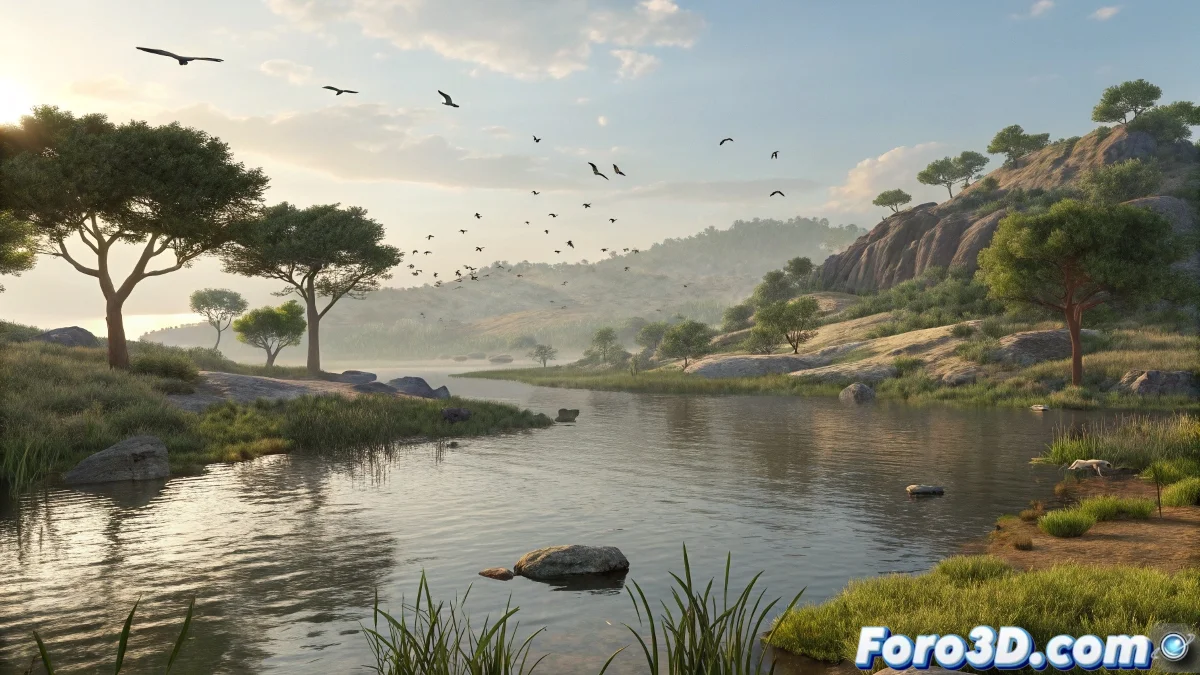
Biodiversity Recovery in the Soto-Gutiérrez Lagoon and Its Recreation in Maya
Nature gives us a lesson in resilience right in the heart of Madrid 🌿. A recent study has revealed that biodiversity in the Soto-Gutiérrez lagoon is showing promising signs of recovery, with species of birds, fish, and invertebrates thriving again after years of environmental management and ecological restoration. This conservation success demonstrates how human action, when properly directed, can reverse negative impacts on local ecosystems. To celebrate this ecological achievement, what better way than to digitally recreate this natural environment in Autodesk Maya, capturing the essence of this reborn lagoon through 3D modeling, simulation, and advanced shading.
When nature recovers and 3D artists have to get to work to document it digitally.
Lagoon Environment Modeling
The first step to recreate this natural scene in Maya is building the topographic base of the lagoon and its surroundings. Use polygons or NURBS to model the lagoon's contour, creating irregular and natural shores that avoid artificial geometric perfection. Add surrounding terrain with sculpting tools, forming small hills and vegetation areas that frame the whole scene. Import tree and plant models from specialized libraries like Xfrog, SpeedTree, or Maya's own Assets to populate the scene with varied and believable vegetation. The key is to avoid symmetry and seek the organic irregularity that characterizes natural spaces. 🏞️
Water Simulation and Aquatic Dynamics
To convincingly recreate the water surface, use a subdivided plane and apply nCloth or Bifrost Fluids to generate small waves and natural movement. Add displacement maps to simulate light currents and realistic water textures that capture the reflectivity and transparency characteristic of clean water. The interaction between the water and environmental elements, such as shores and aquatic vegetation, is crucial for achieving visually coherent integration. Adjust turbulence and viscosity parameters according to the specific conditions of the lagoon you want to represent.
Integration of Fauna and Dynamic Vegetation
Animal life is essential to convey biodiversity recovery. Model or import birds, fish, and insects from asset libraries, using motion paths to animate birds in flight and animation along curve for fish. For more realistic simulation, consider nParticle motion fields to manage collective fish movement. Vegetation must respond dynamically to the environment: apply nHair or nCloth for grass and reeds, allowing them to move smoothly with the wind, or use XGen to create plant populations with random variation that avoid repetitive patterns. 🐟
Lighting, Shading, and Final Composition
Lighting is key to conveying the atmosphere of a healthy ecosystem. Use a Directional Light simulating morning or late afternoon sun to create long, warm shadows, complemented with Ambient Occlusion to softly fill shadows. Materials should follow PBR principles: use Arnold Standard Surface with refraction and transparency for water, and Subsurface Scattering for plants and animals to capture how light interacts with organic materials. Place the camera at water level for an immersive perspective, adding depth of field to direct attention to the most relevant faunistic elements.
After all, Maya can recreate a perfect lagoon, with every fish swimming harmoniously and every bird flying gracefully… but there's still no plugin that makes forum visitors stop commenting I was there and didn't see any of that. 😉