When Technology Was Available But Not Implemented
The nursing home crisis during the pandemic revealed systemic failures that available technologies could have mitigated. Tools for Building Information Modeling (BIM) and flow simulation existed commercially, but their implementation in healthcare management was marginal. Simultaneously, 3D printing demonstrated rapid response capability in manufacturing critical equipment, though without established protocols for its integration into health emergencies. This analysis examines what could have been different if these technologies had been deployed strategically.
The "bottlenecks in the flow of people and resources" were not merely a consequence of volume, but of predictable structural inefficiencies. While global logistics centers use simulation software to optimize flows, many nursing homes operated with 20th-century methodologies. The crucial question is: are we ignoring tools that could save lives in the next crisis?
Crises do not create new problems, they only reveal the ones that already existed and we chose to ignore
Flow Simulation with Anylogic and BIM Tools
Crowd simulation tools like Anylogic, Pathfinder, or even integrated modules in Navisworks allow for modeling complex behaviors in built environments. In the residential context, these platforms could have identified critical congestion points between healthcare staff, patients, and supplies. The simulation would have revealed how small changes in spatial distribution—relocating triage points, optimizing supply routes—could have significantly reduced cross-infections.
Agent-based modeling is particularly relevant for understanding how individuals with different roles and behaviors interact in confined spaces. We could have simulated cross-contamination scenarios, emergency response times, and maximum staff capacity under different operational stress conditions. These models are not theoretical—they are validated tools in airports, stadiums, and industrial complexes.
- Agent-based modeling for individual behaviors
- Cross-contamination simulation on critical routes
- Spatial distribution optimization to reduce contacts
- Staff capacity analysis under different scenarios
BIM as a Real-Time Command Center
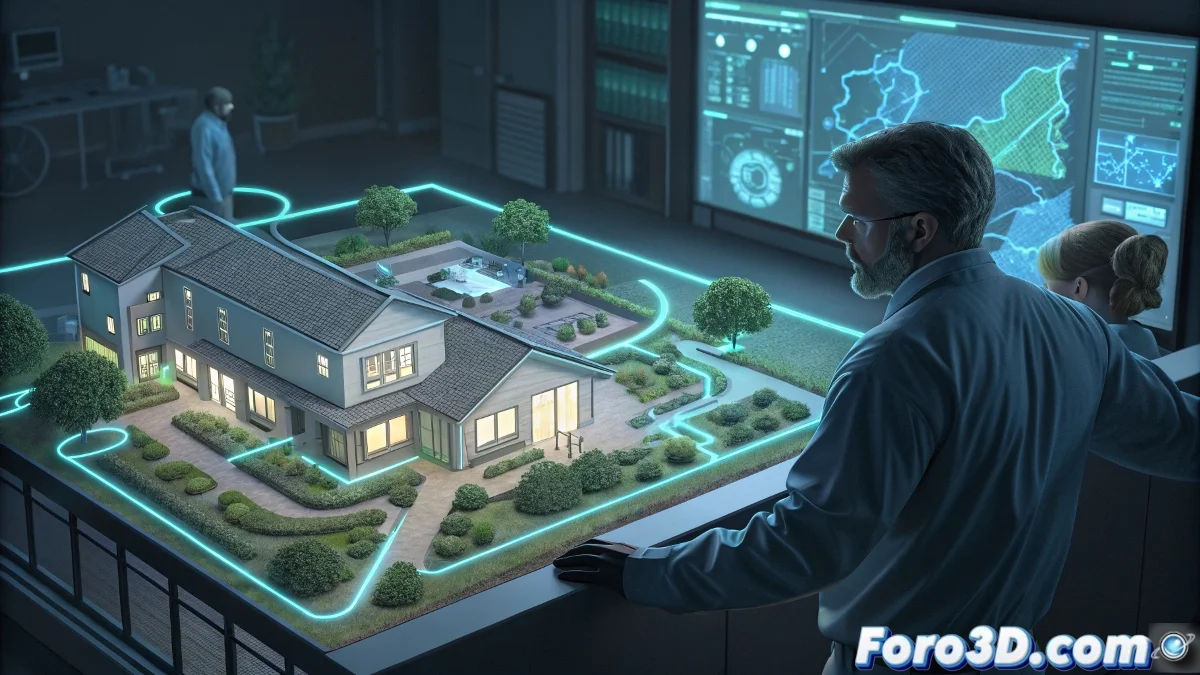
Building Information Modeling (BIM) transcends its conventional use in architectural design to become an essential crisis management tool. A real-time updated BIM model could have functioned as a unified "control dashboard" showing critical ventilator stock, room occupancy status, and availability of personal protective equipment (PPE). Integration with inventory systems and IoT sensors would have provided complete visibility over scarce resources.
The ability to visualize critical data on interactive 3D plans transforms decision-making under pressure. Managers could have visually identified propagation patterns, optimized space allocation according to contagion levels, and coordinated internal logistics with spatial precision. This approach goes beyond traditional dashboards by contextualizing information in the physical environment where actions occur.
A BIM model in a crisis is like having X-rays to see through the walls of the operation
- Unified visualization of critical stock and occupancy
- Integration with IoT sensors for real-time data